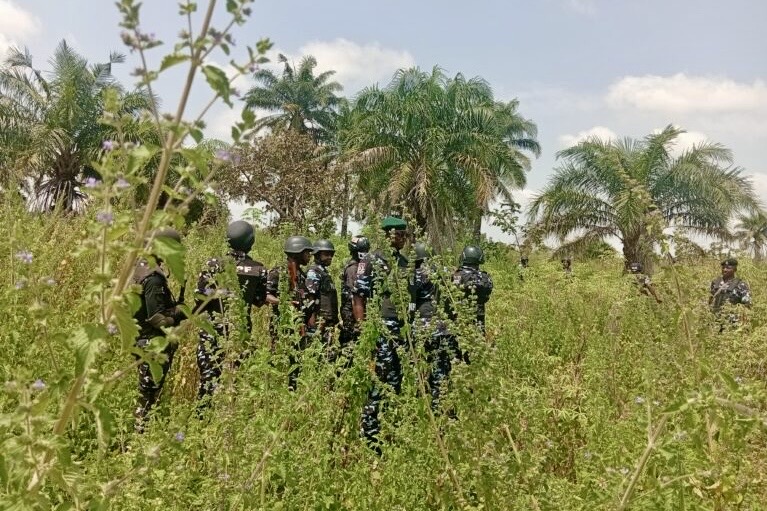
ABUJA, FCT — A suspected kidnapping operation targeting a businessman in the Zuba area of the Federal Capital Territory has reportedly been foiled, with three men allegedly arrested while attempting to set their plan in motion.
The suspects, said to be from Kogi State, were reportedly apprehended by police operatives in Zuba after allegedly identifying a businessman as a potential target because of assumptions about his financial capacity.
The case is particularly troubling because the alleged plot was not described as an opportunistic roadside attack. Rather, the account suggests that the suspects had studied their intended victim’s commercial activities, identified his warehouse in the Madalla area and concluded that his business meant he would be capable of paying a substantial ransom.
A video reportedly seen by SaharaReporters showed the suspects being interrogated by police officers following their arrest.
One of the suspects identified himself as Elodio Samson Friday, who said he was from Kogi State. During questioning, he reportedly linked the alleged plot to financial hardship.
“I have been having some financial challenges for some time. So, in order to look for how to resolve the challenges, the idea of kidnapping came up.”
He further said:
“I informed them. We made an attempt of kidnapping, but it backfired.”
Those statements, if accurately recorded and subsequently corroborated by investigators, could offer an important insight into how some kidnapping operations are recruited, planned and rationalised by individuals who may not have previously been known as hardened criminals.
‘I Know His Warehouse’ — How the Alleged Target Was Selected
The most revealing part of the interrogation concerns the alleged selection of the intended victim.
Asked how the suspects knew the businessman, Friday reportedly said he did not personally know him.
Instead, he said he knew of the victim’s warehouse in Madalla and had heard about his business.
“I know his warehouse. Not in person, but I do hear about him. Judging from the business, I assumed he would be financially buoyant.”
That explanation raises a significant security concern beyond the immediate arrest.
Kidnapping gangs do not necessarily need intimate access to a victim before identifying a potential target. Visible commercial activity, warehouses, shops, transport operations, social-media posts, conspicuous assets and information circulated within local communities can all become sources of intelligence for criminals.
In this reported case, the apparent calculation was brutally simple: a businessman operating a visible enterprise was assumed to have money, and therefore was allegedly considered suitable for abduction and ransom extraction.
The account does not establish that the intended victim was actually wealthy, nor does it indicate that he was involved in any wrongdoing. The reported selection appears to have been based largely on the suspects’ own assumptions.
Debt And Financial Pressure At The Centre Of Alleged Plot
The interrogation also placed financial pressure at the centre of the suspects’ alleged motivation.
Another suspect reportedly told police that he became involved because of financial difficulties.
When questioned about his finances, one of the men acknowledged taking a bank loan of approximately ₦7 million.
“Yes, I collected a loan from the bank.”
Asked how much he owed, he reportedly replied:
“N7 million.”
Police then questioned whether the intended kidnapping was meant to provide the money required to settle the debt.
The response was direct:
“Yes, ma’am.”
That exchange, if confirmed as part of the investigation, illustrates one of the most dangerous misconceptions surrounding ransom crime: the idea that kidnapping can function as a shortcut out of financial distress.
The alleged plot demonstrates the extent to which legitimate economic problems can, in some cases, be transformed into criminal calculations when desperate individuals convince themselves that a wealthy-looking target can finance their escape from debt.
But the reality of kidnapping is considerably more complex. It is a violent crime that exposes victims and their families to physical danger, psychological trauma, extortion and, in many cases, death.
From Beverage Distribution To Alleged Kidnap Conspiracy
Another suspect reportedly described himself as a businessman in the beverage distribution sector.
“We sell soft drinks, beverages. We are distributors of soft drinks.”
That detail is significant because it further challenges the simplistic assumption that kidnapping suspects must necessarily operate outside legitimate economic activity.
People involved in criminal networks can sometimes maintain ordinary occupations, social relationships and legitimate sources of income while simultaneously becoming involved in illegal activities.
The case therefore raises questions for investigators about how the alleged group was assembled, whether the men had previous criminal links, who financed any preparatory stage of the operation, whether the intended victim was under surveillance, and whether other people were involved.
Those questions cannot be answered by the interrogation video alone.
‘This Is Our First Attempt’ — But Police Investigation Must Go Further
One of the suspects reportedly appealed to the public after his arrest, claiming that the operation was their first attempt.
“We want to appeal to the public that this is our first attempt and it failed. And today we are saying that this is the first and it will be the last.”
That claim should be treated cautiously.
An assertion by a suspect during interrogation cannot, by itself, establish that a criminal plan was a first offence. Investigators would need to examine telephone records, financial transactions, travel history, digital devices, communications, location data and relationships with other suspects before such a conclusion could be reliably established.
The police would also need to determine whether the men had intelligence on other potential victims, had conducted surveillance in other locations or had links to established kidnapping networks operating around the FCT and neighbouring states.
Zuba’s Strategic Security Significance
The reported arrest is unfolding against a backdrop of sustained police pressure on kidnapping and bandit networks operating around Abuja and the FCT’s borders.
In June 2026, the FCT Police Command announced the arrest of three suspected kidnappers after a viral video showed men dressed in military camouflage while allegedly displaying AK-47 rifles, ammunition and walkie-talkies. Police said digital forensic analysis and intelligence gathering led operatives from the Violent Crime Response Unit and Zuba Division to a hideout in Runji Village, Zuba, where three suspects were arrested.
The development was not an isolated police operation.
In July, FCT Commissioner of Police Ahmed Sanusi disclosed that security personnel operating around the FCT’s border communities had arrested four suspects and recovered 42 rounds of 7.62mm ammunition concealed inside a Volkswagen Golf at Zuba Motor Park. Police alleged that one of those suspects was an arms dealer supplying ammunition to kidnappers and bandits across Niger, Kaduna and Kogi states.
Police further alleged that the suspect had recently supplied more than 20,000 rounds of ammunition to wanted bandits and kidnappers in exchange for ₦3 million. Those are police allegations arising from a separate case and should not be read as evidence connecting the three suspects in the present report to that arms network.
Nevertheless, the developments illustrate why the Zuba axis has attracted sustained security attention.
Zuba sits at a strategically sensitive point on the Abuja-Niger State corridor, while nearby Madalla and surrounding communities provide important links between the FCT and neighbouring areas.
A previous security operation near Zuma Rock, close to the FCT-Niger boundary and not far from Zuba and Madalla, also demonstrated the vulnerability of the corridor. In July 2025, troops reportedly foiled a kidnapping attempt in the area and rescued two victims following a gun battle with suspected bandits.
The Wider Abuja Kidnapping Network
The FCT Police Command has increasingly described kidnapping around Abuja as a problem involving networks operating across administrative boundaries rather than isolated criminals confined to one locality.
In June 2026, police announced the arrest of suspects linked to a kidnapping and banditry network operating around the outskirts of Abuja. The operation focused on the Paze-Byazhin area, close to the boundaries of the FCT, Kaduna and Niger states.
Police said the network had logistical support within communities and that one suspect allegedly supplied food and other logistics to kidnappers and their hostages.
Then in July, the FCT Command said it had dismantled another kidnapping and robbery syndicate after tracking a female victim taken from Abuja into Niger State. Police said the victim’s family eventually paid ₦8.25 million in ransom before she was released, after which six alleged members of the gang were arrested.
The pattern is important.
It suggests that criminals exploiting the Abuja security environment may move victims, money, weapons and operational personnel across state boundaries, making intelligence-sharing and coordinated policing essential.
The Financial Ransom Economy
The reported Zuba case also exposes the financial logic behind kidnapping.
The suspects allegedly believed that a businessman could be converted into a source of ransom money simply because his business appeared successful.
That calculation mirrors a broader danger in Nigeria’s kidnapping economy, where visible wealth can become a liability.
In another Abuja case reported in July 2026, police said a kidnapping syndicate abducted a woman, moved her outside the FCT and demanded ₦20 million before allegedly accepting ₦8.25 million. The police subsequently tracked the gang into Niger State and arrested six suspects.
In a separate June operation, police said they arrested suspects linked to a kidnapping and banditry network and recovered ₦320,000 allegedly representing a share of a ₦7 million ransom.
These cases underline an uncomfortable reality: ransom payments can create an incentive structure in which victims are selected according to perceived ability to pay.
What Investigators Must Establish
The arrest of three suspects is only the beginning of the investigation.
Authorities will need to establish whether the men acted alone or were connected to a larger syndicate. They will also need to determine whether the alleged target had been physically monitored, whether the group had weapons, whether vehicles were prepared for the operation, who provided intelligence about the victim and whether other potential targets had already been identified.
The identity of the intended businessman has not been publicly established in the material reviewed for this report.
It is also not clear from the reported video whether police recovered firearms, ammunition, communication devices, vehicles or other operational equipment from the suspects.
Those details matter.
A kidnapping operation requires logistics: transportation, communication, surveillance, safe locations and, frequently, access to weapons. Identifying those supporting structures can be more important to long-term security than simply arresting the individuals caught at the operational stage.
No Room For Complacency
For residents and businesses around Zuba, Madalla, Kubwa and adjoining communities, the reported arrest should be welcomed as a police success if formally confirmed. But it should not create a false impression that the larger threat has disappeared.
Recent FCT operations show that kidnapping networks remain capable of exploiting communities around Abuja’s borders, moving between the FCT, Niger, Kaduna and other neighbouring areas.
The police have demonstrated that intelligence-led tracking can disrupt those networks. The July recovery of ransom money and the tracing of suspects outside the FCT showed how digital intelligence can be used to follow criminal operations beyond Abuja itself.
The challenge is maintaining that pressure.
Verification Notice
Atlantic Post has not located, as at 18 August 2026, an indexed public statement from the FCT Police Command independently confirming this specific Zuba arrest, the identities of the three men named in the supplied account, the identity of the alleged intended victim or the recovery of any weapons or other exhibits.
The central allegations and quotations concerning Elodio Samson Friday, the ₦7 million bank loan, the alleged targeting of the businessman and the suspects’ claim that it was their first attempt are therefore presented as reported claims from the interrogation material supplied for this report, rather than as independently established facts.
The suspects remain entitled to the presumption of innocence unless and until a court of competent jurisdiction determines otherwise.
What is beyond dispute, however, is the strategic importance of the Abuja-Niger border corridor and the continuing effort by security agencies to break kidnapping networks operating around the Federal Capital Territory.
For investigators, the crucial question now is not simply whether three suspects have been arrested.
It is who else is behind the alleged plot, how much information had already been gathered on the intended victim, and whether the men were acting independently or as part of a wider kidnapping network operating between Abuja and its neighbouring states.
That is where the real investigation begins.