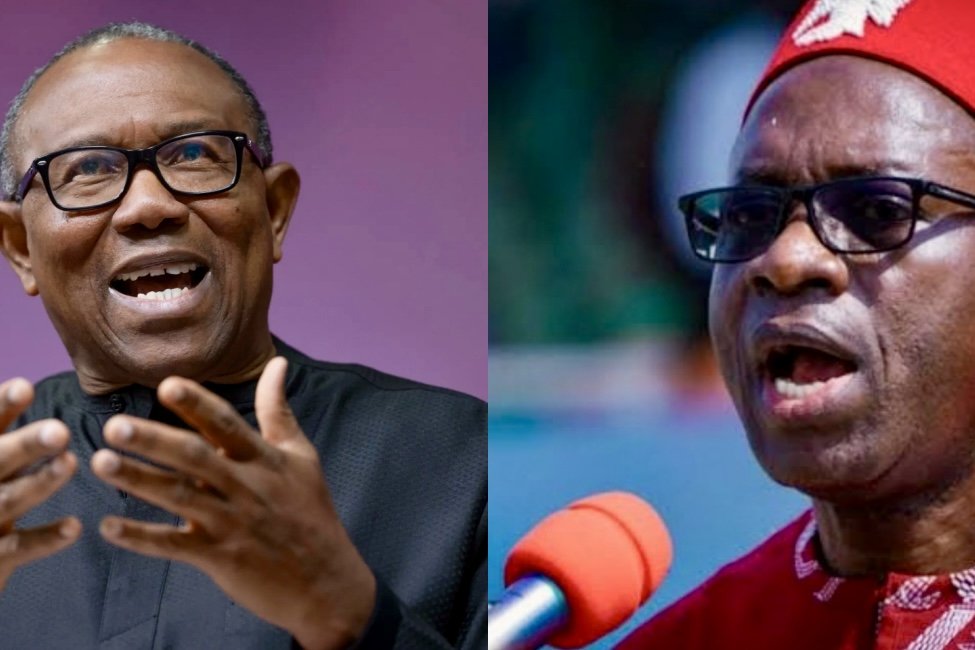
The dispute over Peter Obi’s financial record in Anambra has moved beyond political claims. DMO records, court proceedings and World Bank documents show a more complicated picture in which debt existed, but the $123.77 million figure cannot simply be treated as money personally borrowed by one governor.
The most revealing part of the latest Anambra debt controversy is not the exchange of accusations between former Governor Peter Obi and the state government.
It is the accounting gap between three very different numbers.
One is the US$123.77 million the Anambra State Government says was contracted through eight external development-financing facilities associated with projects during Obi’s tenure.
Another is the US$92.35 million the state says remained outstanding on those facilities as of June 30, 2026.
The third is the figure from the Debt Management Office’s own historical records. The DMO recorded Anambra’s external debt at US$41.46 million as of June 30, 2014 and US$45.15 million as of December 31, 2014.
That is an important difference.
It means the question is not simply whether Anambra had debt connected to development programmes during Obi’s years.
The records establish that it did.
The harder question is what exactly the $123.77 million represents, how much was actually drawn, who legally borrowed it, what Anambra owed when Obi handed over on March 17, 2014, and how much of today’s balance belongs to facilities approved or drawn after his tenure.
Those distinctions could determine whether the two sides are actually contradicting each other or using different definitions of “debt”.
What the Anambra government says
The Anambra State Government has accused Obi of denying liabilities that it says successive administrations have continued to service.
In its latest response, the government said eight external facilities linked to projects during Obi’s eight years in office had an aggregate contracted value of US$123,771,179.30, with US$92,353,182 still outstanding at June 30, 2026.
It said the obligations are being serviced through deductions from the state’s federal allocations.
The facilities cover malaria control, agricultural development, healthcare, education, community development, erosion management and agricultural value chains. Contemporary and official development records confirm that these programmes existed and that Anambra participated in several of them.
The government then went further, arguing that Obi could not deny involvement simply because the financing came through multilateral development programmes.
“It is Accountancy 101,” the government said, arguing that Obi had emphasised assets while failing to acknowledge liabilities.
It also attacked his claim that he left government without unpaid salaries, pensions or gratuities.
The language was political and severe. The underlying financial question is more precise.
Were the facilities state liabilities?
Yes, the available DMO records show that Anambra carried external debt.
Were all US$123.77 million outstanding when Obi left office?
The available DMO records do not support that interpretation.
Did Peter Obi personally borrow US$123.77 million from international lenders?
The World Bank and IFAD documentation complicates that description.
The World Bank documents change the meaning of “borrowed”
This is where the dispute becomes more technical.
Obi has argued that the state government is combining different accounting categories — the amount approved, the amount drawn down and the amount still outstanding — and presenting them as one debt “left by Peter Obi”.
He also said the facilities were mainly World Bank and IFAD programmes negotiated through the Federal Government, with participating states receiving financing through subsidiary arrangements.
That part of his argument is supported by the international institutions’ own documentation.
The World Bank’s State Education Program Investment Project, for example, identifies the Federal Republic of Nigeriaas the borrower, with the Federal Ministry of Finance involved in implementation.
The World Bank’s documentation for the Nigeria Erosion and Watershed Management Project similarly describes a US$600 million financing agreement between the International Development Association and the Federal Republic of Nigeria, with participating states, including Anambra, implementing state-level components.
The IFAD agreement for the Value Chain Development Programme is even more explicit. It names the Federal Republic of Nigeria as the borrower/recipient, while the programme was implemented in nine states including Anambra.
That does not mean Anambra had no obligation.
It means “Peter Obi personally borrowed $123.77 million” is not the same accounting proposition as saying “Anambra participated in federally negotiated multilateral financing and carried repayment obligations arising from those facilities”.
Those are materially different statements.
Then comes the DMO problem
The strongest documentary complication for the state government is contained in DMO records from 2014.
The DMO’s June 30, 2014 statement put Anambra’s external debt at US$41,459,335.44.
The DMO’s December 31, 2014 statement, issued after Obi had left office, put it at US$45,154,626.04.
Those are not $123.77 million.
Obi has cited a figure of about $30 million for March 2014 and used it to challenge the state’s presentation. Channels Television reported that he argued the government had failed to distinguish between approved financing, actual drawdowns and outstanding balances.
But there is an important qualification.
The DMO documents available for June and December 2014 do not show the $30 million figure Obi cited. They show approximately $41.46 million in June and $45.15 million in December.
That does not automatically disprove his broader argument.
It does mean that the $30 million claim itself needs documentary reconciliation with the exact DMO series and date he used.
The $123.77 million is not the same as money spent
The Anambra government’s figure is a total of the original amounts associated with eight facilities.
That is important because an approved or contracted facility is not automatically the same thing as the amount actually disbursed.
A development loan can move through several stages:
approval, signing, effectiveness, drawdown, expenditure, repayment and final outstanding balance.
The World Bank and IFAD documents themselves illustrate why the terminology matters. Their projects are structured around federal financing agreements, implementation arrangements and participating states rather than the simple commercial-bank model implied by the political language now surrounding the dispute.
This is why the next level of evidence should be the individual financing agreements, subsidiary agreements and drawdown schedules for each of the eight facilities.
Without those documents placed alongside the DMO debt series, the public cannot properly determine how much of the $123.77 million was available, how much Anambra actually accessed before March 2014 and how much was outstanding at handover.
The debt is real. The attribution is more complicated.
There is little documentary basis for arguing that Anambra had no external debt at all.
The DMO records settle that point.
Anambra had external debt before Obi left office and still had external debt years later. The DMO reported US$102.58 million for Anambra at December 31, 2025, showing how substantially the state’s external debt position had changed over the following decade.
At the same time, those figures do not establish that Obi personally incurred every dollar of Anambra’s external debt, nor that the entire $123.77 million was outstanding on the day he left office.
That distinction is central.
A government can inherit debt, participate in a federally negotiated financing programme, draw part of a facility and leave the resulting liability to succeeding administrations without personally signing a conventional commercial loan from a bank.
The Water Corporation dispute provides another warning
The argument over unpaid salaries is similarly less straightforward than the political claims suggest.
The National Industrial Court record shows a long-running dispute involving workers of the Anambra State Water Corporation and the environmental protection agency.
In the 2011 proceedings, the dispute included claims over 48 months of salaries and eight years of leave allowance for Water Corporation workers, alongside 25 months of salaries and eight years of leave allowance for ANSEPA employees.
The legal dispute continued after that.
A 2019 National Industrial Court judgment records that parts of the 2012 Industrial Arbitration Panel award had already been enforced through garnishee proceedings in 2014, while other aspects remained unresolved.
That matters because it again breaks the argument into separate periods.
It would be misleading to say the entire Water Corporation liability suddenly appeared after Obi left office.
It would also be too broad to say every later payment represented salary debt that Obi personally accumulated.
The record describes a liability with roots predating his administration, continuing through it and remaining contested after his departure.
The 2024 settlement confirms the dispute did not disappear
The Anambra State Government itself acknowledged the long-running nature of the Water Corporation dispute.
In February 2024, the state announced that it had reached an out-of-court settlement with the workers’ union after years of litigation. The government described it as the conclusion of a 14-year dispute involving the defunct Water Corporation and the environmental protection agency.
The state said the settlement saved about N1.3 billion and created a route towards possible re-employment for some affected former workers.
That official account establishes a continuing liability.
It does not, by itself, establish that every naira paid in the 2024 settlement was money owed exclusively as a result of decisions made by Obi.
The court record points to a much longer chain.
The teachers’ pension arrears are even more revealing
The dispute over pension arrears also cuts across administrations.
The Nigeria Union of Pensioners in Anambra said in 2026 that 11 months of pension arrears affecting retired primary-school teachers remained outstanding, with the amount put at about N490.18 million. The union traced the arrears to 2002/2003, before Obi became governor.
A former NLC chairman previously said that Obi inherited about 16 months of arrears from the Mbadinuju administration and had cleared part of them, leaving 11 months.
That evidence produces a different picture from the simple political claim that “Obi created the arrears”.
The arrears predated him.
But evidence also indicates that the problem was not completely cleared before he left office.
Both facts can be true at the same time.
Where the $123.77 million argument is strongest
The Anambra government has one important documentary advantage.
The facilities it identified are not imaginary numbers created in 2026.
There are genuine World Bank and IFAD development programmes involving Anambra, and the state has carried external debt obligations associated with multilateral financing.
The DMO also continues to record substantial external indebtedness for Anambra.
Where the state’s presentation becomes more vulnerable is in collapsing three separate propositions into one:
that financing was associated with projects during Obi’s tenure;
that the state was legally responsible for repayment;
and that Obi personally borrowed the entire US$123.77 million and left that exact amount as debt when he handed over.
The first two are supported in broad terms by the documentary record.
The third requires much more precise evidence.
Where Obi’s defence is strongest — and where it is not
Obi is on firmer documentary ground when he says these were not conventional personal commercial loans he obtained directly from lenders.
The World Bank and IFAD agreements support the point that the federal government was the formal borrower in major programmes involving Anambra.
His argument is weaker when the discussion shifts to the overall external debt position.
The DMO records clearly show that Anambra had external debt around the time he left office. The official June 2014 figure was more than $41 million, while the December 2014 figure was more than $45 million.
So the factual record does not support a literal interpretation of “Anambra had zero external debt”.
It does, on the other hand, complicate the government’s attempt to use the $123.77 million contracted value as if it were automatically the state’s debt balance on March 17, 2014.
The real unanswered questions
The dispute can be settled without political rhetoric.
The state government should publish the eight financing agreements, the corresponding subsidiary agreements, drawdown records and repayment schedules.
It should identify the precise balance of each facility as at March 17, 2014, rather than only giving the original facility values and the combined balance as at June 30, 2026.
It should also reconcile its $123.77 million calculation with the DMO’s historical state-level debt figures.
Obi, on his part, should publish the DMO records and documentation supporting the approximately $30 million figure he cited for March 2014, alongside evidence showing which facilities had not been drawn or were not attributable to Anambra at handover.
That would move the debate from personalities to ledgers.
It would also answer the question that matters most to Anambra taxpayers: what did the state owe on the day power changed hands, what did it receive in return for those liabilities, and how much has succeeding governments paid since?
The available evidence already shows that both “zero debt” and “$123.77 million left behind” are incomplete descriptions of a much more complicated public-finance history.
The documents point to debt.
They also point to federally negotiated development financing, inherited liabilities, partial repayments, continuing legal disputes and obligations that crossed several administrations.
That is the story the numbers tell.
Follow us on our broadcast channels today!
- WhatsApp: https://whatsapp.com/channel/0029VawZ8TbDDmFT1a1Syg46
- Telegram: https://t.me/atlanticpostchannel
- Facebook: https://www.messenger.com/channel/atlanticpostng