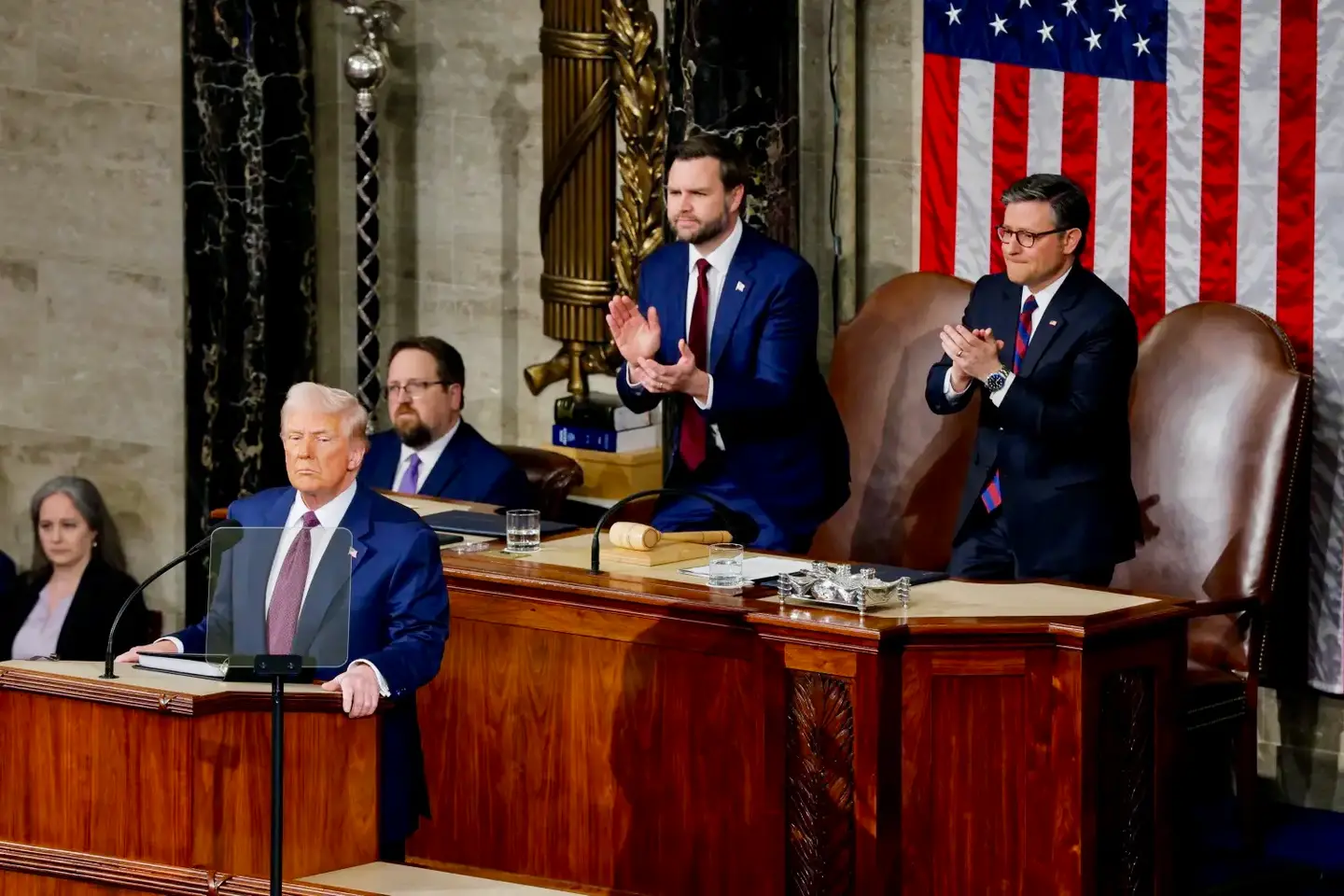
Trump stuns Congress with a bold, explosive address igniting chaos and triumph. Discover the drama reshaping U.S. politics.
WASHINGTON DC, U.S. — In a display of political bravado that few could have foreseen, President Trump delivered what many are calling a defining moment in his nascent administration. Speaking before a joint session of Congress on Tuesday night, the 47th president launched into his so-called “common sense revolution” in an address that was part rallying cry, part state of the nation, and entirely unapologetic in its message.
With his signature bombast, Trump proclaimed “America is back,” setting the stage for an evening of explosive rhetoric and unprecedented confrontation in the halls of Capitol Hill.
A Spectacular Display of Political Theatre
Right from the opening moments, the speech was designed to captivate and polarise. Trump’s address – unofficially styled as a State of the Union – was not merely a recitation of policy but a full-throated celebration of his agenda.
In a tone that blended defiance with triumph, the president celebrated the end of what he labelled as “divisive DEI policies,” positioning his government as the antidote to what he claimed was a culture of political correctness that had stifled the nation for too long.
In a move designed to stir both passion and controversy, Trump also touted the cost-cutting measures of DOGE, a reference that has since become a talking point among his supporters and detractors alike.
The exact details behind this measure remain subject to interpretation, yet its inclusion in the address symbolised his broader commitment to financial prudence and a streamlined approach to governance.
For many on the right, this was yet another affirmation of Trump’s promise to dismantle bureaucratic excesses that have long plagued Washington.
Key Moments and Celebrated Victories
Perhaps the most dramatic segment of the evening was the president’s announcement regarding the capture of a “top terrorist” – an individual he held responsible for the disastrous Afghanistan withdrawal that tragically cost the lives of 13 US service members.
This claim, though met with mixed reactions, was intended to showcase the administration’s commitment to national security and to underscore its resolve in addressing threats both foreign and domestic.
Adding a deeply personal note to the address, Trump took time to recognise the families of Laken Riley, Jocelyn Nungaray, and NYPD officer Jonathan Diller – lives claimed in incidents linked to illegal migration.
This poignant moment was crafted to appeal directly to voters’ emotions, tying national security and immigration policy to the human cost of political inaction.
For supporters, these recognitions affirmed a narrative of a country under siege being rescued by a leader who would not shy away from addressing hard truths.
Turmoil in the House: Disruption and Disorder
Yet, the night was not without its moments of chaos. In an incident that captured national attention, Democratic Representative Al Green of Texas vociferously interrupted the proceedings, challenging the president by shouting that he did not have a “mandate.”
The disruption quickly escalated, with House Speaker Mike Johnson warning of an impending censure resolution should Rep Green’s conduct not be rectified.
Johnson, emphasising the need for decorum, labelled the disruption as “quite shameful” and insisted that the standards of the House must be upheld.
Former White House press secretary Dana Perino did not mince words in her condemnation of the Democrats’ behaviour, criticising them for lacking “common sense, no ideas, and no heart.”
Her remarks, made on Fox News, resonated with a substantial portion of the conservative base, who viewed the protest as emblematic of what they see as a broader failure on the part of the opposition to engage constructively with national issues.
Meanwhile, former Tennessee Democratic congressman Harold Ford Jr. weighed in on the disruption, remarking that the moment was not conducive to unity and criticised the manner in which partisan theatrics had overshadowed substantive policy debate.
Bipartisan Reactions and the Battle for Credibility
The political fallout from Trump’s address has been as dramatic as the speech itself. Commentators across the spectrum have offered their verdicts on what they term a “successful night” for the president.
CNN’s Scott Jennings described the spectacle as a “HORRIFIC night for the opposition party,” arguing that the Democrats emerged not only defeated but also increasingly lost in their attempts to articulate a counter-narrative.
For many on the conservative side, the president’s delivery – even if “a touch low-energy” – was enough to cement his status as the definitive political heavyweight of our time.
National Review’s Jeff Blehar dismissed the long-term significance of such speeches, noting that while they are often forgotten by week’s end, the terms of tonight’s address made it clear that Trump’s political messaging had struck a chord.
Fox News veteran Brit Hume went further, declaring that the events of the evening had cemented Trump’s image as a “colossus” in the political arena.
Hume’s commentary struck a nerve with viewers who had long anticipated a night of unbridled political theatre, and his assertion that the Democrats were left “glumly on their hands” resonated widely.
Yet, not all reactions were unequivocal. In a stark rebuke, Democratic Senator Elissa Slotkin from Michigan urged her colleagues to remain engaged and to learn from the evening’s events.
While Slotkin’s words attempted to galvanise a more constructive response among Democrats, she was equally scathing in her critique of the president’s foreign policy stance.
Accusing Trump of “cozying up to dictators” and “kicking Canada in the teeth” with his tariff threats, Slotkin invoked comparisons with past administrations, notably pointing out that his mantra of “peace through strength” was little more than a recycled line from the Reagan era.
The Broader Implications for American Politics
This address, with all its bombast and controversy, is unlikely to be forgotten anytime soon. At its core, it encapsulates the deep divisions that continue to define American politics.
Trump’s rhetoric – whether heralded as a return to common sense or decried as incendiary – is emblematic of a broader cultural clash.
His celebration of policy wins, from the elimination of DEI measures to the capture of a high-value terrorist suspect, is designed to present a clear choice to the American electorate: a decision between what he terms a pragmatic, results-driven approach and the perceived inefficacy of his opponents.
For political analysts and veteran correspondents alike, the spectacle of Tuesday night offers a rich tapestry of themes to explore.
The interplay between emotion and policy, the use of personal tragedy as a political tool, and the very public disciplinary actions against dissenting members of Congress all point towards a future where partisan lines are not just blurred but actively contested on every front.
With the promise of more confrontations to come, the political landscape appears poised for a prolonged period of uncertainty and spectacle.
A Night that Redefined Political Engagement
For some, the events of the evening represent a turning point – a moment when the old conventions of political debate gave way to an era defined by direct, unfiltered communication.
Whether through calculated policy announcements or the theatrics of a disrupted session, the president managed to command attention and, crucially, to frame the narrative on his own terms.
Even as critics on the left decry the spectacle as little more than a self-serving monologue, the undeniable fact remains that the address has, in many ways, succeeded in setting the stage for what promises to be a tumultuous period in American politics.
As the nation reels from the impact of Tuesday night’s events, one thing is clear: President Trump has once again demonstrated his uncanny ability to galvanise support, provoke fierce opposition, and redefine the parameters of political discourse.
Whether this will translate into long-term political success remains to be seen, but for now, the president’s message – resounding with both triumph and controversy – has struck a powerful chord across the country.
In the coming days, as political analysts dissect every nuance of the speech and the ensuing fallout, the true impact of this address will likely become clearer.
For now, however, the night stands as a vivid reminder that in the realm of American politics, no moment is ever purely black or white.
It is a landscape where spectacle, strategy, and sentiment collide in ways that leave an indelible mark on the nation’s political psyche.
With the echoes of this tumultuous address still reverberating through the corridors of power, the question remains: Is this the dawn of a new era in American politics, or merely another chapter in a long saga of partisan strife?
As debates rage on and opinions remain as divided as ever, one thing is certain – Tuesday night’s address has set the stage for an unforgettable political season, one that will undoubtedly be scrutinised for years to come.