A video allegedly showing a serving police inspector spraying ₦200 notes has reopened a harder question: what happens when an officer enforcing the law is accused of ignoring it?
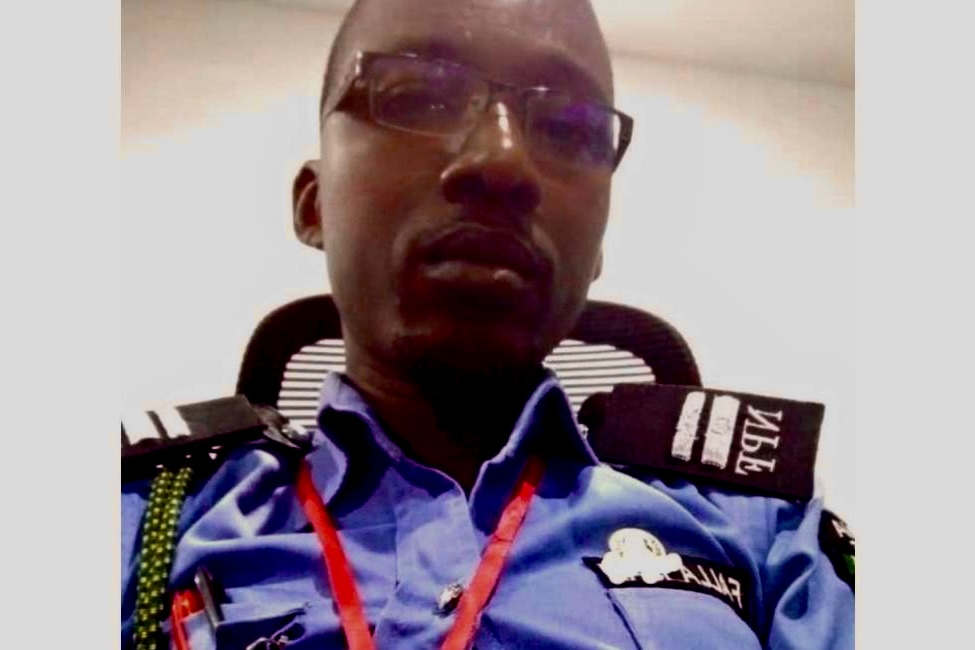
A police inspector linked to the Taraba State Criminal Investigation Department is at the centre of fresh scrutiny after a video purportedly showed him spraying ₦200 notes at a social gathering.
The development is particularly sensitive because the officer, identified in the latest report as Falla Falla, has also been linked to the arrest and transportation of Abuja-based activist Abdulmumin Imam to Taraba in an episode that generated competing accounts of what happened. SaharaReporters reported the video on September 19, 2026, while earlier reporting by PUNCH and FIJ documented the dispute surrounding Imam’s arrest and transfer.
The issue is therefore larger than a social event, a handful of banknotes or even one police officer.
It goes to the credibility of enforcement.
When an ordinary citizen is warned that spraying or stepping on the naira is an offence, but a serving law-enforcement officer is apparently seen doing the same thing, the public is entitled to ask whether the law is being applied consistently.
That question becomes sharper because the Central Bank of Nigeria has repeatedly stated that spraying, dancing on or stepping on naira notes is prohibited under Section 21 of the Central Bank of Nigeria Act 2007. The CBN says such conduct can attract imprisonment of not less than six months, a fine of not less than ₦50,000, or both.
The law does not create a social-event exemption for uniformed personnel.
Section 21 expressly defines spraying and “matching” or stepping on naira notes as abuse and defacement. The CBN has also urged Nigerians to give cash gifts through envelopes or electronic channels instead of spraying currency.
The video raises a simple question
The apparent contradiction is difficult to miss.
A man identified as a police inspector is allegedly shown in native attire, dancing while throwing ₦200 notes into the air. Other people are seen stepping on notes scattered on the ground.
Atlantic Post has not independently authenticated the video or established the precise date and venue of the event from the material currently available.
That is an important distinction.
A video can raise serious questions without, on its own, establishing every fact necessary for criminal or disciplinary liability. The identity of the officer, the authenticity and date of the recording, and the circumstances in which the notes were handled should all be formally established.
There is also an unresolved spelling issue.
Recent reports identify the officer as “Fala” or “Falla”, while the latest report describes him as “Falla Falla”. Earlier FIJ reporting on Imam’s detention referred to an officer named Fala among the officers involved in transporting the activist.
That should be straightforward for the police to clarify.
If the officer in the video is the same police inspector linked to Imam’s arrest, the public interest becomes even greater.
Imam’s case complicates the picture
Abdulmumin Imam was arrested in Abuja in April after making social-media posts questioning the handling of relief materials by the Taraba State Emergency Management Agency.
His family alleged assault and a secret transfer. Imam himself later told FIJ that several officers detained him and that he was subsequently taken by road to Jalingo despite telling the officers he was not fit for the journey.
“They dragged me to Abattoir and dumped me,” FIJ quoted Imam as saying.
He also alleged that he slept on a bare floor and was denied food and water before being transported to Taraba.
Those allegations were disputed by the Taraba State Police Command.
The command said Imam had been invited over petitions and alleged that he failed to honour earlier invitations. It rejected claims that he had been assaulted or forcibly abducted.
“At no time was Imam assaulted or subjected to any form of inhuman treatment,” the command said.
Taraba’s then Commissioner of Police, Morkwap Dongshal, also said he wanted to establish the facts personally before reaching conclusions.
“I want to see the documents myself,” he said, adding that Imam would be given a fair hearing.
Imam was subsequently released in Jalingo after the controversy attracted public and media attention. Media Rights Agenda reported that he was released on April 9, two days after his detention, and that he alleged he had been held without food and water.
The police dispute has never been the same thing as a judicial finding of torture or unlawful abduction.
That distinction should remain intact.
Yet the allegations matter because Nigeria’s legal framework puts specific obligations on police officers dealing with suspects.
The Police Act 2020 requires humane treatment of arrested suspects and prohibits torture and cruel, inhuman or degrading treatment. The Anti-Torture Act 2017 separately requires the authorities to ensure that suspects and detainees are not subjected to physical harm, force, violence, threat or intimidation while under investigation or custody.
The naira case makes the credibility problem harder to dismiss
The timing of the latest controversy matters.
In March 2026, the EFCC prosecuted a 24-year-old man, Iziga Jude Ikechukwu, after investigators obtained a video showing him abusing naira notes at a birthday celebration.
A Federal High Court in Enugu convicted him after he pleaded guilty to mutilating ₦81,700. He received a one-year prison sentence with an option of a ₦300,000 fine, while the recovered ₦81,700 was ordered forfeited to the Federal Government.
The EFCC case provides a useful benchmark.
It demonstrates that naira abuse is not merely a symbolic offence that authorities invoke when convenient. It has been the basis of an actual prosecution and conviction in 2026.
The CBN has likewise stated that it works with the police, EFCC, FIRS and the Nigerian Financial Intelligence Unit to tackle the practice.
That creates an obvious accountability question for the authorities now.
If the person in the video is confirmed to be a serving police inspector, will the same enforcement standard be applied to him?
The test should not be punishment. It should be due process.
There is a temptation in cases such as this to turn a disturbing video into a complete verdict before the relevant authorities have investigated it.
That would reproduce the same problem of arbitrary judgment that accountability systems are supposed to prevent.
The proper test is evidence.
The police should establish whether the officer is indeed the person shown.
The date and location of the event should be confirmed.
The recording should be preserved and examined.
The notes shown in the recording should be assessed against the statutory definition of spraying or matching.
The officer should be given an opportunity to respond.
And if the evidence supports an offence or professional misconduct, the appropriate disciplinary or criminal process should follow.
Nigeria already has institutions designed to do precisely that.
The Police Service Commission’s discipline department handles disciplinary matters, appeals, petitions and public complaints involving police officers. Its stated principles include the rule of law, respect for citizens’ rights and integrity.
The system has also demonstrated that disciplinary action is possible.
In July 2026, the PSC approved the dismissal of four senior police officers over misconduct and imposed various sanctions on 31 others, including demotions and other disciplinary measures.
The Nigeria Police Force had earlier said 167 senior officers were facing its Force Disciplinary Committee over alleged breaches of professional conduct and related offences.
The existence of those mechanisms makes the present case easier to frame.
The question is not whether police officers should be above the law.
They should not.
The question is whether the mechanisms designed to hold them accountable will be used when scrutiny becomes uncomfortable.
A law-enforcement credibility test
There is a deeper institutional issue beneath the video.
Public trust in policing does not depend only on the number of arrests made or criminal cases investigated.
It is also built through consistency.
If a young Nigerian is prosecuted for stepping on ₦81,700 at a birthday party while a serving police officer appears to perform the same act at another social event, the public will inevitably compare the two cases.
That comparison does not determine guilt.
But it does determine confidence.
The same principle applies to the Imam episode.
The police have said he was lawfully invited for questioning and denied allegations of assault and inhuman treatment. Imam and his supporters have given a sharply different account. Those competing narratives require evidence, not slogans.
The police therefore have an opportunity.
They can treat the video as an administrative irritation and allow the story to fade.
Or they can treat it as a credibility test.
A transparent examination of the officer’s identity, the video, the circumstances of the gathering and any connection to Imam’s arrest would do more than resolve one controversy.
It would demonstrate whether the principle is still intact that the uniform does not place an officer outside the law.
That is ultimately what is at stake.
Not the ₦200 note.
Not the party.
Not even one inspector.
The larger question is whether Nigerians can reasonably expect the people who enforce the law to be bound by the same rules they enforce.
Follow us on our broadcast channels today!
- WhatsApp: https://whatsapp.com/channel/0029VawZ8TbDDmFT1a1Syg46
- Telegram: https://t.me/atlanticpostchannel
- Facebook: https://www.messenger.com/channel/atlanticpostng