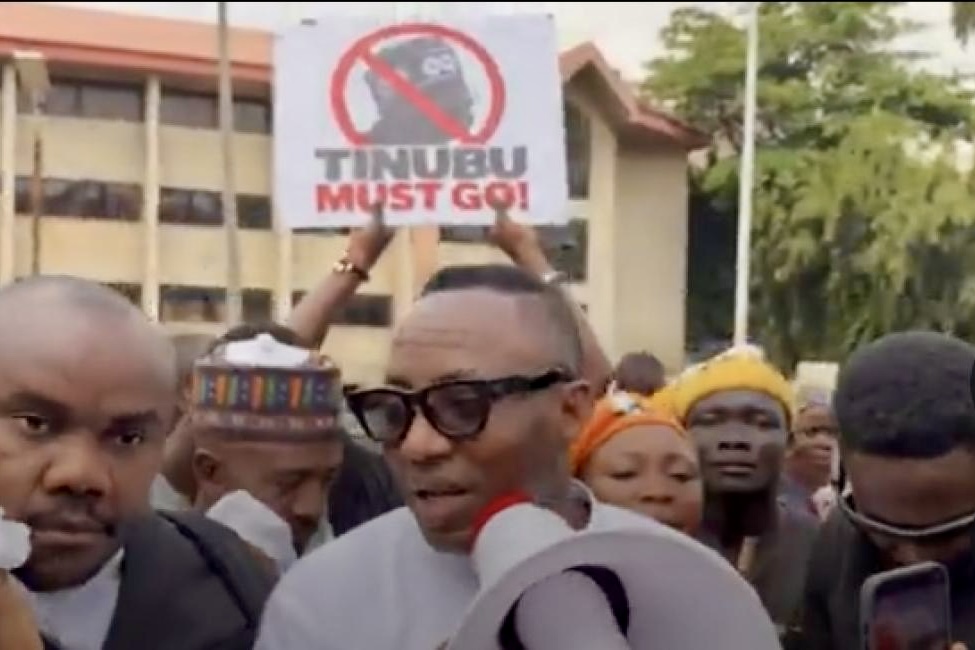
Omoyele Sowore has called on Nigerians to take their opposition to President Bola Tinubu’s government from social media to the streets, announcing a Tuesday rally in Abuja. But conflicting accounts of the crowd at Tinubu’s Kaduna campaign launch raise a larger question: can street mobilisation translate into a credible challenge at the ballot box?
ABUJA, Nigeria — Omoyele Sowore has challenged Nigerians to turn their anger against President Bola Tinubu’s administration into a mass street protest, announcing a “Tinubu Must Go” rally in Abuja for Tuesday, 27 October.
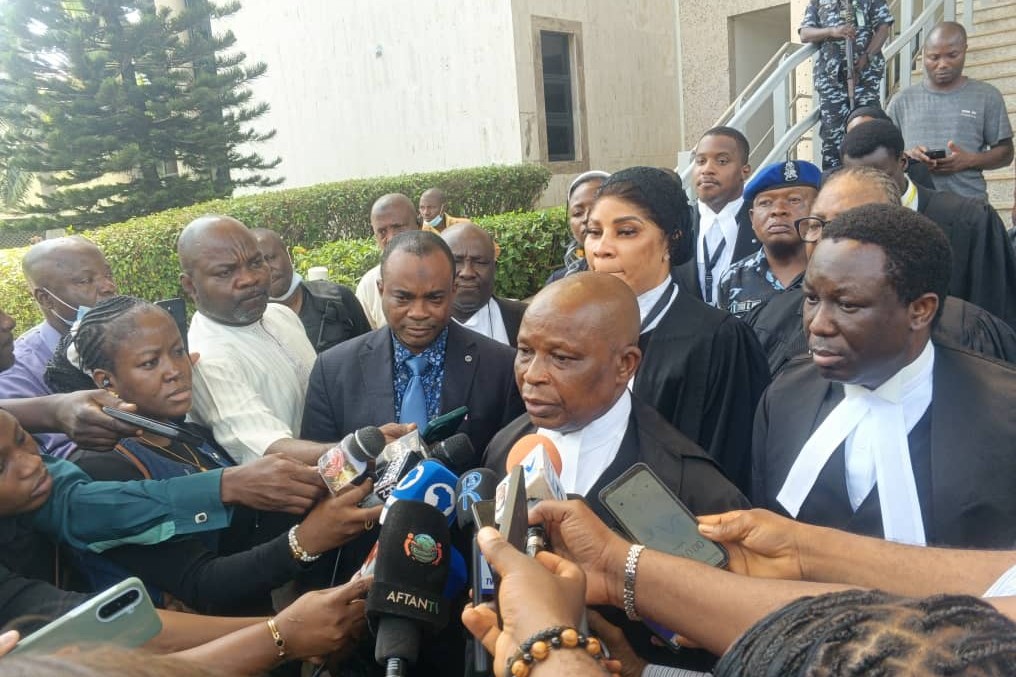
The human rights activist and African Action Congress (AAC) presidential candidate made the announcement on Monday, 26 October, after proceedings at the Federal High Court in Abuja in his ongoing case over social media posts describing Tinubu as a “criminal”.
His message was blunt: opposition confined to keyboards and timelines will not force political change.
“You cannot drive Tinubu away by social media,” Sowore told supporters. “If you like, you can write everything you want on Twitter (X). If you are serious, all of you should come out at once.”
The rally presents an immediate test of his ability to translate online criticism, discontent over living costs and opposition to the government into visible public mobilisation.
It also arrives at a critical moment. Tinubu’s All Progressives Congress (APC) has begun its campaign drive for the 2027 presidential election, while the country continues to grapple with economic hardship and persistent security challenges.
The question is whether Sowore’s call can build a broad-based protest movement or remain a demonstration led by a determined but politically smaller opposition force.
‘Tinubu Must Go’: A call beyond the courtroom
Sowore announced the rally after the latest proceedings in his long-running dispute with the Department of State Services (DSS), which prosecuted him over social media posts in which he described the President as a criminal.
Speaking to journalists and supporters, he portrayed the trial and the presence of government institutions around the case as insufficient to halt what he considers an emerging movement against Tinubu.
“Because judgment time has come. And all this desperation you are seeing at the Federal High Court, prosecutors, DSS, police, they cannot help Tinubu,” he said.
He went further, invoking Nigeria’s political history to argue that security institutions could not indefinitely shield a government from public opposition.
“They couldn’t help Babangida, they couldn’t help Abacha, they couldn’t help Obasanjo. Tinubu will face disgrace,” Sowore declared.
These were political assertions, not judicial findings. No court ruling has established that Tinubu’s tenure is over, and Sowore’s comments do not themselves alter the President’s constitutional position.
The distinction matters because the activist is simultaneously challenging the government in court and attempting to mobilise the public against it.
His immediate objective is to move the campaign from criticism into physical participation.
“We are coming back tomorrow and we want you to mobilise everybody,” he said. “Because tomorrow when we leave this place, tomorrow we will enter town. Yes, our Tinubu Must Go rally.”
He called on residents of the Federal Capital Territory (FCT) to invite friends, relatives and associates to join the demonstration.
“We want to do this revolution once and for all,” he added.
The precise size of the mobilisation will be one of the first measures of the rally’s reach. The announcement, as reported, does not establish how many people are expected to attend or provide an independently confirmed route and timetable.
The Kaduna crowd dispute behind Sowore’s challenge
Sowore’s declaration that Tinubu’s political tenure is nearing its end came amid competing interpretations of the APC’s campaign launch in Kaduna.
The ruling party held its presidential campaign flag-off at Kaduna Township Stadium on Saturday, 24 October, seeking to demonstrate support for Tinubu’s re-election bid.
Accounts of the turnout have diverged. The government-owned Voice of Nigeria reported that supporters occupied virtually all available seats, while TheCable described a crowd that filled the stadium and extended into surrounding streets.
By contrast, the African Democratic Congress (ADC) accused the APC of relying on a rented crowd and claimed that the stadium was sparsely occupied. Those allegations have not, on the evidence reviewed, been independently established.
Sowore also attacked the significance of the gathering, claiming that organisers had brought supporters from across the country but struggled to fill a stadium with a capacity of about 5,000.
The conflicting accounts expose a persistent weakness in Nigeria’s political debate: rival parties often use crowd size as a measure of legitimacy without providing independently verified attendance figures.
A large turnout can demonstrate organisational capacity, enthusiasm or the effectiveness of political mobilisation. It does not, by itself, establish how the wider electorate intends to vote.
Equally, allegations of a poorly attended rally cannot prove that a president has lost national support.
Sowore’s argument will therefore be tested by more than his interpretation of the Kaduna event. The Abuja rally must demonstrate whether his movement can attract participants beyond its established supporters and sustain public engagement after the immediate spectacle.
The court case and the battle over free expression
The timing of the protest announcement is significant because Sowore’s prosecution has become part of his wider confrontation with the Tinubu administration.
The DSS brought the case over social media posts published in August 2025 in which Sowore described Tinubu as a “criminal” and criticised the government’s handling of corruption.
The activist has denied wrongdoing and continued his defence before the Federal High Court.
In May 2026, the court rejected his no-case submission, ruling that the prosecution had presented sufficient evidence to require him to enter a defence. That decision was not a conviction.
On 19 October, Justice Mohammed Garba Umar also rejected Sowore’s application to compel DSS Director-General Tosin Ajayi to testify personally, holding that another agency official could give evidence concerning official DSS actions.
The latest proceedings thus form part of an ongoing legal dispute, not a final determination of Sowore’s guilt or of the political claims he makes against the administration.
For critics of the prosecution, the case raises questions about the limits of political expression and the use of criminal law in disputes involving criticism of public officials. For the prosecution, the allegations must be addressed through the judicial process.
The central democratic issue is whether the proceedings are handled fairly and transparently, with the court determining the legal questions on evidence rather than political pressure.
Sowore has also argued that the case threatens to impede his preparations for the 2027 election. The prospect of an opposition candidate spending time in court while campaigning for office adds a political dimension to a case that began with statements published online.
But neither the pending trial nor the activist’s allegations establish that the government has deliberately sought to prevent him from competing. Such a conclusion would require evidence beyond the political claims made in his public addresses.
Why Sowore wants Nigerians off social media
Sowore’s criticism of online-only activism reflects a broader struggle over how political opposition should operate in Nigeria.
Social media can amplify grievances, circulate evidence, organise supporters and expose developments that traditional political structures might otherwise ignore. But visibility online does not necessarily translate into physical mobilisation, enduring organisation or electoral strength.
“You cannot drive Tinubu away by social media,” Sowore said, challenging opposition figures who, in his view, rely excessively on online criticism.
He insisted that his movement would operate both online and offline.
“But we, we are determined online, offline to make sure that this country is liberated. And we are going to sacrifice whatever it will take for it,” he said.
The strategy carries both opportunity and risk.
A peaceful demonstration could give citizens a public platform to express dissatisfaction with economic conditions, governance and security. It could also attract people who do not identify with Sowore’s political party but share particular grievances.
Yet a protest’s ability to sustain pressure depends on more than its numbers on a single day. Clear demands, credible leadership, disciplined organisation and a strategy that extends beyond a rally can determine whether public anger produces lasting political consequences.
Sowore cited student protests in Serbia and demonstrations in France and Spain as examples of citizens challenging their political and social conditions.
“Why is it that we cannot do our own in Nigeria? Our own time has come as well,” he asked.
The comparisons make a political appeal rather than establish that Nigeria is experiencing the same conditions as those countries. Different political institutions, protest traditions and public grievances shape the outcomes of mass movements.
For Abuja, the immediate question is whether Sowore can turn that appeal into a peaceful gathering with broader participation.
The test for the police and government
The rally will also test how the authorities respond to political dissent.
Section 40 of Nigeria’s Constitution protects the right to assemble freely and associate with others. That right is central to democratic participation, including the ability to criticise a government and demand political change through peaceful protest.
The National Human Rights Commission has similarly identified freedom of peaceful assembly and association as fundamental rights that must be respected.
The authorities have a responsibility to protect participants, preserve public safety and safeguard the rights of other residents. Protest organisers and demonstrators, in turn, must respect the law and avoid violence or the deliberate infringement of other people’s rights.
The distinction between maintaining public order and suppressing dissent is crucial. A peaceful demonstration should not be treated as a security threat simply because its message is hostile to the government.
At the same time, organisers need to communicate practical details to supporters and take reasonable steps to prevent confusion and avoidable disruption.
As of the announcement reported on Monday, the available information did not establish a confirmed attendance target or detailed route for Tuesday’s rally. Those details will matter for crowd management, traffic planning and public safety.
The conduct of security agencies will be as important as the size of the crowd. A restrained, professional response would help protect both the protesters’ rights and the wider public. Unnecessary force or arbitrary arrests would risk intensifying the confrontation.
What the rally can—and cannot—prove
Sowore ended his address with a confident prediction that the current administration would soon become a thing of the past.
“We just have a little bit of time left before this regime will become a regime of the past. And this affliction shall never have a second time in our lives,” he said.
His words are designed to convey urgency and persuade supporters that political change is within reach.
But a rally cannot determine an election result, and a crowd in Abuja cannot automatically be taken as a national verdict on Tinubu’s leadership.
The 2027 contest will ultimately depend on political organisation, candidate support, voter participation and the credibility of the electoral process. Street demonstrations can shape debate and place pressure on elected officials, but their influence must be demonstrated rather than assumed.
The immediate measure of Tuesday’s protest will be whether Sowore attracts a substantial, peaceful and diverse turnout. The longer-term test is whether the movement can convert that participation into sustained engagement with Nigeria’s political and economic problems.
Sowore has issued his challenge. Abuja’s response will show how far it reaches.
Follow us on our broadcast channels today!
- WhatsApp: https://whatsapp.com/channel/0029VawZ8TbDDmFT1a1Syg46
- Telegram: https://t.me/atlanticpostchannel
- Facebook: https://www.messenger.com/channel/atlanticpostng


Join the debate; let’s know your opinion.