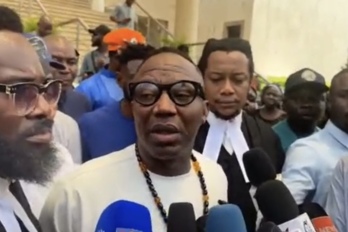
Human rights activist and presidential candidate of the African Action Congress, Omoyele Sowore, on Monday said his trial at the Federal High Court in Abuja is not about any criminal offence but about what he described as a wider attempt to silence his activism and criticism of power.
Sowore spoke to journalists after proceedings in the case brought against him by the Department of State Services, DSS, over allegations linked to comments in which he referred to President Bola Tinubu as a criminal. The charge has drawn attention from civil rights advocates, political observers and supporters who see the case as another flashpoint in Nigeria’s long-running struggle over free expression, dissent and state power.
Appearing upbeat after the session, Sowore said the day marked the opening of his defence and insisted the case was politically driven.
“I’m not appearing here because I committed any crime. I’m in court and I’m being persecuted because I decided to stand up to be counted on the side of rights in this country,” he told journalists.
He added that he would not align himself with corruption or violence in public life.
“I will never be part of the people who will steal your money. I will never be part of the people who will murder somebody because they don’t agree with me. I will never be in this country, or be a citizen of any country in the world, particularly Nigeria, and watch while they sink your destinies,” he said.
According to him, the day’s proceedings were productive and represented progress in the case. He said even the lead prosecutor, a Senior Advocate of Nigeria, made a remark he interpreted as light-hearted and revealing.
“I am a presidential candidate, so I need to discuss serious national issues. I want to announce to you today that even the prosecutor, who is a Senior Advocate of Nigeria, said that he is waiting for me to convince him so that he can vote for me in the election,” Sowore said.
“That is progress made today. We are close to winning the election. This is an attempt to clear himself of bias.”
The activist urged journalists to report the proceedings directly from the courtroom rather than relying on second-hand accounts. He said the court hearing was open and that media practitioners should observe the case for themselves.
“The lawyers did the submission and application,” he said. “I want to urge you, it is an open court. Go in there and cover the case. That is what journalists do, right? Most of you are experienced at this.
“Just cover the case. Make an informed judgment about what the lawyers are doing in court. We opened our defence today. It was a blockbuster.”
Sowore also dismissed questions about his recent detention, saying he did not regard the issue as a closed matter and claimed that authorities were still trying to return him to prison.
“Incarceration and experience about incarceration is not something I pay attention to, considering that even today I was supposed to go back to prison again,” he said.
“So an experience that has not been concluded cannot become a matter for discussion. It is an ongoing issue. And my persecution is also an ongoing concern.
“Don’t worry about it. If I tell you my experience now, if I write a book, most of you will not buy it. And I have a duty to raise money.”
On whether he was treated fairly while in custody, Sowore rejected the idea that fairness could be discussed in relation to imprisonment for someone who has not been convicted.
“There is no fair treatment for somebody who has not been committed. We can’t even say that,” he said.
“We are talking about prison. I made it clear last week when I spoke to the media. They called it the correctional centre, but for me, it was prison.
“Nobody should be correcting a person who is correcting society. That’s the job I do in this country.”
The AAC candidate said repeated arrests and prosecutions had not weakened his resolve. He described himself and others who continue to challenge the government as voices of conscience.
“Listen, no matter what they do to you in this country, no matter what it turns into, look at me very well today, I remain the conscience of this nation. And I’m not the only one. All these people are the conscience of this nation. Some of you are the conscience of the nation,” he said.
“We are dealing with conscienceless power. But when conscienceless power meets a powerful conscience, it collapses.”
He thanked his lawyers, supporters and activists who have continued to attend court proceedings from different parts of Nigeria, saying the case had attracted attention beyond the country’s borders.
“Sometimes in the history of mankind, people like us come once in a while. When I say people like us, I mean many of us here,” he said.
“Our lawyers have to spend countless hours defending this case. We have activists who come here from across the country. There are people watching us from all over the world.”
Sowore said his concerns extend beyond his personal legal battle and argued that Nigeria’s main crises remain insecurity, poverty, weak healthcare and economic hardship.
“They are trying to figure out what will happen to us. They’ve already known that I’ve been singled out to be maltreated,” he said.
“But what will happen to this country? How can children who are abducted be reunited with their families? How can we travel safely in our country? How can people who are working earn a living wage?
“How can hospitals attend to diseases that are not ours? How can our economic system empower us without disenfranchisement?
“We are talking about this country where characters are running fake agencies. And the people who are behind them are paying them and putting them in their pockets.
“So, we are living in that country regardless of the risks involved.”
He said the repeated prosecutions and efforts to remand him were ultimately meant to stop him from speaking publicly.
“It is about how to make Sowore not talk. That’s the whole thing,” he said.
“The judge had to say, ‘I did not give him an order that he should not talk.’
“But it’s all about making sure he doesn’t talk. The anxiety is: ‘He’s going to talk, he’s going to talk, he’s going to talk.’
“So they ask, ‘Why not make sure he doesn’t talk?’”
“That tells you something. There is power in our voice,” he added.
The case continues to draw scrutiny because of its implications for political speech, state accountability and the boundaries of dissent in Nigeria. For Sowore, however, the message from Monday’s hearing was clear: the matter is bigger than one man, one charge, or one courtroom appearance.
Follow us on our broadcast channels today!
- WhatsApp: https://whatsapp.com/channel/0029VawZ8TbDDmFT1a1Syg46
- Telegram: https://t.me/atlanticpostchannel
- Facebook: https://www.messenger.com/channel/atlanticpostng