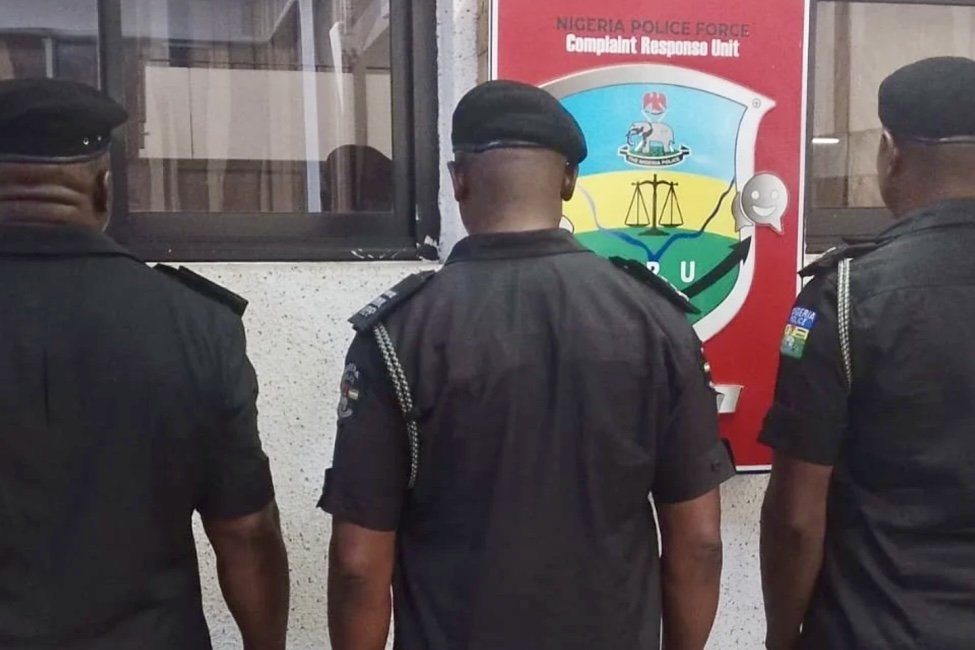
Three officers have been summoned after footage showed a motorist being threatened during a vehicle search. But Nigeria already has laws protecting citizens against arbitrary searches, intimidation and excessive force. The real test is whether those safeguards will finally be enforced.
A motorist asked Nigerian police officers to search his vehicle one section at a time so he could watch what they were doing. What followed, captured on video in Rivers State, has raised a more troubling question than the officer’s threat: can Nigerians exercise their rights during police operations without becoming targets of intimidation?
The confrontation began with what appeared to be a straightforward request.
“Please sir, can you close the door, let’s focus on one side. Let him close the door so we can focus here, so that I can see what he is doing,” the motorist said.
Rather than responding to the request, one of the Mobile Police (MOPOL) officers questioned the necklace around his neck, suggesting it was a charm.
“What is this one on your neck?” the officer asked.
When the motorist explained that it was a necklace, the officer demanded: “Bring it out! What is necklace? Is it not talisman?”
The exchange escalated.
“I will teach you a lesson you have not learned in your life. Open your bag. We are moving you to criminal charge. You are making noise. Who are you?” the officer threatened.
He subsequently ordered the motorist to remove his glasses.
“Remove the glass in your face. I say remove the glass in your face! Don’t put the glass on until I finish searching.”
The motorist, who was also recording the encounter, refused to put his phone away.
“I wouldn’t put my phone in my pocket. Why are you assaulting me? I won’t put my phone in my pocket!” he shouted.
The footage ends amid an apparent physical confrontation. It does not establish everything that happened before or after the recording, whether the motorist sustained injuries or what initially prompted the vehicle search.
But it raises legitimate questions about the manner in which the operation was conducted.
Police summon three officers as investigation begins
On Saturday, 31 October 2026, the Nigeria Police Force Complaint Response Unit (CRU) announced that the officers captured in the footage had been identified and summoned for investigation.
The unit stated:
“The officers captured in the viral video from Rivers State @PoliceNG Command were identified and subsequently summoned to the @PoliceNG_CRU, for an in-depth investigation and necessary actions.”
It added that the action was being taken under the leadership of the Inspector-General of Police, Olatunji Disu, with the declaration: “#NoToImpunity.”
A report by Gazette on the development identified three officers as having been summoned.
The development followed the circulation of the footage on social media on Tuesday, 27 October. SaharaReporters had previously reported the incident, while the video was shared on X by the account @MR__sulaiman2.
One of the MOPOL personnel appears to have a name tag reading “Afambu Uche”. That visible inscription is a potential identification clue, but it should not replace formal confirmation of the identities and individual responsibilities of all the officers involved.
The CRU’s announcement is an important first step. It is not, by itself, a finding of guilt or proof that disciplinary action has been taken.
The officers must be given an opportunity to respond to the allegations, while the investigation must establish what happened, who was responsible and whether the conduct breached the law and police regulations.
What Nigeria’s Police Act says about vehicle searches
The most important question is whether the police operation complied with the Nigeria Police Act 2020.
The Act gives police officers powers to stop and search people and vehicles in specified circumstances. It does not, however, give them unlimited authority to conduct searches simply because they wish to do so.
Section 49 identifies circumstances in which officers may detain and search a person or vehicle. These include reasonable grounds for suspecting that someone is carrying stolen property or an unlawful article, information about a suspected offender or article, and certain serious security concerns.
A search must therefore have a lawful basis.
Section 50 requires an officer, before searching a detained person or vehicle, to provide their name, identify the police station to which they are attached, explain the purpose of the search and state the grounds or authorisation for undertaking it.
The officer must also be in uniform or visibly display a valid police identity card.
These are statutory requirements, not optional courtesies.
The law also places limits on how searches should be conducted.
Under Section 51, officers must make reasonable efforts to minimise embarrassment and seek the cooperation of the person being searched. A forcible search is permitted only as a last resort after unwillingness to cooperate or resistance has been established.
The law also requires searches to be conducted within a reasonable time.
Section 54 goes further by stating that personal attributes, including colour, age, hairstyle and manner of dress, cannot constitute reasonable grounds for suspicion.
This provision is particularly relevant to the confrontation over the motorist’s necklace.
An officer describing jewellery as a talisman does not automatically turn it into a prohibited article. The police must be able to establish a legitimate connection between the item, the suspected offence and the legal grounds for the search.
The same principle applies to the demand that the motorist remove his glasses. An instruction during a search should have a legitimate operational purpose and must be consistent with the law.
The purpose of police search powers is to detect and prevent crime, not to provide an opportunity to humiliate citizens.
Sections 56 and 57 also require officers to prepare written search records, where practicable, and provide a copy to the person searched or the driver of a searched vehicle. The record must include the grounds and purpose of the search, the date, time and location, its result, the officer’s identity and any injury or property damage resulting from the operation.
Whether such a record was prepared during the Rivers encounter is among the questions the police investigation should answer.
A phone camera is not a criminal offence
The motorist’s refusal to put his phone away deserves particular attention.
Recording a police officer performing official duties in public is an important safeguard against abuse of power. It allows citizens to preserve evidence, supports independent scrutiny and can also protect officers against false allegations.
This position received fresh judicial reinforcement in March 2026.
On 17 March, the Federal High Court in Warri, Delta State, delivered judgment in a fundamental rights case, FHC/WR/CS/87/2025, involving lawyer Maxwell Nosakhare Uwaifo and the Inspector-General of Police and other authorities.
The court affirmed Nigerians’ constitutional right to record police officers performing their duties in public spaces.
Justice H. A. Nganjiwa also held that police officers must wear visible name tags and display their force numbers, and must not harass, intimidate or arrest citizens for recording official police activities.
The court awarded Uwaifo ₦5 million in damages and an additional ₦2 million in litigation costs.
The case arose from the lawyer’s encounter with police personnel during a stop-and-search operation along the Benin–Warri route in May 2025.
The judgment is particularly significant because the dispute involved the same fundamental issues now raised by the Rivers footage: stop-and-search procedures, officer identification, intimidation and the citizen’s ability to document police conduct.
It is a Federal High Court judgment, not a Supreme Court ruling. Nevertheless, it provides an important judicial statement on the rights of citizens during public law enforcement operations.
The Rivers investigation should therefore establish whether the motorist was threatened or assaulted because he insisted on keeping a record of the search.
Rivers has witnessed a similar police accountability test
The latest incident is not the first time Rivers State has attracted national attention over police conduct during roadside encounters.
On 9 April 2023, a video circulated showing an armed police officer assaulting a civilian at Emohua, Rivers State.
Following public outrage, the Nigeria Police Force identified three officers: Inspector Adejoh Siaka, Inspector Friday Obaka and Sergeant Ndiwa Kpuebari.
An orderly room trial subsequently resulted in Siaka being demoted from inspector to sergeant, while Kpuebari received a severe reprimand.
Obaka, who was found to have been absent from the incident, was discharged unconditionally. All three officers were posted out of Rivers State.
The outcome demonstrated that the police could identify officers through video evidence and impose internal disciplinary sanctions.
But it also raises a difficult question about deterrence.
Did the sanctions sufficiently discourage similar conduct, or do repeated incidents suggest that individual punishment has not translated into consistent operational change?
The distinction matters. Transferring officers or reducing their ranks may address particular cases, but neither automatically changes the behaviour of other personnel at checkpoints and during vehicle searches.
From EndSARS to another viral confrontation
In October 2020, Nigerians took to the streets under the #EndSARS movement, demanding an end to police brutality and abuses associated with the now-disbanded Special Anti-Robbery Squad.
The protests brought international attention to allegations of extrajudicial killings, torture, extortion, unlawful detention and arbitrary arrests.
Six years later, the debate has not disappeared.
On 20 October 2026, the Rule of Law and Accountability Advocacy Centre (RULAAC) warned that police reform measures had failed to produce the fundamental changes Nigerians demanded.
“The central question six years after #EndSARS is therefore not whether reforms were announced, but whether policing has become more lawful, professional, humane and accountable,” the organisation said.
“The available evidence shows that the gap between promise and practice remains dangerously wide.”
RULAAC also described the implementation of judicial panels’ recommendations as fragmented, opaque and inadequate, particularly in relation to criminal accountability, institutional reform and compensation for victims.
Its warning is relevant to the Rivers incident.
A police force cannot convincingly claim institutional reform merely by disbanding a controversial unit, announcing new regulations or summoning officers after videos of misconduct become public.
Reform must be visible in everyday encounters between citizens and the officers empowered to enforce the law.
The Enugu case shows why internal discipline is not enough
The fatal shooting of Ogene musician Okezie Chikezie Nwamba, popularly known as Igbo-Jah, in October 2024 offers another illustration of the consequences of police misconduct.
The musician was shot by Inspector Ozonwanji Joseph at the Enugu State Police Command’s Anti-Cultism Tactical Squad headquarters on 25 October 2024.
Following an internal disciplinary proceeding, the inspector was dismissed from the police.
He was also arraigned at the Enugu East Magistrate Court on 28 October 2024 on a murder charge.
The case demonstrated the importance of separating internal disciplinary measures from criminal prosecution where the evidence indicates that an offence may have been committed.
The Rivers incident is different in nature and gravity. No finding has established criminal liability against the officers summoned in the latest case.
Nevertheless, the principle is the same: misconduct cannot be conclusively addressed through public relations statements alone.
What the police must establish
The CRU’s investigation should answer several questions.
What were the specific grounds for stopping and searching the vehicle? Were those grounds communicated to the motorist? Did the officers identify themselves and explain their reasons for the search as required by the Police Act?
Was a proper search record prepared? Was any unlawful item discovered? Why did the disagreement over a necklace and glasses escalate into threats and an apparent physical confrontation?
Did the officers attempt to prevent the motorist from recording their conduct, and, if so, on what lawful basis?
The police should also clarify the identity and responsibilities of each officer present, whether supervising officers were involved and what independent evidence is available.
The Police Act provides for a Police Complaints Response Unit at Force Headquarters and in every state command. Section 133 requires the unit to receive complaints of police misconduct and monitor investigations. It also provides that the relevant investigative unit should submit its findings to the CRU within 21 days of the complaint.
The statutory process provides an accountability framework. The public should now be told how it is being applied in this case.
That includes whether the investigation will result in disciplinary proceedings, referral for criminal investigation where appropriate, or a finding that the allegations are not substantiated.
The officers must have a fair opportunity to defend themselves. The motorist, meanwhile, deserves an investigation that does not simply disappear after the public’s attention moves elsewhere.
The real test is what happens after the cameras stop recording
There is a fundamental difference between having laws that protect citizens and having a police institution that consistently enforces them.
Nigeria already has statutory provisions governing reasonable suspicion, officer identification, search procedures, the use of force and the documentation of police operations. A Federal High Court has also recently affirmed the right to record police officers performing public duties.
The unanswered question is why encounters that appear to challenge these safeguards continue to emerge.
The Rivers case offers the Nigeria Police Force another opportunity to demonstrate that its commitment to accountability goes beyond responding to viral videos.
Summoning three officers is a beginning. A credible investigation, transparent findings, appropriate sanctions where misconduct is established and effective measures to prevent recurrence would be a much stronger demonstration of reform.
For millions of Nigerians who encounter armed officers on the country’s roads, the issue is larger than one necklace, one pair of glasses or one confrontation.
It is whether an ordinary citizen can ask to see what is happening during a police search without being threatened, assaulted or treated as an enemy.
That is the standard by which Nigeria’s police reform should ultimately be judged.
Follow us on our broadcast channels today!
- WhatsApp: https://whatsapp.com/channel/0029VawZ8TbDDmFT1a1Syg46
- Telegram: https://t.me/atlanticpostchannel
- Facebook: https://www.messenger.com/channel/atlanticpostng

Join the debate; let’s know your opinion.