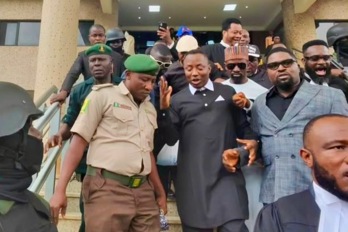
ABUJA, Nigeria — Omoyele Sowore walked out of Kuje Correctional Centre on Tuesday and immediately turned his release into a political indictment of the Nigerian state.
The Federal High Court in Abuja had just granted the AAC presidential candidate ₦200 million bail with two sureties, one a traditional ruler from his community in Ese Odo, Ondo State, and the other a landed-property owner in the Federal Capital Territory, while also ordering him to surrender his international passport.
The court had earlier revoked his self-recognisance bail on 16 June after he failed to appear, issued a bench warrant for his arrest and later remanded him at Kuje pending the hearing of his challenge to that revocation.
What makes the episode politically charged is not merely the bail drama but the symbolism. Kuje has become one of the country’s most charged correctional centres, a place associated with state power, insecurity and the long shadow of Nigeria’s prison crisis.
Sowore’s detention ended just as the Nigerian Correctional Service said the national inmate population stood at 80,812 as of 9 February 2026, with 64 per cent of inmates awaiting trial.
That figure underlines the wider problem his supporters say his case represents: a justice system where detention can become the punishment before trial is even concluded.
In his first public response after release, Sowore chose defiance over relief. Writing on X, he said, “Prison has never broken the resolve of those who fight for justice. If anything, it only strengthens our determination,” adding, “The struggle continues. We will never surrender. #RevolutionNow #Sowore2027.”
In the fuller statement shared after his release, he was even blunter: “I am back, and I remain unbroken.” He also said he had spent nine days in Kuje alongside more than 1,158 inmates, including 37 who were undergoing treatment for tuberculosis in overcrowded cells.
That claim lands in a prison-health context that is difficult for the state to dismiss. Nigeria’s National Tuberculosis and Leprosy Control Programme says the country remains the highest TB burden in Africa, recording 371,019 TB notifications in 2023.
A 2025 peer-reviewed study of two Nigerian correctional facilities found TB prevalence among inmates at about 0.5 per cent, roughly 489 per 100,000, more than double the national prevalence cited in the study.
The research also warned that prison TB burden can be about 10 times higher than in the general population and called for systematic screening in custodial centres.
Sowore’s detention was not an isolated legal event. It sits inside a widening dispute over free speech, protest, executive power and the role of the Department of State Services in political trials.
TheCable reported that the DSS is prosecuting him on a two-count charge tied to a social media post in which he allegedly described President Bola Tinubu as “a criminal”, while Sowore has pleaded not guilty.
The same report noted that the court had initially granted him bail on self-recognition before later revoking it after he failed to attend proceedings on 16 June.
Human rights advocates have treated the case as a test of civic space. Amnesty International, according to Sahara Reporters’ account of its statement, condemned the deployment of heavily armed security personnel around the Federal High Court in Abuja and called on Nigerian authorities to drop what it described as unfounded charges against Sowore.
The group said, “Again today heavily armed security personnel have barricaded Federal High Court Abuja as Sowore goes on trial,” and added that he should never have been charged in the first place.
Amnesty also urged the authorities to allow activists and journalists to work without harassment, intimidation or fear of reprisals.
For Sowore’s camp, the legal fight and the political project are inseparable. His statement framed the case as part of a longer campaign against repression, saying the Nigerian state had pursued him since his university days in the struggle against military rule.
He accused successive civilian governments of becoming more repressive, and he pointed to the police and DSS as instruments through which constitutional rights are routinely violated.
Those are his allegations, but they resonate with a broader pattern that critics of state power have long described in Nigeria: arrests that chill dissent, prosecutions that outlive their political utility and bail conditions that look designed to burden rather than release.
His release also reveals something about the politics of survival. Rather than stepping back, Sowore immediately used the moment to relaunch his presidential ambitions, declaring,
“The task before us is greater than any individual. The struggle for justice, freedom, and the liberation of Nigeria continues,” before adding, “And now, the next major assignment is before us. The Sowore Presidential Campaign 2027. The campaign must go on.”
That move matters because it turns a prison release into a campaign signal. In a country where opposition politics often lives under the pressure of state security, the line between legal resistance and electoral mobilisation is increasingly thin.
The deeper question is whether Nigeria is witnessing a routine criminal case or a familiar state reflex against a persistent dissident. The answer may lie in the timing, the scale of the security presence, the bail conditions and the intensity of the public reaction.
On paper, the court has acted within its powers. In political reality, the optics are far less tidy. Sowore has now been freed, but the case, the accusations and the larger battle over Nigeria’s democratic space are still very much alive.
The next hearing, fixed for 6 July 2026, will show whether the system intends to de-escalate or tighten its grip.
Follow us on our broadcast channels today!
- WhatsApp: https://whatsapp.com/channel/0029VawZ8TbDDmFT1a1Syg46
- Telegram: https://t.me/atlanticpostchannel
- Facebook: https://www.messenger.com/channel/atlanticpostng
Follow us on our broadcast channels today!
- WhatsApp: https://whatsapp.com/channel/0029VawZ8TbDDmFT1a1Syg46
- Telegram: https://t.me/atlanticpostchannel
- Facebook: https://www.messenger.com/channel/atlanticpostng