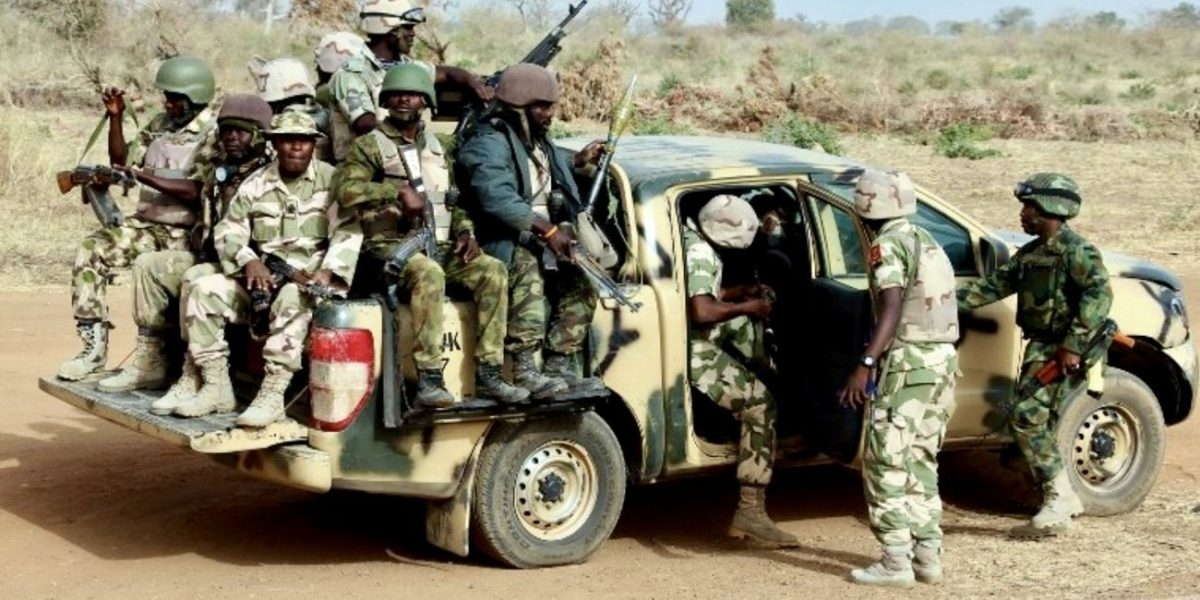
More than 150 residents of Muvur allegedly suffered beatings during a midnight military operation, with motorcycle owners reportedly ordered to pay ₦50,000 or surrender 50 litres of petrol to recover their property. The allegations raise troubling questions about military accountability and civilian protection in Nigeria’s insurgency-affected North-East.
Residents of Muvur community in Adamawa State have accused Nigerian soldiers deployed under Operation Hadin Kai of turning a security operation into an alleged campaign of intimidation, physical assault and extortion, with motorcycle owners reportedly forced to surrender money or petrol to recover their property.
The allegations, which involve troops attached to Sector 4 of Operation Hadin Kai and reportedly operating under a commander identified as Captain Aliyu, have raised fresh concerns about the treatment of civilians in communities affected by Nigeria’s prolonged counter-insurgency operations.
The residents, from Muchalla Ward in Mubi Local Government Area, alleged that soldiers stormed their community at approximately 1am, broke into residential buildings, dragged people from their beds and subjected them to severe beatings.
Among those allegedly assaulted were elderly residents, including an octogenarian.
One victim, describing the experience, said the soldiers seized motorcycles and demanded payments before releasing them.
“We were beaten and assaulted worse than dogs. They seized our motorcycles and everyone had to pay a ransom of N50,000 or two 25-litre jerrycans of petrol to recover their motorcycles,” he said.
The demand, if established, represents an alleged payment of either ₦50,000 or 50 litres of petrol for the return of a seized motorcycle.
Another victim alleged that soldiers bundled residents into military Hilux vehicles, transported them to their base and physically assaulted them.
Elderly residents allegedly dragged from their homes
The accounts suggest that the operation was not limited to motorcycle seizures or questioning suspected offenders.
Community leader Wakili Joseph alleged that soldiers scaled residential walls, forced their way into homes and dragged approximately 150 residents outside, irrespective of their age or physical condition.
“Soldiers came to our community around 1am. They scaled the walls of our houses and pulled people out, including the young and the aged, numbering about 150 of us. They hit us with sticks like mere animals,” he said.
Perhaps among the most disturbing accounts is that of Raymond Makamu, an octogenarian who said he was forcibly removed from his home while sleeping.
“I was asleep around 1:20am when the soldiers arrived and broke into our houses. When they woke me up, they ordered me to come out. I asked who they were, and they said they were soldiers.
“They packed as many as 150 of us, comprising both the old and the young, and randomly hit us with sticks,” he said.
Another community leader, identified simply as Kabiru, described an alleged assault inside his home.
According to him, soldiers broke down his bedroom door around 1:15am and dragged him outside while he was wearing only a pair of shorts.
“They forced my room door open around 1:15am and took me out half-naked because I was wearing only a pair of shorts.
“They took us into muddy water, forced us to lie down in it and flogged us severely,” he alleged.
These allegations require independent investigation, particularly because they involve claims of forced entry into private homes, physical violence and the treatment of elderly people.
Youth leader alleges repeated seizures and shop raids
The allegations extend beyond the reported midnight operation.
Jonathan Ishaya, a youth leader in Muvur, claimed that the community had experienced previous confrontations with the soldiers over motorcycle seizures and demands for money.
He alleged that soldiers had previously invaded the village around 4pm, when residents were returning from their farms, seized motorcycles and demanded ₦50,000 or two 25-litre containers of petrol for each motorcycle.
Ishaya further alleged that the soldiers returned the following Tuesday, this time dressed in civilian clothing rather than military uniforms.
According to him, residents initially struggled to identify the men as military personnel, prompting youths to mobilise against the operation.
The confrontation reportedly subsided after community elders intervened.
But the youth leader alleged that the soldiers returned between 6:30pm and 7pm, broke into several shops and took items, including bicycles.
He claimed that the owners were subsequently asked to pay ₦10,000 for each bicycle before recovering their property.
If independently established, the allegations would raise questions about whether legitimate military enforcement activities were being used to facilitate private financial demands.
They also raise concerns about the transparency of operations conducted by security personnel who sometimes operate in civilian clothing.
Community security representatives say they were not informed
The allegations have also exposed possible breakdowns in communication between military personnel and local security structures.
Hilary Ahmadi, a local vigilante commander, corroborated complaints about the confrontation and criticised the soldiers for allegedly conducting the operation without notifying community security representatives.
“In my position as the commander of our local vigilante group, I must speak the truth. We had an ugly incident involving the military here in Muvur, under Muchalla Ward.
“They stormed the area without even notifying us, despite the fact that we have always cooperated with them previously,” Ahmadi said.
His account raises an important operational question.
In communities where local hunters, vigilantes, traditional leaders and residents provide intelligence to security agencies, what happens when the relationship between those groups and the military deteriorates?
Community cooperation is particularly important in counter-insurgency operations, where identifying armed groups, tracking suspicious movements and distinguishing civilians from insurgents can be difficult.
An operation that undermines local confidence risks weakening an important source of intelligence.
Administrator raises questions over Captain Aliyu’s return
The allegations have also reached the local government administration.
Mohammed Usman Jarangol, Administrator of the Uba-Gaya Local Government Development Area, confirmed receiving complaints from constituents about alleged extortion and assault involving military personnel under Captain Aliyu.
He reportedly said he had taken the matter to the Speaker of the Adamawa State House of Assembly.
Jarangol further claimed that Captain Aliyu was redeployed following the complaints but subsequently returned to the area.
“I have received several complaints from my constituents that military officers under Captain Aliyu, based in Uba, were extorting the people and assaulting them at the same time.
“I took the matter to the Speaker of the State Assembly, and the Captain was immediately redeployed. But surprisingly, he returned to our community last week, and the same abuse of power has returned,” Jarangol said.
His account introduces another significant dimension to the controversy.
If an officer was previously redeployed following complaints of misconduct, what informed the decision to return him to the same operational environment?
Was the earlier complaint formally investigated? Were witnesses interviewed? Was any disciplinary action taken? And was the alleged redeployment connected to an official investigation or simply an administrative decision?
These questions remain unanswered in the available account.
An officer’s redeployment, by itself, does not establish guilt or constitute disciplinary accountability.
The security dilemma: When counter-insurgency becomes a civilian burden
There is an important security context behind the allegations.
Adamawa’s Mubi and Michika areas are part of a wider Lake Chad borderland security environment where military authorities have legitimate concerns about the movement of petrol, diesel, fertiliser and other materials that could potentially support insurgent operations.
Restricting the diversion of fuel to terrorist networks is a legitimate security objective.
But the distinction between lawful security enforcement and the exploitation of that authority is fundamental.
A 2025 research report by the Bonn International Centre for Conflict Studies, titled Adapting Border Controls in the Lake Chad Basin, documented the problem of informal payments demanded by some state security personnel in border communities.
The research found that 41 per cent of respondents in North-East Nigeria reported security payments, making the region the worst affected among the three borderland regions examined.
The study specifically identified fuel transportation as an area vulnerable to exploitation, noting that some security personnel allegedly demanded money from residents transporting petrol for legitimate local needs.
Its underlying field survey was conducted between September and November 2023.
The report also warned that illegal levies, coercive enforcement and informal taxation could undermine civilian confidence in state security institutions and create opportunities for insurgents to exploit public resentment.
The research does not establish that the allegations against Captain Aliyu or the soldiers in Muvur are true. It does, however, demonstrate that the broader problem of informal security payments in the North-East has been documented independently.
The implication is serious.
When people seeking to move essential goods or recover their property believe they must pay unofficial charges to armed personnel, the legitimacy of security operations begins to suffer.
A military operation can disrupt an insurgent supply chain while simultaneously damaging the relationship between the state and the civilians it is supposed to protect.
What Nigerian law says about alleged military abuses
Nigeria’s Constitution does not suspend citizens’ fundamental rights simply because they live in areas experiencing insurgency.
Section 34(1) of the Constitution guarantees respect for the dignity of every person and prohibits torture and inhuman or degrading treatment.
The Armed Forces Act also contains provisions dealing with criminal conduct by military personnel.
Section 104 addresses unlawful assault, while Section 108 specifically provides for the offence of extortion involving threats intended to obtain something of value or financial gain.
If the allegations are established through a proper investigation, the conduct described by the residents could therefore raise questions under both constitutional protections and military law.
The appropriate response would go beyond simply moving personnel from one location to another.
It should include identifying the officers involved, documenting victims’ accounts, examining the alleged seizures, establishing whether money or petrol changed hands and determining whether criminal or disciplinary proceedings are warranted.
Military authorities must answer the allegations
The National Human Rights Commission has previously highlighted the need for stronger accountability mechanisms in military operations across the North-East.
Its November 2024 Special Independent Investigative Panel report recommended dedicated military human rights structures, transparent investigations and independent mechanisms for receiving and resolving complaints.
In March 2025, Attorney-General of the Federation Lateef Fagbemi promised an implementation committee to review the panel’s recommendations.
The Muvur allegations provide another reason why those accountability commitments matter.
When contacted over the incident, SaharaReporters reported that the Sector 4 Operation Hadin Kai Public Relations Officer, Lieutenant Austin Nwoba, did not answer repeated telephone calls or respond to a WhatsApp message seeking the military’s position.
No military explanation was therefore included in the original account.
The allegations remain unproven, and the officers accused of wrongdoing are entitled to an opportunity to respond.
Nevertheless, the military high command has a responsibility to establish what happened, including whether the operation was authorised, why residents’ motorcycles were seized, whether any payments were demanded and what became of the allegedly confiscated property.
The investigation should also establish whether the earlier complaints against the officer identified as Captain Aliyu were formally recorded and what action followed.
Ultimately, the question confronting Operation Hadin Kai is larger than the fate of one military officer.
Nigeria cannot build durable security by making vulnerable communities afraid of the very institutions deployed to protect them.
The war against Boko Haram and ISWAP requires intelligence, discipline, public cooperation and professional conduct.
Where allegations of abuse emerge, accountability is not a distraction from national security.
It is part of national security.
Follow us on our broadcast channels today!
- WhatsApp: https://whatsapp.com/channel/0029VawZ8TbDDmFT1a1Syg46
- Telegram: https://t.me/atlanticpostchannel
- Facebook: https://www.messenger.com/channel/atlanticpostng



Join the debate; let’s know your opinion.