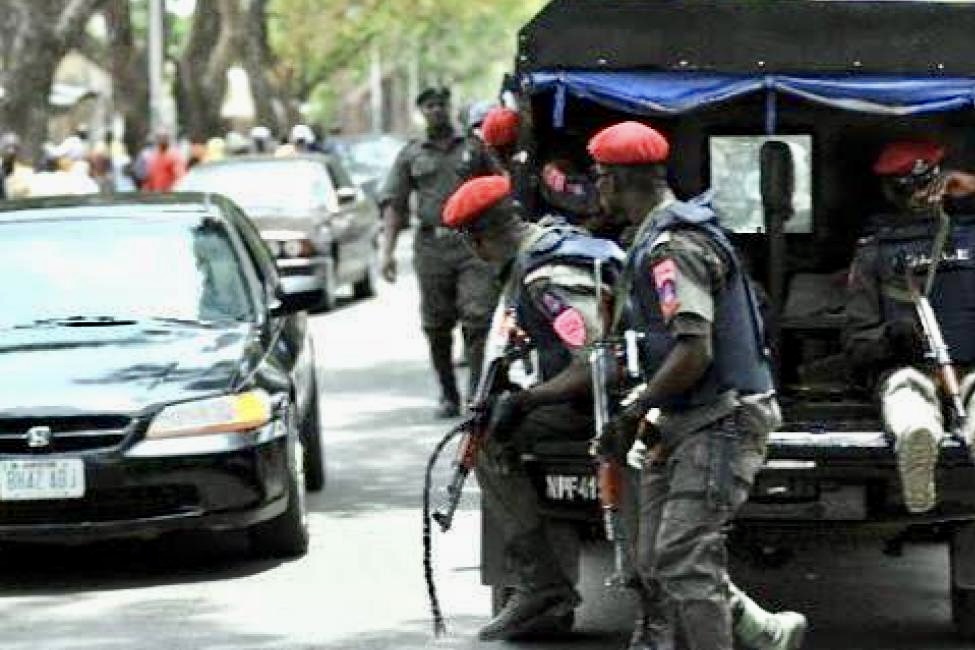
ABUJA, Nigeria — The Nigeria Police Force has directed selected Mobile Police Force (MOPOL) formations to urgently submit comprehensive nominal rolls containing extensive personal, career and deployment information on Special Police Officers (SPOs), including the officers’ tribes.
The directive, contained in a police wireless message dated September 4, 2026, was issued from the office of the Assistant Inspector-General of Police, MOPOL Force Headquarters, Abuja, and addressed to MOPOL formations at Trg Ende-Hills, Ila-Orangun and Gwoza, with the Directorate of Operations and Force Security (FORSEC), Abuja, copied.
The instruction is significant not simply because police authorities routinely maintain nominal rolls, but because the latest return expressly includes tribe alongside service number, rank, date of enlistment, promotion history, date of birth, state of origin, Local Government Area, current duty post and date of deployment.
The demand has immediately raised a central question: why does the Force require officers’ tribal identities for this particular personnel exercise, and how will that information be used?
Atlantic Post could not establish from the wireless message itself what operational, administrative or personnel-management purpose the tribal information is intended to serve. Nor does the document, as reproduced in the material reviewed for this report, explain whether the information will be used to assess Federal Character compliance, deployment balance, promotion patterns, manpower distribution or another internal objective.
That unexplained element is likely to attract scrutiny, particularly because recruitment, promotion and deployment in the Nigeria Police Force already sit within a framework that places emphasis on merit, fairness and Federal Character.
What the police ordered
The message instructed the named MOPOL formations to forward both hard and soft copies of an updated nominal roll covering all SPOs serving under them.
The prescribed headings are unusually detailed. They include:
“S/NO X AP/NO X RANK X NAME X DATE ENLISTED X DATE LAST PROMOTED X DATE OF BIRTH X STATE OF ORIGIN X L.G.A X TRIBE X CURRENT DUTY POST X DATE DEPLOYED TO CURRENT DUTY POST.”
The police communication was marked “IMMEDIATE” and said the instruction had been issued with the approval of the Inspector-General of Police.
It further instructed the affected formations to ensure that their submissions reached the relevant office no later than 10am on Friday, September 4, 2026.
The urgency was repeated in unusually emphatic language:
“TREAT AS VERY IMPORTANT PLEASE X ENDS X AS A MATTER OF UTMOST URGENCY X YOU ARE DIRECTED TO FORWARD MINE X COMPREHENSIVE NOMINAL ROLL OF ALL SPOS SERVING YOURS X IN BOTH HARD AND SOFT COPIES X RETURN YOURS TO REACH THIS OFFICE NLT 1000HRS X FRIDAY 04/09/2026 X”
The message ended with the reminder:
“NER REMINDER X TREAT AS VERY URGENT. PLEASE.”
Taken together, the wording indicates that the exercise was intended as an immediate Force-level personnel return rather than an ordinary periodic administrative update.
Nominal rolls are not unusual in the police
There is nothing inherently extraordinary about a police organisation demanding an updated nominal roll.
The Police Service Commission states that maintaining an up-to-date nominal roll of Nigeria Police Force personnel and conducting personnel audits are among the functions of its recruitment establishment. Its recruitment department is also responsible for checking the validity and correctness of personnel data.
A nominal roll can therefore serve legitimate purposes such as establishing the actual strength of a unit, identifying serving personnel, reconciling postings, monitoring promotions, checking deployment records and eliminating discrepancies between personnel records and officers physically serving in a formation.
The more sensitive issue in this case is not necessarily the existence of the nominal roll, but the specific categories of data being requested and the purpose attached to them.
Why the “tribe” field matters
Under Nigeria’s Data Protection Act 2023, information concerning a person’s race or ethnic origin is classified as sensitive personal data.
That does not automatically mean that a government security agency is prohibited from processing such information.
The law contains provisions allowing competent authorities to process personal data for certain criminal justice and national-security purposes. However, even where exemptions apply, the Act preserves important requirements concerning lawful processing, data minimisation, security and accountability.
Section 24, in particular, requires personal data to be processed fairly, lawfully and transparently; collected for specified and legitimate purposes; limited to what is necessary; retained only for as long as required; and protected against unauthorised access, loss or damage.
For sensitive personal data, the threshold is higher. Section 30 permits processing in specified circumstances, including where processing is necessary under employment or social-security laws or where it is required for reasons of substantial public interest on the basis of law, provided it is proportionate and accompanied by suitable safeguards.
That legal architecture makes the unanswered question surrounding the MOPOL instruction particularly important.
What is the lawful purpose for collecting tribal identity in this exercise?
And, perhaps more importantly:
What decision will be made with the information once it is collected?
Federal Character may provide one explanation — but not yet the answer
There is a legitimate institutional reason why police authorities may have an interest in geographical, state and possibly demographic representation.
Nigeria’s policing system operates within the constitutional principle of Federal Character, and the Police Service Commission has repeatedly stated that the principle should inform recruitment and other personnel processes.
In December 2025, the PSC and Nigeria Police Force explicitly incorporated Federal Character considerations into the recruitment of 50,000 police constables, citing disparities in participation among states and saying the process was intended to ensure equitable representation nationwide.
The PSC’s own policy guidelines on appointment, promotion and discipline state that police appointment and promotion should be based on merit while also enshrining Federal Character principles.
The Commission has also previously stated that Federal Character is considered alongside merit in police recruitment and that recruitment, promotion and discipline should be governed by established rules rather than ethnic or religious considerations.
In 2023, the PSC approved policy guidelines directing that Federal Character should guide recruitment and the deployment of police management and tactical commanders, with the stated objective of ensuring balance, equity and fairness.
Against that background, recording officers’ states of origin and LGAs can have an obvious administrative rationale.
But tribe is a different and more sensitive category.
The document reviewed for this report does not state that the information is being sought for a Federal Character audit, nor does it disclose a formula, policy or criterion under which the tribal information would influence promotion, posting, deployment or command decisions.
That distinction matters.
A database can be used to measure representation. It can also be used, deliberately or otherwise, to make decisions about individuals. The critical issue for accountability is therefore not merely whether the data exists, but how it is processed and whether an officer’s ethnic identity can affect his or her career.
Promotion records add another layer to the directive
The request also seeks each officer’s date of last promotion.
That may be routine personnel administration, particularly where commanders need to reconcile establishment records, seniority and promotion status.
The Police Service Commission’s promotion department specifically handles matters concerning promotion, upgrading, conversion, appeals and complaints involving placement on the seniority staff list or nominal roll.
The combination of promotion history, tribal identity, state of origin, LGA and deployment history, however, potentially permits the Force to construct a much more detailed profile of individual officers than a basic nominal roll would require.
That does not establish wrongdoing. But it makes the stated purpose of the exercise more important.
If the aim is simply personnel verification, why is tribe required?
If the aim is representation analysis, what level of aggregation is intended?
If the exercise is connected to promotions or postings, will ethnic data influence individual decisions?
The wireless message does not answer those questions.
The wider context inside the Police Mobile Force
The timing also matters.
The Police Mobile Force has undergone repeated efforts to restore its original operational role. The NPF said in April 2025 that it was reorganising the PMF to strengthen internal security and improve operational readiness, while addressing the diversion of mobile policemen into non-core escort and guard duties.
The Force’s Department of Operations identifies the Police Mobile Force as part of the Department of Federal Operations alongside tactical capabilities including explosive ordnance disposal, the police air wing, the Counter-Terrorism Unit, marine and other specialist formations.
That means manpower and deployment data are operationally important.
Knowing who is deployed where, for how long, at what rank and with what promotion history can help commanders identify vacancies, overstretched formations, irregular deployments and manpower gaps.
But the addition of tribe remains the unexplained component.
Nigeria’s security environment makes personnel data increasingly valuable
The police are operating under exceptional manpower and security pressure.
Nigeria is simultaneously confronting terrorism, banditry, kidnapping, violent crime and other threats requiring highly mobile tactical deployments. President Bola Tinubu, in June 2026, identified internal security as a central challenge while the Presidency continued consultations on the proposed national policing framework and state police. Inspector-General of Police Olatunji Disu has been participating in those discussions.
Disu became substantive Inspector-General after the Nigeria Police Council ratified his appointment in March 2026, following Kayode Egbetokun’s resignation.
At a time when the Force is seeking stronger manpower management, personnel audits can be legitimate and necessary.
Indeed, on September 4, 2026, the Police Force was also reported to have paid ₦2.317 billion in insurance and welfare benefits to 2,971 beneficiaries and next-of-kin of deceased officers, demonstrating the scale of administrative records required to manage a national police workforce.
The challenge is ensuring that the collection of increasingly granular personnel information is matched by equally strong safeguards.
The questions the Police Force should answer
For transparency, police authorities should be able to explain whether the September 4 directive forms part of a routine personnel audit, a Federal Character review, a deployment assessment, a promotion exercise or another administrative programme.
The Force should also clarify whether the tribal information will be used merely in aggregate or linked to individual career decisions.
There is a further question concerning access.
The order requires submissions in both hard and soft copies. That potentially creates multiple copies of sensitive personnel information, increasing the number of locations and personnel through which the records could pass.
Under the Data Protection Act, organisations processing personal data are required to employ technical and organisational measures to preserve confidentiality, integrity and availability.
Where processing presents a high risk to the rights and freedoms of data subjects, the Act also contemplates a Data Privacy Impact Assessment addressing necessity, proportionality, risks and safeguards.
Whether such an assessment is required in this particular exercise cannot be determined from the wireless message alone.
What this directive does — and does not — prove
There is an important distinction between asking for tribal information and using tribal information to discriminate.
The document establishes that MOPOL formations were directed to provide the field labelled “TRIBE”.
It does not, on its face, establish that officers will be promoted, demoted, transferred, denied opportunities or otherwise treated differently because of their ethnic identity.
Nor does it establish that the exercise is unlawful.
What it does establish is a potentially sensitive data-collection exercise at a time when questions about representation, fairness and professionalism within Nigeria’s security agencies remain highly consequential.
The responsibility therefore falls on police management to remove the uncertainty.
A professional security institution should not leave its personnel wondering whether their ethnicity is merely being counted or whether it may eventually count against or for them.
That is the investigative question raised by the September 4 wireless directive.
Until the Nigeria Police Force explains the purpose of the “TRIBE” column, its intended use, the legal basis for the processing and the safeguards surrounding the information, the unusual field in an otherwise ordinary nominal roll will remain the most consequential unanswered question in the document.
Follow us on our broadcast channels today!
- WhatsApp: https://whatsapp.com/channel/0029VawZ8TbDDmFT1a1Syg46
- Telegram: https://t.me/atlanticpostchannel
- Facebook: https://www.messenger.com/channel/atlanticpostng