The reported death of a motorcyclist and the burning of a Bus Rapid Transit vehicle at Ogolonto raise urgent questions about motorcycle restrictions, crowd violence and the ability of emergency responders to secure a crash scene before it becomes a second disaster.
A road accident can kill in seconds. What happens next can determine whether the tragedy ends at the crash scene or develops into another emergency.
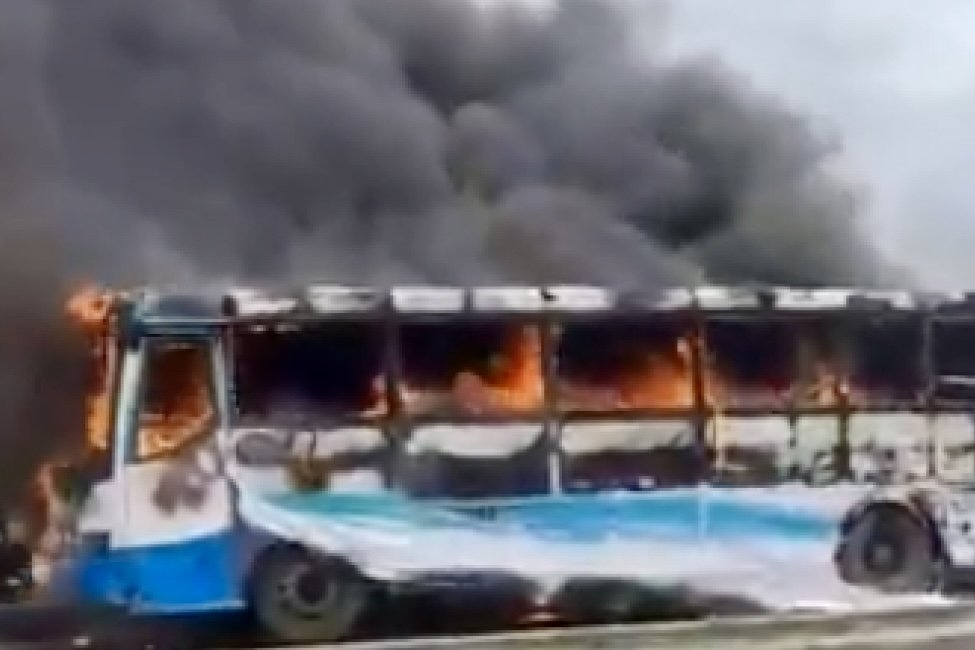
That question is now confronting Lagos following reports that an angry crowd set a Bus Rapid Transit (BRT) bus ablaze at Ogolonto Bus Stop along Ikorodu Road after a motorcyclist was allegedly crushed to death.
The incident, reported on Friday, 16 October 2026, reportedly included an assault on the BRT driver before police officers and operatives of the Lagos Neighbourhood Safety Corps (LNSC) intervened to rescue him.
The driver was reported to have escaped unharmed. The circumstances surrounding the motorcyclist’s death, the cause of the collision and the sequence of events leading to the fire had not been independently established at the time of filing.
The immediate questions are who was responsible for the collision and who set the bus on fire. The wider public-safety investigation must go further: why was a crowd able to turn a reported fatal crash into an episode of assault and arson, and what safeguards were in place to prevent further casualties?
What happened at Ogolonto?
NewsClick Nigeria Media and other social-media accounts reported that the motorcyclist was riding alone when the collision occurred along the BRT corridor.
One widely circulated post described the incident as a case in which a bus had allegedly crushed a motorcyclist to death before the driver was attacked. The reports also indicated that security personnel intervened before the driver suffered further harm.
A video described in reports by SaharaReporters showed a BRT bus engulfed in flames.
Another social-media post alleged that a task force’s intervention prevented further damage to other buses nearby. That claim has not been independently confirmed by an official account.
These reports establish the immediate public concern, but they do not provide a complete reconstruction of the incident. The motorcyclist’s identity, the precise movements of both vehicles and the individuals responsible for the assault and fire remain critical unanswered questions.
A separate online allegation about the deceased’s supposed association with a confraternity was also unverified. It should not be treated as fact or used to explain the collision or subsequent violence.
Atlantic Post’s attempts to obtain comments from Lagos State Police Command spokesperson SP Abimbola Adebisi were unsuccessful as of filing.
The road restriction that demands answers
One important line of inquiry concerns motorcycle access to the Ikorodu Road corridor.
The Lagos State Road Traffic Law lists the Lagos–Ikorodu Expressway among the routes prohibited to motorcycles and tricycles. Its Schedule II also identifies Ikorodu Road, from Mile 12 to Ikorodu Benson Roundabout, as a restricted route under the provisions governing Ikorodu Local Government Area.
That legal framework raises a practical question: how effectively are restrictions enforced along this busy transport corridor?
Reports place the alleged collision in the BRT lane, but the precise crash location and the motorcyclist’s movements have not been independently established. The published route restrictions do not, by themselves, prove that the rider violated the law or establish what caused the collision.
Investigators should establish where each vehicle was travelling, whether the motorcycle entered a prohibited section of road, whether the bus remained within its authorised lane and what the available video footage and physical evidence reveal.
The distinction matters. A traffic violation, if established, would not automatically explain the collision. Nor would it justify an assault on the driver or the destruction of the bus.
For Lagos’s traffic authorities, the broader issue is whether existing restrictions are backed by consistent enforcement, adequate lane separation, effective surveillance and a visible presence at high-risk locations.
If the route is restricted but violations continue, enforcement needs examination. If the motorcyclist was not where reports claim, the evidence must correct the public narrative.
When a crash scene becomes a crime scene
The reported assault on the bus driver presents a separate public-safety concern.
Residents who witness a fatal accident may be angry, frightened or convinced that someone is responsible. Those reactions do not confer the authority to punish a suspected offender.
A crowd assault can prevent emergency treatment, destroy evidence and expose the victim, bystanders and first responders to further danger. Setting a vehicle on fire adds the risk of burns, smoke inhalation and the spread of flames to nearby vehicles or infrastructure.
Lagos police issued an explicit warning against this behaviour last month following a separate fatal mob attack after a road incident on Lagos Island.
In a statement reported by the News Agency of Nigeria, police spokesperson Abimbola Adebisi said: “Without ambiguity, jungle justice is murder. It is not justice. It is a crime.” She stressed that investigating alleged offences and determining guilt or innocence were responsibilities of the police and courts.
The earlier case demonstrates why the Ogolonto incident needs a response extending beyond the immediate rescue.
In September, police announced the arrest of four suspects over the alleged mob killing of Basit Kolade following a road incident on Freeman Street, Lagos Island. The command said the case had been transferred for further investigation and legal action.
The two incidents are not identical. The reported outcome at Ogolonto differs, and the identities and roles of those involved remain unestablished. But both illustrate the danger of allowing a crowd to determine guilt and administer punishment at a road accident.
The reported rescue of the BRT driver is therefore important. The next test is whether investigators can identify those responsible for the assault and burning of the bus and establish what happened without relying on rumour.
The emergency-response questions still unanswered
The intervention by police and LNSC personnel reportedly prevented the assault on the driver from becoming more serious. That is a significant aspect of the emerging account.
It is not, on its own, enough to assess the wider emergency response.
The available reports do not establish how quickly the first responders arrived, whether the motorcyclist received prompt medical assistance, when the fire service was alerted, or whether nearby buses and passengers were moved out of danger.
These are questions for the relevant agencies, not grounds for assuming that a particular service failed.
Investigators should establish a clear timeline covering the collision, the crowd’s arrival, the assault, the ignition of the bus and the intervention by security personnel. Emergency-call records, CCTV footage, mobile-phone videos and witness statements could help reconstruct that sequence.
The fire itself also requires examination. Authorities should establish how it started, whether an accelerant was used, how extensively the vehicle was damaged and whether any other person or property was endangered.
The reported claim that a task force prevented additional buses from being attacked should likewise be checked against an official account.
The distinction between a crowd claiming responsibility and investigators establishing individual responsibility is central to a credible prosecution.
The cost of burning a BRT bus
Lagos has already experienced the consequences of large-scale destruction of its mass-transit assets.
During the violence surrounding the October 2020 #EndSARS protests, the Lagos State Government reported that 80 BRT buses had been burnt in the Oyingbo and Ojodu Berger areas. A report published by Punch at the time put the combined value of the destroyed vehicles at approximately ₦3.9 billion, based on figures supplied by the state’s information commissioner.
That episode occurred in a different context and on a far greater reported scale. It should not be equated with the Ogolonto incident.
It nevertheless illustrates what is at stake when transport vehicles are destroyed. Beyond the immediate financial loss, damage can reduce the available fleet, disrupt commuter services and impose additional costs on operators and, potentially, the public.
The ownership of the bus involved at Ogolonto, its value, the extent of the damage and the eventual financial liability have not been established in the reports reviewed for this article.
Those details matter. The public deserves to know whether the loss falls on a state-owned fleet, a contracted operator or another party, and what measures will be taken to prevent a recurrence.
What investigators must establish
The immediate investigation should resolve several distinct questions.
First, a technical reconstruction must determine how the collision occurred, where the motorcycle was travelling and whether either road user breached a traffic rule.
Second, police should identify the people involved in the alleged assault and arson. Available footage, witness testimony and other forensic evidence should be preserved rather than allowing online speculation to substitute for proof.
Third, the relevant emergency agencies should clarify the response timeline, including the reported intervention that rescued the driver and the measures taken to prevent the fire from spreading.
Finally, traffic authorities should review compliance with motorcycle restrictions and the practical safeguards in place along the corridor. If the rules are being breached repeatedly, enforcement must be examined. If existing safeguards proved inadequate, authorities should identify what needs to change.
These are not competing investigations. They address different risks exposed by the same reported incident.
Ogolonto’s central question is not simply why a crowd became angry after a fatal collision. It is whether Lagos can enforce its road rules, protect people at crash scenes and produce verifiable answers when a road emergency turns violent.
Until those questions are answered, the burning bus will remain more than a traffic story. It will be a test of Lagos’s ability to prevent one reported tragedy from becoming another public-safety failure.
Follow us on our broadcast channels today!
- WhatsApp: https://whatsapp.com/channel/0029VawZ8TbDDmFT1a1Syg46
- Telegram: https://t.me/atlanticpostchannel
- Facebook: https://www.messenger.com/channel/atlanticpostng