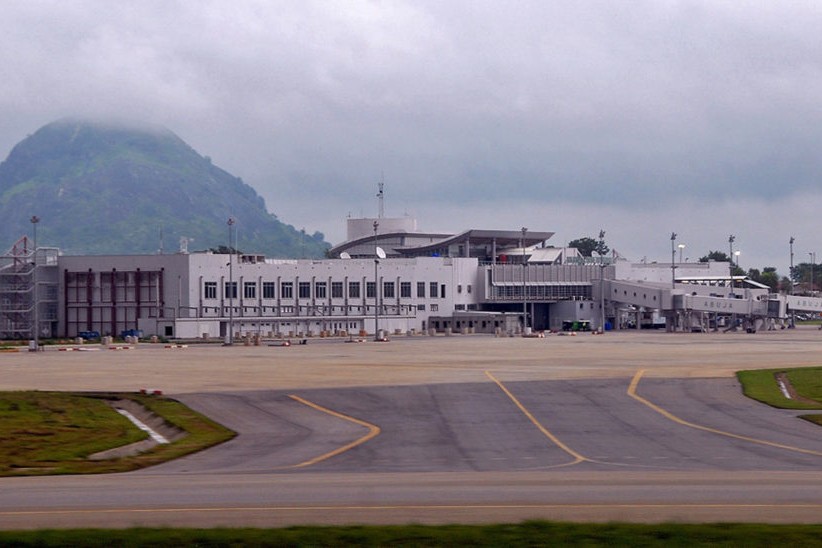
The Triton Aviation aircraft returned safely after a Mayday call at about 3,000 feet. Investigators now face questions over how the door separated, whether maintenance or locking mechanisms were involved, and what the incident reveals about aviation safety oversight.
ABUJA, Nigeria — A jet can return safely to the runway and still leave a serious question hanging over the aviation industry: how did a door come off an aircraft just minutes after take-off?
That question now confronts investigators examining a serious aviation incident involving a CL60 aircraft operated by Triton Aviation, which was flying from Abuja to Lagos on Thursday, 15 October 2026.
The aircraft, registered as T7-SEI and operating under flight identification DWC052, had departed Nnamdi Azikiwe International Airport when its crew reported that a door had opened in flight and declared an emergency.
The aircraft returned to Abuja and landed safely. After landing, an air traffic controller observed that the door was missing from the fuselage. Footage subsequently obtained by Nigerian media showed what farmers reportedly identified as the missing aircraft door on a farm in the Abuja area.
The safe landing was the immediate success. Establishing why the door separated, whether the aircraft remained structurally sound and what safeguards should prevent a recurrence is the more consequential task.
At the time of reporting, the number of people aboard had not been independently confirmed, Triton Aviation had not responded to media requests, and the Nigerian Safety Investigation Bureau (NSIB) had deployed investigators. The Nigeria Civil Aviation Authority (NCAA) confirmed the incident but referred questions about the investigation to the NSIB.
Three minutes from take-off to Mayday
The incident report obtained by The Guardian provides a minute-by-minute account of the emergency response.
The aircraft departed Runway 22 at Abuja at 16:17 UTC. Approximately three minutes later, at 16:20 UTC, it was about three nautical miles from the airport and climbing through 3,000 feet when the crew transmitted an urgent distress call.
“Mayday, Mayday, Mayday.”
The crew reported that a door had opened in flight. Air traffic control directed the aircraft back towards Abuja for an emergency landing, while airport fire and medical teams were alerted and placed on standby.
Emergency personnel were instructed to position themselves at designated locations, identified in the report as A4 and A5, in preparation for the aircraft’s return.
The decision to return was a critical step in managing the immediate risk. Rather than continue towards Lagos, the crew headed back to the departure airport, where emergency services could be prepared to respond if the landing deteriorated.
At 16:29 UTC, while in contact with the Abuja control tower, the crew asked whether controllers could see if the door was open.
The report states:
“The duty air traffic controller attempted to observe the aircraft using binoculars, but could not establish the door’s condition because of the aircraft’s position.”
The controller informed the crew that the condition could not be confirmed visually.
Five minutes later, at approximately 16:34 UTC, the aircraft landed safely on Runway 22. The missing door became visible to the controller once the aircraft was on the ground. It was then taxied to the international apron extension and guided into its parking position.
At about 16:40 UTC, the crew reported seeing the marshaller. The aircraft was subsequently parked.
Time clarification: The incident report records its key events in UTC. Nigeria operates on West Africa Time, which is UTC+1. The recorded departure at 16:17 UTC therefore corresponds to 17:17 local time, while the landing at 16:34 UTC corresponds to 17:34. This distinction matters when reconstructing the sequence of events.
A missing door turns up on a farm
The incident acquired a second dimension when footage emerged of farmers reportedly discovering the missing door while returning from their farmland.
In the video, a man whose identity had not been established told an unidentified recipient:
“This is what we found as we were returning from our farm. It fell from a plane, but we don’t know much about its identity. As I am sending it to you, sir, just check it.”
The footage provides a potential lead for investigators, but it should not be treated as a substitute for an authenticated examination of the recovered component.
Investigators will need to establish where the door was found, document its condition, determine whether it is consistent with the aircraft’s missing component and preserve any physical evidence that could help explain how the separation occurred.
The discovery also raises a public-safety question beyond the aircraft itself: what risks arise when components fall from aircraft over populated or cultivated land?
No injury to anyone on the ground was reported in the accounts reviewed for this report. The precise location of the farm, the circumstances of the recovery and the chain of custody of the door had not been independently established at the time of writing.
Those details matter. A recovered component may help establish the sequence of failure, but investigators must verify its identity and examine it alongside the aircraft, maintenance records and operational evidence.
The central question: How did the door come off?
A door opening during flight and a door separating from an aircraft are not necessarily the same mechanical event.
The distinction is central to this investigation.
The initial air traffic control account records the crew reporting an open door. The controller subsequently observed that the door was missing after the aircraft landed. The reports do not, by themselves, establish precisely when or how the door detached.
Possible explanations that investigators may need to examine include a problem with the door’s locking or latching mechanism, damage or wear affecting its attachment points, an incorrect closure or securing procedure, or a maintenance-related defect.
These are investigative possibilities, not established causes. No evidence currently available in the reports reviewed for this article proves that any one of them was responsible.
A sound investigation must begin with physical evidence rather than assumptions.
Investigators will need to examine the door’s attachment points, locking components, hinges and surrounding fuselage structure. They will also need to establish whether the aircraft’s door-warning systems generated any indication before or during the flight, if such systems were fitted and relevant to this particular aircraft configuration.
Maintenance records could help establish when the door and its associated mechanisms were last inspected, repaired or adjusted. The aircraft’s pre-flight inspection records, defect history and technical log may also be relevant.
Crew interviews and available flight data could help reconstruct the aircraft’s movements, the crew’s observations and the timing of the emergency declaration.
The key question is not merely whether a component failed. It is whether the evidence reveals an isolated mechanical problem, a maintenance deficiency, a procedural failure or a combination of factors.
What the investigation must establish
The NSIB says its mandate is to investigate transport accidents and serious incidents independently, determine their probable causes and make safety recommendations to prevent recurrence. Its stated approach is fact-finding rather than the assignment of blame or liability.
That distinction is important. The purpose of the investigation should be to establish what happened and identify any necessary safety improvements, not to reach a premature verdict against the operator or crew.
Several questions deserve clear answers.
1. What exactly failed?
Was the door improperly secured, did a locking component malfunction, or did a structural attachment fail? The recovered door and the aircraft’s corresponding attachment points should be examined together before any conclusion is drawn.
2. What did the pre-flight inspection establish?
Investigators should examine the aircraft’s technical records and relevant inspection documentation to determine whether any defect had previously been recorded, whether required checks were completed and whether there were warning signs that should have prevented departure.
3. What did the crew know, and when?
The initial report indicates that the crew declared an emergency after reporting an open door. Investigators should reconstruct when the crew first detected the problem, what indications or warnings were available and how the crew assessed the aircraft’s condition.
4. Was the aircraft taken out of service pending investigation?
The available reports describe the aircraft being parked after landing. They do not establish its subsequent technical status, whether a formal inspection was completed or whether it was cleared to fly again.
The operator and relevant authorities should clarify those points. Parking an aircraft after an incident is not, by itself, evidence that it has been permanently grounded or certified as safe.
5. Was anyone on the ground endangered?
Investigators should establish the door’s recovery location, its likely trajectory and whether people, buildings, roads or other property were exposed to danger. The fact that farmers reportedly recovered the component makes this a legitimate part of the inquiry.
These are reasonable investigative questions, not allegations of wrongdoing.
The role of the NCAA and the operator
The NCAA confirmed the incident but indicated that the investigation fell under the NSIB’s remit. The distinction between the two bodies matters.
The NSIB’s role is to investigate the circumstances and causes of the serious incident and issue safety recommendations where necessary. The NCAA has a separate regulatory and safety-oversight role in civil aviation.
The two functions are complementary. An independent investigation can establish the technical facts, while the appropriate regulatory authority can determine whether any regulatory action is warranted under the applicable rules and evidence.
Triton Aviation also has an important part to play in establishing the facts. At the time of reporting, the operator had not been reached for comment in the media accounts reviewed.
The company should be given an opportunity to explain the aircraft’s maintenance history, the steps taken after the emergency landing and any measures introduced while the investigation proceeds.
Those answers would help the public distinguish between the immediate response and the longer-term safety implications.
A safe landing is not the end of the safety inquiry
The most reassuring fact in this incident is that the aircraft returned safely to Abuja. The crew’s Mayday call triggered a response that included the return to the airport and the preparation of emergency personnel.
But a successful outcome does not eliminate the need to understand the hazard that prompted it.
Aviation safety depends on identifying failures and weaknesses before they contribute to a more serious event. That means examining not only the component that failed, but also the maintenance, inspection, operational and reporting systems surrounding it.
The recovered door could prove especially important if investigators can establish its identity, preserve its condition and link any damage to evidence on the aircraft. The findings may help explain whether the incident resulted from a localised defect or exposed a broader safety issue requiring corrective action.
The public should also be able to distinguish between preliminary information, confirmed findings and recommendations that emerge after technical analysis. A viral video can bring an incident to public attention, but it cannot establish its cause.
For now, the known facts are serious enough without embellishment: an aircraft lost a door shortly after departure, its crew declared a Mayday emergency, it landed safely and the missing component was reportedly found on farmland.
What remains unknown is why it happened.
That is the question the investigation must answer, and the standard against which its eventual findings should be judged.
Follow us on our broadcast channels today!
- WhatsApp: https://whatsapp.com/channel/0029VawZ8TbDDmFT1a1Syg46
- Telegram: https://t.me/atlanticpostchannel
- Facebook: https://www.messenger.com/channel/atlanticpostng




Join the debate; let’s know your opinion.