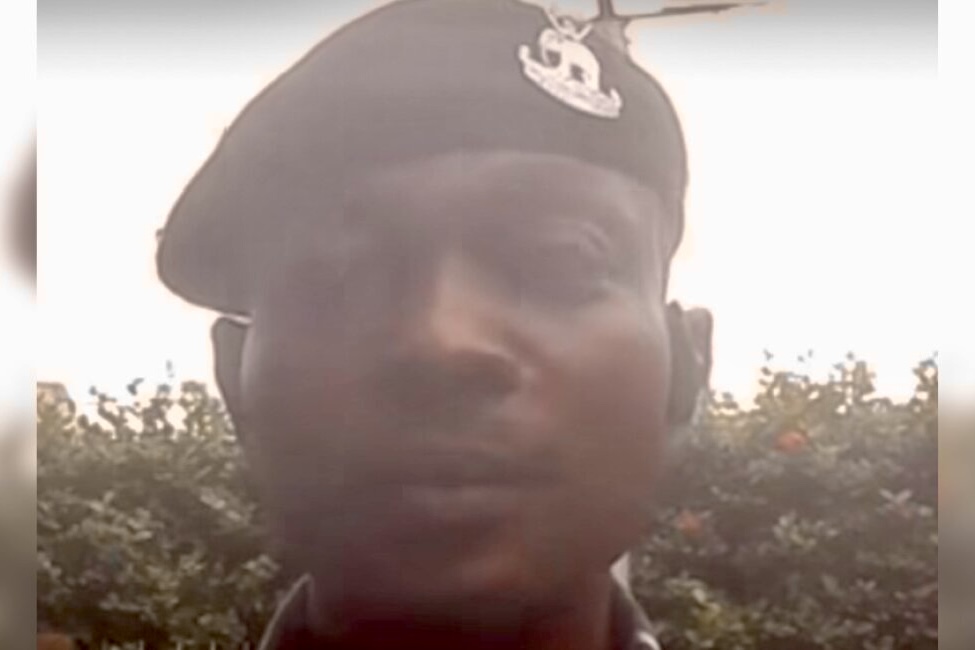
Fifteen days after a cybercrime petition named the Niger Delta activist, unidentified men took him from his Abuja home. The case now tests whether allegations against an activist, and allegations made by him, will receive equal scrutiny.
Daniel Ezekiel’s detention has turned a bitter Niger Delta dispute into a much bigger test: can Nigeria’s security institutions investigate accusations against a powerful oil-sector network while also giving a fair process to the activist making them?
For the moment, Daniel Ezekiel’s case has fewer answers than questions.
The Niger Delta human rights activist was reportedly taken from his home in Life Camp, Abuja, on Friday, September 18, by men whose identities he said he could not independently verify. He was subsequently held at Agwa Cement Police Station before being transferred to the Force Criminal Investigation Department in Abuja, according to recent reporting.
Three days later, the most important public question was still remarkably basic:
Who authorised the arrest, on what legal basis, and what exactly is Ezekiel being accused of?
The questions matter because the reported arrest sits at the intersection of two competing claims.
On one side is a complaint alleging that Ezekiel published defamatory material about businessman Chief Ekomieyefa Uduboh, popularly known as KFT.
On the other is a much broader set of allegations Ezekiel has made for months against High Chief Government Ekpemupolo, popularly known as Tompolo, Tantita Security Services Nigeria Limited and people linked to their operations in the Niger Delta.
Neither side’s central allegations have been established as criminal findings by a court.
Yet one side now has a man in police custody.
That asymmetry is what has turned the case into more than another social-media dispute.
The 15-Day Timeline
The chronology is straightforward.
On September 3, lawyers from Ebilade Obiri & Associates reportedly petitioned the Inspector-General of Police and the Nigeria Police Force National Cybercrime Centre on behalf of Uduboh.
The petition reportedly named Ezekiel and another individual, Yemi Otuedon, also known as Otuedon Warri. The lawyers alleged that Facebook posts published around August 24 portrayed their client in highly damaging terms and described the material as false and malicious. They reportedly attached screenshots and asked the police to investigate.
Fifteen days later, Ezekiel was reported arrested in Abuja.
The sequence does not, by itself, prove that the petition caused the arrest. It does, though, make the petition a central document in establishing what happened next.
What remains unclear is whether the police had obtained judicial authority, whether officers properly identified themselves, what offence was being investigated at the point of arrest and whether Ezekiel was formally informed of the grounds for his detention.
Recent reporting by the Nigerian Observatory for Human Rights said Ezekiel told its reporter that one of the men introduced himself as Jerry but that he could not independently establish that they were police officers.
“I don’t know if they are police officers or not. I don’t trust them,” he reportedly said.
That account has not been matched by a publicly available Nigeria Police statement explaining the operation.
A Warrant Is Not the Entire Legal Question
The civil society coalition has described the circumstances as deeply troubling and demanded Ezekiel’s immediate and unconditional release.
But there is an important legal distinction.
A warrantless arrest is not automatically unlawful in Nigeria. The Administration of Criminal Justice Act 2015 provides circumstances in which police may arrest without a warrant. The law also requires safeguards around the treatment of an arrested person.
Section 6 of the Act requires a suspect to be informed of the reason for the arrest and of rights including the right to remain silent and consult a lawyer. Section 8 requires humane treatment and prohibits torture, cruel, inhuman or degrading treatment.
The Constitution goes further.
Section 35 protects personal liberty and requires an arrested or detained person to be informed in writing, within 24 hours, of the facts and grounds for the arrest. It also provides for access to counsel and requires an arrested person to be brought before a court within a reasonable time, subject to the constitutional provisions governing detention.
That means the central issue is not simply whether the arresting officers carried a warrant.
It is whether the entire process complied with the law.
As the coalition put it:
“A warrantless arrest by unidentified men, followed by an unexplained transfer between police locations, raises serious questions of legality.”
That is a question the Nigeria Police Force can answer with documents, names, dates, the legal authority relied upon and the status of the investigation.
What Is the Actual Case Against Ezekiel?
The public record currently points to allegations surrounding social-media publications about Uduboh.
Recent reports say the complaint accused Ezekiel and Otuedon of publishing Facebook material that allegedly called Uduboh a “thief”, “killer”, “kidnapper”, “abductor” and “human rights violator”.
Those are allegations by the complainant’s lawyers, not findings of a court.
There is another important legal complication.
Nigeria’s Cybercrimes (Prohibition, Prevention, etc.) (Amendment) Act 2024 changed Section 24 of the earlier cybercrime law. The amended provision replaced the much broader wording in the 2015 law with narrower language concerning pornographic messages and messages known to be false for the purpose of causing a breakdown of law and order, or posing a threat to life.
That makes the exact wording of any charge against Ezekiel critical.
A complaint containing allegations of defamation is not, by itself, enough to establish that the statutory ingredients of a cybercrime offence have been met.
As of the latest publicly available reporting reviewed for this article, no charge sheet has been publicly produced establishing precisely which offence, which statutory subsection or what evidence the police intend to rely upon.
That gap should not be filled by speculation.
The ECOWAS Court Issue Is More Complicated Than It First Appears
The coalition also cited the ECOWAS Court’s history with Nigeria’s cybercrime law.
That reference has a real legal foundation, but the history is important.
In 2020, the ECOWAS Community Court of Justice found that the 2015 version of Section 24 violated freedom of expression protections because of its broad criminalisation of messages described as offensive, insulting or annoying. The National Human Rights Commission still cites that ruling in its guidance on freedom of expression.
But Nigeria subsequently amended the law.
And in a more recent decision concerning the 2024 amended Section 24, the ECOWAS Court dismissed SERAP’s challenge, holding that the applicant had not established a human-rights violation from the enactment or application of the amended provision.
So it would be misleading to suggest that the present Section 24 has already been judicially declared invalid.
The legal picture is now more nuanced: the old wording was condemned by the ECOWAS Court, while a later challenge to the amended law failed on the evidence presented in that case.
That distinction could become important in any court proceedings involving Ezekiel.
The Other Half of the Story Has Not Gone Away
The arrest would be easier to understand as an ordinary cybercrime dispute if Ezekiel had not spent months making much wider allegations about security operations in the Niger Delta.
He has alleged unlawful detention, torture, forced labour, intimidation, abductions and the existence of illegal detention facilities linked to Tompolo, Tantita and people associated with them.
Those allegations remain unproven.
They have also been disputed.
A July investigation by Punch recorded Ezekiel’s claims and separately reported denials from Tantita representatives, community leaders, the Delta State Police Command and the Nigeria Security and Civil Defence Corps. During a visit to Oporoza, Punch said its correspondent saw the Oporoza Police Station but did not observe another detention facility.
Tompolo’s spokesman, Dr Paul Bebenimibo, dismissed the allegations, saying:
“Tantita would not want to glamorise their antics.”
Gbaramatu Kingdom spokesman High Chief Godspower Gbenekana also rejected the allegations while calling for an independent investigation.
The Delta State Police Command said it had no record of the alleged private detention facilities.
NSCDC officials likewise said they had no reports confirming the allegations.
That is precisely why an independent investigation matters.
A denial is not an investigation.
An allegation is not proof.
The distance between those two positions is where credible institutions are supposed to operate.
The Coalition Wants the Two Tracks Kept Separate
The coalition of 57 civil society organisations, human rights groups and community advocates wants the police to deal with Ezekiel’s alleged online offences through due process while separately investigating the allegations he has raised.
Juwon Sanwolu, Coordinator of the Take It Back Movement, speaking for the coalition, said:
“When a whistleblower is detained before the allegations he raised are examined, the public is left to ask whose interests the system is protecting.”
That is the political and institutional heart of this story, without requiring a conclusion about guilt or innocence.
The answer cannot be decided by social-media outrage.
It has to emerge from evidence.
The coalition has called on the police to release Ezekiel immediately and unconditionally, or publicly disclose the legal basis for holding him, identify the officers involved and identify the police unit handling the petition.
It also wants immediate access to lawyers and family members, medical care where required and guarantees for his physical safety.
Most significantly, it wants the Federal Government, the Attorney-General of the Federation and the National Human Rights Commission to facilitate an independent investigation into the torture, unlawful detention and forced-labour allegations raised by Ezekiel.
That demand is not legally exotic.
The National Human Rights Commission has an established mandate to investigate alleged human-rights violations and bring its findings to government.
Nigeria Already Has a Law Against Torture
This point deserves particular attention.
Nigeria is not without a legal framework for investigating torture.
The Anti-Torture Act 2017 places a duty on government to protect suspects, detainees and prisoners from physical harm, violence, intimidation and other conduct that impairs their free will. It criminalises torture and provides penalties for violations.
The law also provides for oversight arrangements within law-enforcement and investigative agencies.
So, in principle, the country has the tools.
The harder question is whether those tools will be used when allegations involve politically exposed, economically powerful or security-connected actors.
Tantita is not an ordinary private company operating in isolation from the state.
In 2026, courts, lawmakers and federal institutions have continued to examine or support the company’s role in pipeline surveillance. An FCT High Court dismissed a suit seeking to halt the renewal of the pipeline surveillance arrangement, while National Assembly committees backed the continuation of the contract.
That public-security and economic role makes allegations against the company more, not less, important to investigate properly.
It also means the company and its principals have a strong interest in having unsupported claims disproved through transparent procedures rather than left to circulate indefinitely.
What an Independent Investigation Would Need to Establish
The dispute has now reached a point where statements will not settle it.
A credible investigation would need to establish at least five things.
First, who ordered Ezekiel’s arrest and which police unit executed it.
Second, the precise offence under investigation and the exact statutory provision being relied upon.
Third, whether Ezekiel was informed of the reason for his arrest and given access to counsel in accordance with Nigerian law.
Fourth, what evidence exists behind the allegations Ezekiel made about detention, torture and forced labour.
Fifth, whether any person or organisation attempted to influence, obstruct or improperly direct either investigation.
That last question may prove the most difficult.
The public should not have to choose between believing an activist automatically and believing the state automatically.
Both positions can produce bad investigations.
The proper standard is evidence.
The National Human Rights Commission Has Already Given Police a Warning
In an April 2025 advisory on freedom of expression, the National Human Rights Commission specifically warned law-enforcement agencies to exercise caution when using Section 24 of the amended Cybercrimes Act.
It said arrests and prosecutions should be based on clear and specific evidence of an actual threat to public order, rather than vague or generalised interpretations of the law. It also stressed that journalists, activists and human-rights defenders should be protected from violence, intimidation and retaliation for exercising their rights.
That guidance does not decide Ezekiel’s case.
It does establish the standard against which the handling of such a case can reasonably be examined.
And it raises an obvious question:
What evidence of a statutory cybercrime existed before the handcuffs went on?
The Bigger Test Is Institutional, Not Personal
There is a temptation in a case like this to reduce everything to personalities.
Daniel Ezekiel says he is exposing abuses.
His accusers say he has crossed the line into false and defamatory online attacks.
Tompolo’s camp rejects Ezekiel’s allegations.
The police have reportedly taken custody of him.
But the institutional question is larger than any of the personalities involved.
Can Nigeria investigate claims made against an influential security contractor without assuming they are true?
Can it prosecute alleged online offences without allowing a criminal process to become punishment before trial?
Can the police establish exactly who arrested a citizen and why?
Can a human-rights complaint be investigated without allowing the complainant’s own conduct to determine whether the underlying allegations are ever examined?
Those questions do not require anyone to decide in advance who is telling the truth.
They require the institutions to find out.
Until the police publish the legal basis for Ezekiel’s detention, disclose the status of the investigation and allow appropriate access to counsel, uncertainty will continue to fill the space where verified facts should be.
And until the allegations against Tompolo, Tantita and their associates are tested through an independent process, those allegations will remain exactly what they are now: serious claims awaiting proof.
The most consequential question in the case may therefore be the simplest one:
Will Nigerian institutions investigate both sides with the same urgency?
Follow us on our broadcast channels today!
- WhatsApp: https://whatsapp.com/channel/0029VawZ8TbDDmFT1a1Syg46
- Telegram: https://t.me/atlanticpostchannel
- Facebook: https://www.messenger.com/channel/atlanticpostng