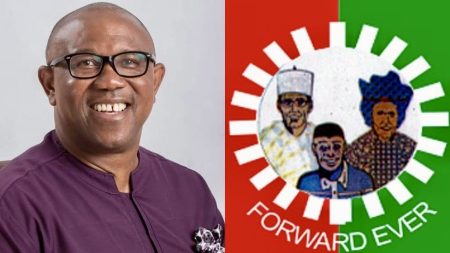
In a development set to send seismic tremors through Nigeria’s political terrain, the Julius Abure-led National Working Committee (NWC) of the Labour Party (LP) has publicly “welcomed” Peter Obi’s declaration to pursue the 2027 presidency under its banner.
This volte-face comes despite a protracted and bitter leadership tussle that has left the party factionalised, its national chairman’s legitimacy questioned by both the judiciary and rival camps, and its rank and file in disarray.
As Obi, the LP’s 2023 standard-bearer, re-enters the fray, questions abound: is this a genuine olive branch or a cynical manoeuvre by Abure’s camp to consolidate power?
A Factionalised LP: Courts, Coalitions and Chaos
The LP’s internecine war reached a crescendo on 4 April 2025, when a five-member panel of the Supreme Court ruled that it lacked jurisdiction to adjudicate internal party disputes, effectively declaring that only the party’s organs can determine its leadership.
While this was hailed by one faction as a victory for intra-party democracy, it simultaneously deepened the confusion by giving licence to competing committees to claim legitimacy.
On one side stands Julius Abure’s NWC—affirmed by INEC as the body entitled to field candidates for the upcoming Anambra governorship contest—while on the other is the Nenadi Usman-led caretaker committee, backed by the Obi-aligned Abia State Governor, Alex Otti.
Abure’s ‘Enthusiastic’ Endorsement
When pressed by The PUNCH on Sunday, the LP’s National Publicity Secretary, Obiora Ifoh, effused that the Abure camp was “excited” by Obi’s intention to remain within the party fold and challenge for the presidency again in 2027.
Ifoh told The PUNCH:
“We are excited about the news. If we have waited all these while for two years with all the things that happened, we can still wait for tomorrow and the next, for the whole thing to crystallise. Then we can now begin to talk about the way forward.”
Yet the enthusiasm may mask deeper anxieties. Having weathered the shock of Obi’s narrow defeat in 2023—where the “system”, not the candidate, was blamed by his supporters for electoral shortcomings—the Abure faction is acutely aware that Obi’s star power remains the LP’s greatest asset.
The question is whether this alliance is founded on mutual respect or on Abure’s urgent need for Obi’s populist sheen to mask the faction’s mounting legitimacy crisis.
The Cold War Between Two Titans
Despite the public embrace, the relationship between Obi and Abure remains frosty. Ifoh admitted that communications were “not completely blocked” yet “not formal,” with “rapprochement here and there” ahead of the Anambra governorship race slated for November 2025.
Obi, himself a former governor of Anambra, is expected to play kingmaker in his home state—a fait accompli that could provide Abure’s faction with an electoral lifeline.
However, insiders note that any reconciliation is tentative at best. The Abure camp must tread carefully: overplaying Obi’s endorsement risks alienating grassroots members who feel betrayed by the factional intransigence, while underplaying it could see Obi’s supporters defect or obstruct party machinery at critical junctures.
Obi’s Defiant Stand and Systemic Charges
In a viral video address circulated on social media, Obi unequivocally affirmed:
“I will still continue to run in the Labour Party. I’m a member of the Labour Party.”
He went on to indict the Nigerian system for engineering crises across parties, lamenting that both the LP and the PDP have been “deliberately” destabilised by vested interests within government.
Obi’s indictment of President Bola Tinubu’s administration—and by extension, the broader political establishment—resonates powerfully with a youth electorate disillusioned by corruption and economic malaise.
Yet, can he translate that moral high ground into coherent party unity amidst the internecine warfare that has defined the LP since 2023?
Ripple Effects: The Opposition Coalition on Edge
Obi’s recommitment to the LP has sent shockwaves through the opposition coalition championed by former Vice-President Atiku Abubakar and ex-Kaduna Governor Nasir El-Rufai.
The coalition, once heralded as the vanguard of a united front against the APC, now finds itself hamstrung by internecine ructions in both the PDP and the LP. When The PUNCH sought reaction, former SGF Babachir Lawal admitted surprise:
“I don’t know what is in his mind. You need to ask Obi himself when you see him.”
This ambivalence threatens to unravel the coalition’s coherence. With both principal partners engulfed in leadership crises, the 2027 contest risks being fought not on policy platforms but on the battlefields of legal briefs and party registries.
Stakes for the Youth and the ‘Old Order’
Obi implored Nigerian youths not to be disheartened, warning that “positive change will always be resisted by those who benefit from the old order.”
He also floated the idea of instituting a retirement age for politicians—a proposal that, if enacted, would target the gerontocracy that has dominated Nigerian politics for decades.
At 65 by 2027, Obi concedes he would be on the cusp of this new threshold, yet insists his experience remains an asset rather than a liability.
This generational appeal has revitalised LP’s youth brigades, yet poses a strategic dilemma. The factional leaders hectoring for control—Abure, Usman, Apapa—are all seasoned operatives. How keen are they to accelerate a transition that might hasten their own exit from the corridors of power?
Anambra 2025: A Prelude to 2027
Long before the national spotlight switches to Abuja in 2027, Anambra’s governorship election in November 2025 looms as a critical litmus test. With Obi’s cultural and electoral capital in his home state, the LP stands a potent chance of wresting power from the PDP-aligned incumbent.
Ifoh emphasised that winning Anambra would lay the groundwork for broader unity:
“At the right time, the parties will meet and thrash all the differences. From there, we’ll move on.”
Yet history warns that intra-party truces forged under duress rarely endure. Whether the Anambra campaign will be conducted under the Abure banner, the Usman caretaker, or a negotiated coalition remains uncertain—and could presage further fragmentations.
A ‘Win-Win’ or a Faustian Bargain?
Ifoh claimed that Obi’s participation on the LP platform would be “a win-win situation for everyone.” In truth, it may be a classic ‘Faustian bargain’: Obi trading his mass appeal for influence within a party whose structures are creaking under the weight of conflicting claims to legitimacy.
For Abure’s faction, the gamble is clear: Obi’s imprimatur could silence critics, shore up morale and present a united front to INEC and the electorate.
But if the rapprochement proves superficial, the LP risks accelerating its descent into irrelevance, ceding ground to both the APC and a beleaguered PDP.
The Road to 2027
As Nigeria hurtles towards the 2027 general election, the Labour Party stands at a crossroads. Will Peter Obi’s re-entry under the LP banner catalyse unity and revitalise an opposition spark, or will it be the pyrrhic victory of a faction struggling to maintain control?
The coming months—beginning with Anambra’s governorship contest—will determine whether this “enthusiastic welcome” endures as a genuine alliance or disintegrates amid renewed power struggles.
One thing is certain: Nigeria’s electorate, weary of empty promises, will be watching closely to see if the Labour Party can translate sensational declarations into substantive change.
Additional reporting from Osaigbovo Okungbowa and Peter Jene