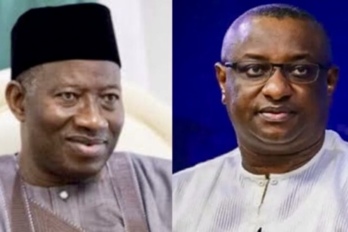
The Peoples Democratic Party’s latest attack on Festus Keyamo is far more than a bruising exchange of political insults. It is a window into the high-stakes scramble now gripping Nigeria’s opposition and ruling parties alike as the 2027 race begins to take shape in the shadows of factional warfare, legal uncertainty and a renewed Jonathan nostalgia.
The immediate trigger is simple enough. Keyamo asked former President Goodluck Jonathan to reject a reported PDP nomination. The larger story is more explosive. It is about who controls the PDP, who gets to speak for it, and why Jonathan’s name still rattles the political establishment.
Jonathan, who served as Nigeria’s president from 2010 to 2015, has now been pulled back into the centre of the 2027 debate by a faction of the party led by Tanimu Turaki.
At the heart of the confrontation is a factional declaration that has already deepened the impression that the PDP remains a party at war with itself. On 30 May 2026, the Turaki-led faction announced Jonathan as its presidential candidate in absentia after moving its convention from a sealed venue to its secretariat in Abuja.
The same group later insisted that its actions were lawful and backed by court judgments. Keyamo responded by describing the episode as a “bizarre comedy” and urged Jonathan to publicly distance himself from the process, saying he should protect his reputation and global image.
That is the political fault line the PDP has now seized upon. In its statement, the party accused the Minister of trying to meddle in its internal affairs and argued that he lacked the moral standing to lecture a former president.
It said Nigerians remembered the Keyamo who once challenged authorities and defended democratic principles, but now appeared comfortable, in the party’s words, with the “asphyxiation” of political space under APC rule.
The PDP also redirected the blame onto the ruling party, insisting that Keyamo should be focused on aviation and governance rather than Jonathan’s ambition.
The sharper political message in the PDP’s statement is that Jonathan’s name is being used as a symbol of resistance to the Tinubu administration, not merely as a candidate.
The faction said Nigerians had not forgotten what it called the political stability, investor confidence and national inclusiveness of the Jonathan years, and argued that the public now wanted a leader capable of reducing the country’s political temperature.
That argument is central to the party’s framing of 2027. It is trying to present Jonathan as a stabilising national figure while casting the APC as anxious, defensive and increasingly unable to control the narrative.
Yet, the story becomes even more revealing when placed beside the PDP’s own internal disorder. Recent reporting shows that the party has been divided by competing leadership claims, with the Turaki bloc and a Wike-aligned bloc contesting legitimacy through the courts, party organs and INEC recognition fights.
The Supreme Court and Court of Appeal disputes over the party’s convention and leadership have deepened the perception that no single structure fully commands the PDP machine.
In that context, the Jonathan nomination looks less like a settled presidential project and more like a tactical move in a party still struggling to define who it is and who speaks for it.
That is important because the Turaki faction’s claim is not operating in a vacuum. It comes at a time when INEC has been reported to have withheld recognition from one PDP structure on the basis of existing court orders, while rival camps continue to present themselves as the true custodians of the party.
The result is a classic Nigerian political paradox. A faction that is not universally recognised is trying to project a national presidential ticket, while insisting that its action is constitutionally valid and democratically rooted.
That contradiction is precisely why Keyamo’s attack landed so hard and why the PDP rushed to answer it with force.
Keyamo, for his part, is not merely speaking as a minister. He is speaking as one of the APC’s most visible legal and political attack dogs, and as a senior government voice who clearly understands the symbolism of Jonathan’s possible return.
The fact that the PDP chose to answer him by invoking his activist past shows that the party understands the optics. It wants to remind voters that Keyamo once built his brand on challenging power, even as it now accuses him of defending it.
The minister’s own recent claim that Nigeria scored 91.4 per cent in the latest ICAO aviation safety audit also gives him an administrative record to defend, even if the PDP wants the debate moved away from performance and towards democratic legitimacy.
The most delicate question remains Jonathan himself. So far, reporting indicates that he has not publicly commented on the Turaki faction’s declaration.
That silence is politically important. It allows supporters to project onto him the image of a reluctant national saviour, while allowing critics to accuse the faction of using his name as a shield against the party’s deeper legitimacy crisis.
That is why this row is not simply about one minister’s opinion. It is about whether Jonathan wants to be recast as the answer to Nigeria’s 2027 anxieties, and whether the PDP, in its fractured state, can credibly sell that story to a restless electorate.
For now, the PDP’s statement has achieved one thing. It has turned Jonathan’s reported 2027 candidacy into a proxy battle over legitimacy, memory and power. The party is betting that nostalgia for the Jonathan years will carry political value.
The APC is betting that the former president’s return, even as a rumour or factional declaration, can be framed as a symbol of PDP confusion and old anxieties. And Keyamo is betting that sharp language will keep the ruling party on the front foot.
What this episode really shows is that 2027 is already being fought with legal claims, factional theatre and psychological warfare long before Nigerians reach the ballot box.
Follow us on our broadcast channels today!
- WhatsApp: https://whatsapp.com/channel/0029VawZ8TbDDmFT1a1Syg46
- Telegram: https://t.me/atlanticpostchannel
- Facebook: https://www.messenger.com/channel/atlanticpostng