Peter Obi and Rabiu Musa Kwankwaso have now moved from speculation to action, formally joining the Nigeria Democratic Congress in Abuja on Sunday, May 3, 2026, in a dramatic development that has upended the opposition’s already fragile realignment ahead of the 2027 general election.
Multiple Nigerian outlets reported that the two heavyweights arrived at the NDC secretariat, were received by party leaders, and were presented with membership cards, signalling a clean break from the African Democratic Congress after days of denial, mixed signals and legal turmoil.
What makes the move especially explosive is the speed with which it has overtaken Kwankwaso’s own public position only hours earlier.
In a statement widely reported on Saturday, he insisted that “no final decision has been taken” on his political future and warned that speculation about his next move was “premature and unfounded”.
He also said the ADC had been pulled into a precarious legal struggle and that he and his associates were still in consultations.
By Sunday evening, however, the same politician was being reported as formally received into the NDC alongside Obi, with a membership card in hand.
The latest reports place the two men at the centre of a new opposition bloc being built around the NDC and led by former Bayelsa governor Seriake Dickson.
Obi and Kwankwaso met NDC leaders at the party’s national secretariat in Abuja and the two moved to the NDC from the African Democratic Congress. The meeting was held behind closed doors and came amid a rising wave of opposition coalition activity.
The political symbolism is sharp. For weeks, Kwankwaso had been publicly distancing himself from any final commitment, while Obi had been battling the fallout from the ADC’s internal turbulence.
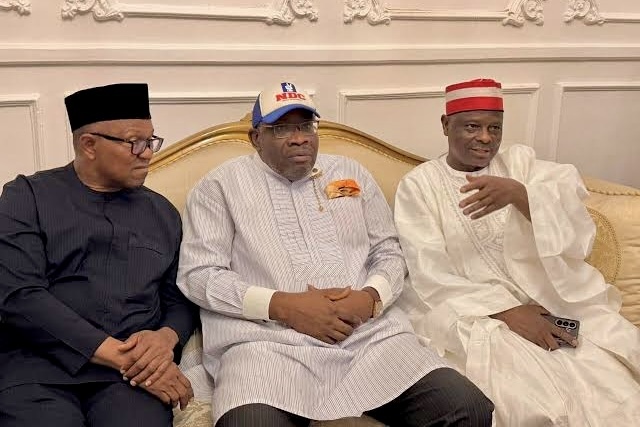
Yet by Sunday, both men were no longer merely associated with the idea of a coalition. They had physically appeared at the NDC secretariat, were photographed with party figures, and were said to have received membership cards from the party leadership.
They were received by Seriake Dickson, top executives and supporters at the NDC’s Abuja secretariat. The two were formally joined to the party on Sunday.
Obi’s own words show how carefully the move is being framed. He said his departure from the ADC was not because Senator David Mark or Atiku Abubakar treated him badly.
He added that he would continue to respect them, but argued that the same pattern of crisis and hostility that had consumed earlier political platforms was now appearing inside the ADC.
Obi complained of “endless court cases, internal battles, suspicion, and division”, language that points directly to the legal and structural uncertainty that has made the opposition platform unstable.
Kwankwaso, for his part, appears to have shifted from caution to open alignment. He urged party members to avoid litigation and said, “Please let there be no litigation. Party members, please don’t go to court. We want to build a party, we are not lawyers.”
He and Obi were received into the opposition party on Sunday at its national secretariat in Abuja. It also quoted Kwankwaso as saying their engagement with NDC stakeholders was based on shared vision and ideological alignment.
That is a striking departure from his earlier position. On Saturday, Kwankwaso had debunked rumours of a presidential declaration and insisted that nothing had been decided about his political future.
The statement also noted that speculation had grown after the opposition summit in Ibadan and that he had been linked with Obi as a possible joint-ticket partner.
What seemed on Saturday like a rebuke to the rumour mill now reads, in hindsight, like the last stage before a formal landing point.
The deeper significance lies in what this means for Nigeria’s opposition architecture. The same politicians who were previously tied to the ADC are now being repositioned inside the NDC, and that suggests a deliberate attempt to escape the legal and factional collapse that has dogged the ADC.
Kwankwaso said he and his allies had realised that their “ideologies and beliefs are the same” and urged Nigerians to register with the NDC ahead of the party membership deadline.
That is not the language of a temporary stopover. It is the language of a platform being sold as the new vehicle for a serious 2027 challenge.
The move also raises immediate questions about strategy, ticket zoning and which political camp will gain the upper hand in the coming battle for the opposition soul.
Reports so far indicate that the NDC leadership has welcomed the pair, but there is still no formal public clarity on how the party intends to manage presidential ambition, regional balance or the inevitable internal bargaining that follows the arrival of national figures.
What is clear is that the opposition has entered another phase, and this one is being driven less by denial and more by hard political survival.
For now, the headline is simple and unforgiving. Kwankwaso, who only hours ago said no final decision had been taken, is now reported to have joined the NDC with Peter Obi. In Nigeria’s fast-moving opposition politics, that is not just a correction. It is a political earthquake.
Follow us on our broadcast channels today!
- WhatsApp: https://whatsapp.com/channel/0029VawZ8TbDDmFT1a1Syg46
- Telegram: https://t.me/atlanticpostchannel
- Facebook: https://www.messenger.com/channel/atlanticpostng