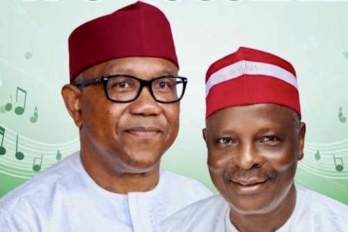
The latest reports suggest that Nigeria’s opposition chessboard has been redrawn again, this time around the Nigeria Democratic Congress, which has emerged as the new staging ground for Peter Obi and Rabiu Kwankwaso after their exit from the earlier ADC-led coalition.
Reuters reported that both men left the coalition after citing legal wrangles, internal battles and suspicion, before moving into a separate opposition grouping now identified as the NDC.
TheCable and Punch also reported that they formally joined the party in Abuja, while BusinessDay said the NDC was registered by INEC following a court order.
If the current reports hold, the most important political development is not simply that Obi has been projected as the likely presidential front man. It is that the NDC has already zoned its 2027 presidential ticket to the South for a single four-year term, with the North pencilled in for 2031.
TheCable, Premium Times and Channels all reported that the party adopted the zoning arrangement at its national convention in Abuja, with the party’s own official handle declaring: “NDC presidential ticket is zoned to the South!!”
That move is politically shrewd because it removes one of the biggest internal contradictions that has repeatedly broken Nigerian opposition projects, namely the struggle over who gets the presidency and who gets the running mate slot.
Premium Times noted that the zoning arrangement strengthens Obi’s chances of becoming the party’s presidential candidate, with Kwankwaso potentially fitting into the vice-presidential slot.
This is an inference, but it is a strong one because the party has publicly fixed the presidential ticket in the South, while Kwankwaso has spent the past few days openly talking like a man already positioning himself for a vice-presidential bridge to Kano and, by extension, the North.
Kwankwaso has been unusually explicit. In reports based on his Premier Radio interview, he said he was confident of securing the vice-presidential slot and framed it as a route for Kano to one day produce Nigeria’s president.
The Sun quoted him as saying, “By God’s grace, the next election will be unlike anything that has ever happened in our state and country, especially if I secure the ticket and my name is on the ballot.”
Premium Times also reported that he described the slot as a “one-way ticket” to the presidency in the near future. That is classic political messaging: keep the northern base hopeful, while telling the South that the ticket remains balanced.
On paper, the alliance has real strengths. Obi still carries strong youth appeal, urban recognition and a protest vote that made him the third-place finisher in 2023.
Reuters said he and Kwankwaso came third and fourth respectively in that election, and that opposition candidates together took about 60 per cent of the vote while Tinubu won with about 35 per cent.
That is the central arithmetic behind every 2027 opposition calculation: a united bloc can be dangerous, but a divided one hands the incumbent an easier road.
Kwankwaso brings a different asset. His political machine in Kano and parts of the North West still gives him regional weight, organisational depth and an established loyal base.
His own argument is that the vice-presidential slot would open the door for Kano to produce a president later, which is why he has sold the ticket not as a demotion, but as a strategic stepping stone.
In a country where region, rotation and symbolism matter as much as policy, that message has electoral logic.
Yet the weaknesses are just as obvious. Reuters reported that Obi left the earlier coalition over “endless court cases, internal battles, suspicion, and division”, and the same report quoted an analyst warning that the opposition’s unity project was “on life support”. That is the core vulnerability here.
The NDC may have a cleaner zoning formula than the parties it replaced, but it is still carrying men with big egos, competing networks and ambitious followings.
Nigeria has seen this film before: opposition unity looks disciplined until the first serious argument over control, candidate selection and future succession.
The other major obstacle is incumbency. Reuters noted that Tinubu benefits from the advantages of office and an entrenched party machine, while AP said the opposition coalition was originally built to prevent Nigeria from drifting into one-party dominance.
That means the NDC’s real test is not announcement day, but whether it can hold together long enough to persuade undecided voters that it is a government-in-waiting rather than another temporary marriage of convenience.
So what are Obi’s chances? At this stage, they are credible but fragile. If the NDC keeps the South-to-North bargain intact, if Kwankwaso genuinely accepts the vice-presidential role, and if the party avoids the legal and ego wars that crippled the earlier coalition, Obi becomes one of the strongest opposition contenders for 2027.
But if the alliance fractures, or if regional suspicion returns, the entire project could collapse into the same vote-splitting that helped Tinubu win last time.
The most honest reading is that Obi has gained structure, but not victory; momentum, but not permanence.
In political terms, the NDC move is a serious challenge to the status quo. In practical terms, it is still a gamble.
Obi now appears to have a party platform, a zoning advantage and a northern balancing act through Kwankwaso. But the road to 2027 will be decided by discipline, trust and machine politics, not by headlines alone.
Right now, the coalition looks more organised than before. That still does not make it invincible.
Follow us on our broadcast channels today!
- WhatsApp: https://whatsapp.com/channel/0029VawZ8TbDDmFT1a1Syg46
- Telegram: https://t.me/atlanticpostchannel
- Facebook: https://www.messenger.com/channel/atlanticpostng