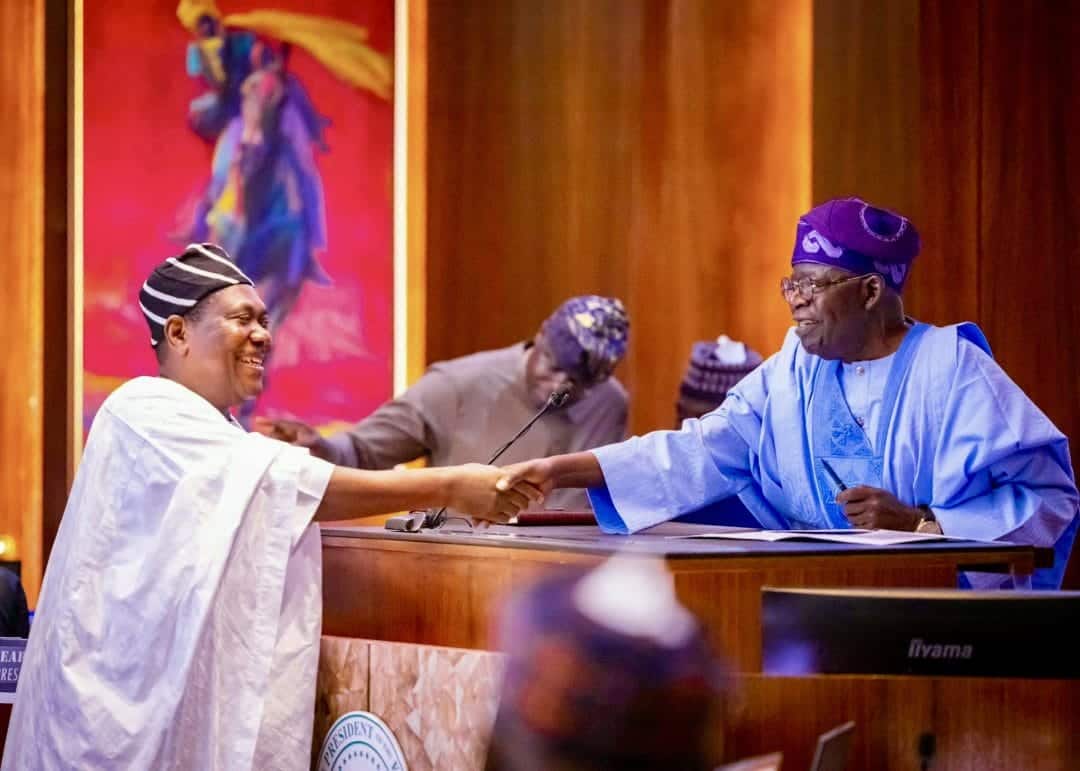
A proposed bill in Nigeria aims to establish a Prime Minister role while retaining the President as head of state, passing its second reading in the House of Representatives. This amendment, part of broader constitutional reforms, sparks debate on governance efficiency versus potential power struggles within the dual executive system.
ABUJA, Nigeria — In a dramatic twist that could reshape Nigerian politics, a bill to create the office of Prime Minister has passed its second reading in the House of Representatives. The proposal, aimed at overhauling the 1999 Constitution, seeks to establish the Prime Minister as head of government while retaining the President as head of state.
This development is not only a significant constitutional reform but also a daring step towards redefining power dynamics in the Nigerian political arena.
The bill’s progress, as one of 32 constitutional amendment proposals at this stage, has ignited fierce debate among political analysts, constitutional experts, and the general populace.
The call for a Prime Minister is seen by some as an inevitable correction to Nigeria’s longstanding political inefficiencies.
Detractors, however, fear that the move could blur the clear separation of powers that has characterised the Nigerian state since 1999.
Reimagining Government Leadership: Prime Minister vs SGF
A critical point of discussion revolves around the potential functions of the proposed Prime Minister role and how they might mirror those of the current non-constitutionally provided office of the Secretary to the Government of the Federation (SGF).
For decades, the SGF has served as a crucial cog in the Nigerian administrative machinery, albeit without explicit constitutional backing.
In many respects, the SGF has operated as the de facto chief operating officer of government, tasked with coordinating policies, overseeing inter-ministerial communications, and ensuring the smooth execution of governmental decisions.
If the Prime Minister’s office were to assume these functions, it would symbolically elevate the role to a constitutionally enshrined position.
This elevation could foster greater accountability and transparency by providing a clear mandate and legal foundation for government operations.
Proponents argue that formalising the responsibilities currently undertaken by the SGF under a Prime Ministerial banner would enhance governance.
It would also provide a direct counterbalance to the powers of the President, thereby mitigating executive overreach—a long-standing critique in Nigerian political discourse.
The Politics Behind the Proposal
Political factions remain divided on the merits of the constitutional amendment. Advocates for the new office contend that it offers a more balanced distribution of executive power, aligning Nigeria’s governance structure with tried and tested Westminster systems.
By designating the Prime Minister as head of government, the bill ostensibly aims to streamline decision-making processes and facilitate a more collaborative approach to national policy.
In a country where political patronage and executive eccentricities have often marred the efficiency of government, this reform is seen as a bold corrective measure.
Critics, however, caution against the potential pitfalls of such a transformation. They warn that the dual executive system might lead to power struggles, with the President and Prime Minister locked in a perpetual tug-of-war over policy and authority.
Moreover, the change could disrupt the delicate balance of power that, despite its flaws, has maintained a semblance of stability in Nigeria’s tumultuous political landscape.
The debate has sparked passionate responses on social media and in political circles, with many questioning whether Nigeria is ready for such a seismic shift.
Constitutional Amendments: A Wave of Reforms
The Prime Minister bill is not an isolated legislative move. It forms part of a broader wave of constitutional reforms currently under consideration.
Alongside the proposal to create the Prime Minister’s office, bills are advancing on issues ranging from ensuring greater representation of women in legislative bodies to streamlining the pre-election petition process and even revising the electoral criteria for top offices.
With 113 constitutional amendment bills having passed the second reading stage, Nigeria appears poised for an unprecedented era of legal and political transformation.
This flurry of amendments reflects a growing recognition among lawmakers that Nigeria’s constitutional framework, while robust in some respects, requires modernisation to meet the demands of contemporary governance.
Each bill, whether focused on enhancing gender representation or refining electoral procedures, is a step towards addressing long-standing issues that have hampered Nigeria’s political and administrative efficiency.
A New Dawn or a Pandora’s Box?
The passage of the Prime Minister bill through its second reading is a momentous milestone, yet it also raises important questions about the future of Nigerian democracy.
On one hand, enshrining a role that mirrors the effective functions of the SGF could lead to a more efficient, accountable, and dynamic government.
The formalisation of these responsibilities within the constitution would ensure that the administrative machinery of the state is not only responsive but also resilient in the face of political pressures.
On the other hand, the move could inadvertently open the door to intensified political rivalry.
The prospect of a dual executive system, with both a President and a Prime Minister, may exacerbate existing fractures within the ruling elite.
Critics warn that without clear delineation of powers and responsibilities, the new system could devolve into a battleground for political supremacy, ultimately to the detriment of effective governance.
Conclusion
As Nigeria stands at the crossroads of constitutional reform, the debate over the creation of a Prime Minister’s office encapsulates both the aspirations and anxieties of a nation in transition.
The proposal is a clarion call for modernisation, one that seeks to harness the efficiencies of the SGF’s current functions while anchoring them in the constitution.
Whether this bold move will usher in a new era of balanced governance or precipitate unforeseen conflicts remains to be seen.
One thing, however, is clear: Nigeria is poised for a dramatic political metamorphosis, the ramifications of which will reverberate across every level of government.
With the nation watching closely, the coming months will reveal whether these constitutional amendments represent the dawn of a more equitable political order or simply open a Pandora’s box of challenges for Nigeria’s future.