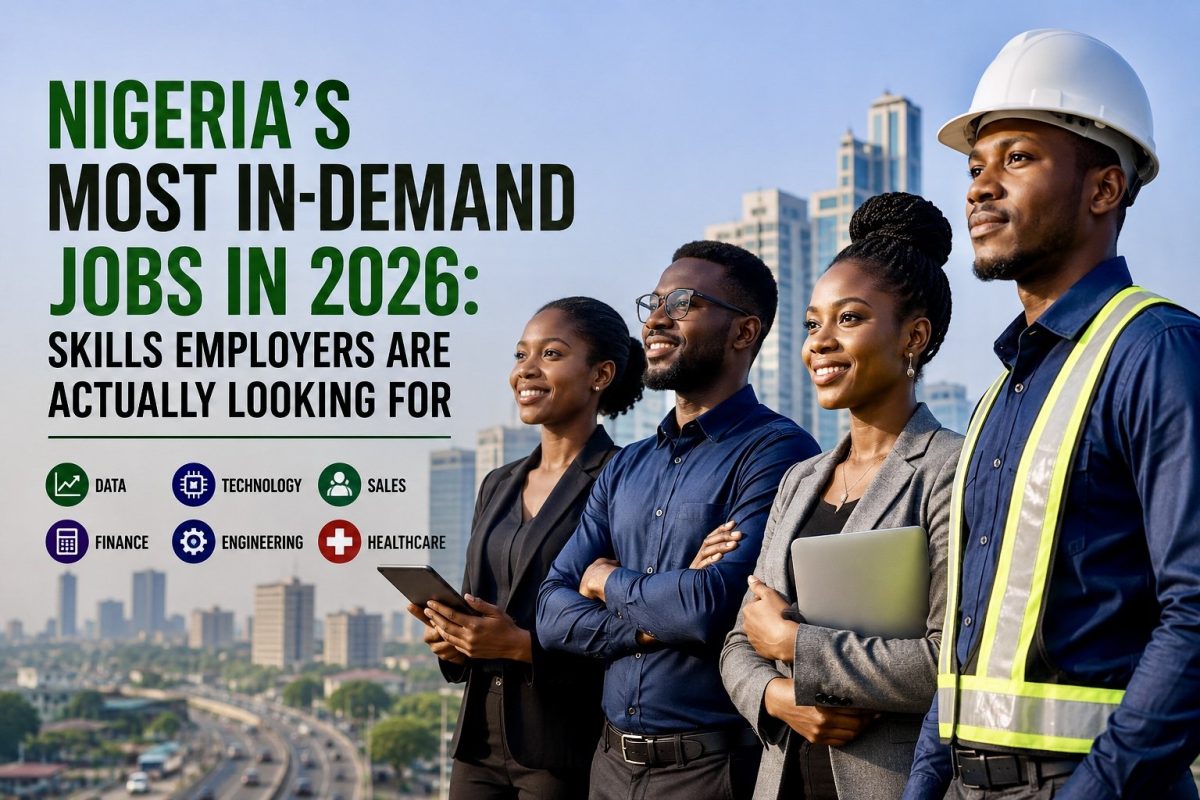
Nigeria’s employment market in 2026 is sending a message that many job seekers are still ignoring: a university degree may get you considered, but demonstrable skills are increasingly what get you hired.
The biggest opportunities are not confined to software engineering, artificial intelligence or the next fashionable technology. Employers are hiring across sales, finance, marketing, operations, engineering, healthcare, supply chain, compliance, technology and project management, but they are becoming much more demanding about what candidates can actually do.
A snapshot of vacancies currently listed on Jobberman illustrates the breadth of demand. As of August 2026, the platform showed more than 4,000 vacancies, including hundreds in sales, accounting and finance, marketing and communications, administration, management and business development, engineering and technology, healthcare, IT and telecommunications, manufacturing and supply chain.
But there is a second, more revealing story beneath the vacancy numbers.
Employers increasingly want people who can use data, sell, manage risk, communicate clearly, work with technology, solve problems and produce measurable results.
That shift is being driven by a Nigerian economy under pressure to become more productive while businesses contend with higher operating costs, tougher competition, digital transformation and a persistent shortage of job-ready talent.
The Nigerian Institute of Social and Economic Research, in its Q1 2026 Job Vacancy Analysis, found that the service sector remained the largest source of formal employment opportunities, while vacancies were heavily concentrated in the South-West. It also highlighted limited opportunities in agriculture and ICT, a shortage of entry-level positions for graduates and significant regional disparities in formal employment.
The implication is uncomfortable but important: Nigeria does not simply have a jobs problem. It has a job-skills matching problem.
The great Nigerian job-market misconception
For years, the conventional career formula was straightforward: earn a degree, complete NYSC, build a CV and wait for the right employer.
That formula is weakening.
Jobberman’s managing director, Oreoluwa Boboye, said in 2025 that Nigeria has a large pool of young, educated people eager to work but faces a mismatch between the skills employers require and those job seekers offer.
That mismatch becomes particularly serious when businesses need employees who can contribute almost immediately.
The Chartered Institute of Personnel Management of Nigeria’s 2025 HR Practice Needs Report identified talent acquisition and retention as the most significant business challenge among surveyed organisations. It also found that technology and digital transformation had risen sharply in importance for employers.
In other words, Nigerian companies are not merely asking, “Does this person have a degree?”
Increasingly, they are asking:
Can this person solve a business problem?
Can the applicant increase sales? Analyse the accounts? Manage a supply chain? Reduce costs? Build software? Protect company systems? Interpret data? Manage customers? Keep a plant operating safely? Navigate regulations? Run a project? Use AI without compromising quality?
That is the real labour-market test in 2026.
1. Sales and business development professionals
One of the clearest signals from the live Nigerian job market is the continuing strength of sales.
Jobberman currently lists more than 500 sales vacancies on its platform, making sales one of the largest job-function categories in its live vacancy pool. Management and business development also account for hundreds of openings.
This is not surprising.
In a difficult economy, revenue becomes more valuable than ever. Companies need employees who can find customers, retain clients, grow accounts and convert opportunities into cash.
The modern sales professional is therefore much more than someone who can make telephone calls.
Employers increasingly value:
Lead generation, customer relationship management, negotiation, presentation, digital selling, pipeline management, market research, account management and commercial awareness.
Communication remains fundamental. But simply writing “excellent communication skills” on a CV is becoming meaningless unless the candidate can demonstrate the result.
For example, “managed client relationships” is weak.
“Managed 45 business accounts and increased monthly sales by 22 per cent” is evidence.
That distinction is becoming increasingly important in recruitment.
A June 2026 analysis of 4,790 verified Nigerian job openings by Careersome found sales among the major functional areas being recruited, while sales-related roles were associated with target-driven selling, lead generation, client relationship management and negotiation.
2. Accountants, financial analysts and finance professionals
Finance remains one of Nigeria’s most dependable employment markets.
Jobberman currently lists hundreds of accounting, auditing and finance vacancies, while its banking and finance recruitment operation reported more than 90,000 finance applications and over 1,000 finance roles fulfilled in 2025.
But finance jobs are changing.
The accountant of 2026 is expected to understand technology, compliance, data and business performance — not merely bookkeeping.
The most useful combination increasingly includes:
Advanced Excel, financial modelling, financial reporting, budgeting, management accounting, audit, tax compliance, IFRS, ERP systems and data analysis.
Professional qualifications remain highly valuable in specialist finance roles, especially where regulation and reporting standards are involved.
The more powerful combination, however, is finance plus technology.
An accountant who can work confidently with Excel, ERP software, Power BI and data is potentially more useful to a growing company than one who possesses accounting knowledge alone.
This is where the Nigerian labour market is becoming more sophisticated.
3. Marketing and digital communications
Marketing is another major area of demand.
Jobberman’s current vacancy snapshot shows more than 400 roles in marketing and communications, alongside substantial demand in advertising, media and communications.
But the definition of “marketing” has changed dramatically.
Employers increasingly want professionals who understand:
Digital advertising, social media, content strategy, SEO, analytics, CRM, email marketing, video content, brand management and customer acquisition.
The strongest marketing candidates are no longer simply creative.
They are commercially literate.
They understand the relationship between attention and revenue.
A social-media manager who cannot interpret campaign performance is increasingly limited. A content writer who understands SEO, analytics and conversion has a more valuable profile. A brand manager who understands consumer data can operate at a higher level than one focused only on creative execution.
The emergence of generative AI makes this even more important.
AI can generate generic copy, images and ideas quickly.
Employers still need people who know what should be created, for whom, why it matters and how to measure whether it worked.
4. Operations and administrative professionals
The administrative category is often overlooked by discussions about the “jobs of the future”.
That is a mistake.
Jobberman currently shows hundreds of vacancies in administration and office functions, while operations-related positions cut across industries including logistics, manufacturing, hospitality, finance and professional services.
The difference is that modern employers want more than clerical support.
They increasingly expect administrative and operations staff to understand:
Excel, reporting, documentation, procurement, customer service, scheduling, process management, ERP systems, compliance and data handling.
The administrative employee who can automate repetitive work, produce management reports and coordinate teams has a considerably stronger value proposition than someone whose skill set ends at filing documents and answering phones.
This is also why digital literacy is no longer a “technology-sector” skill.
It is a workplace skill.
5. Engineering and technical trades
Nigeria’s industrial ambitions cannot function without technically capable workers.
Manufacturing, construction, energy, telecommunications, infrastructure, facilities management and industrial services all require engineers and technically trained personnel.
The current Jobberman vacancy pool contains hundreds of engineering and technology positions, while technical roles are also distributed across manufacturing, energy, construction and industrial employers.
The important shift is toward applied competence.
Employers want people who can work with:
AutoCAD, industrial equipment, electrical systems, instrumentation, automation, maintenance, process control, network infrastructure, cloud platforms, technical troubleshooting and safety systems.
Nigeria’s Employers’ Consultative Association has long identified shortages in areas such as mechanical maintenance, welding, electrical and electronic maintenance, auto mechatronics, automation, process control and instrumentation.
That gap remains economically important because technical incompetence can directly translate into higher downtime, lower productivity and increased maintenance costs.
A skilled technician who can keep a production line running can be just as economically valuable as a highly paid corporate professional.
6. Data analysts and technology professionals
Technology remains important — but the Nigerian market is becoming more nuanced than the simplistic advice that everyone should “learn to code”.
Software development remains a significant career path, alongside data, cybersecurity, cloud infrastructure, IT support, product and digital operations. Jobberman currently lists roles across software and data, IT and telecoms, engineering and technology.
Yet one of the biggest opportunities is the application of technology inside traditional industries.
Banks need data professionals.
Manufacturers need systems specialists.
Logistics companies need digital operations personnel.
Healthcare companies need health-tech expertise.
Professional-services firms need automation.
Retailers need e-commerce and customer analytics.
The World Bank’s recent analysis of online vacancies across African countries found that digital skills increasingly cut across occupations, rather than being limited to explicitly digital jobs. Basic digital capabilities such as computer literacy and Microsoft Office appeared widely, while more advanced competencies such as computer science and data analysis were also significant.
Nigeria’s position is likely to become even more pronounced.
In August 2026, the World Bank disclosed Nigeria’s Digital Skills Development Blueprint 2026–2035, warning that an estimated 28 million Nigerian workers will require digital competencies over the next decade.
That is one of the strongest signals available for Nigerian job seekers.
The future is not “technology versus non-technology”.
It is technology inside almost every job.
7. Cybersecurity and risk professionals
As Nigerian companies digitise operations, they also become more vulnerable to cyber attacks, fraud, data breaches and regulatory failures.
This creates a growing requirement for professionals who understand cybersecurity, information security, risk management and compliance.
LinkedIn’s 2026 Skills on the Rise research found that risk and compliance management skills — including governance and risk management — are gaining importance as organisations confront increasingly complex regulatory, security and financial environments.
For Nigerian professionals, this creates opportunities in banking, fintech, telecommunications, government, healthcare, energy and other data-intensive industries.
The valuable combination is not simply “cybersecurity”.
It is cybersecurity plus:
risk assessment, incident response, cloud security, governance, compliance, data protection and communication with non-technical executives.
8. Compliance, audit and regulatory specialists
One of the more revealing findings from the 2026 Nigerian recruitment market is the prominence of compliance.
Careersome’s analysis of thousands of vacancies found compliance was the most frequently cited domain area in its dataset, appearing in 41.3 per cent of postings. Finance followed at 25.9 per cent, while safety/HSE appeared in 23.6 per cent and sales in 23.1 per cent.
That tells an important story about the Nigerian economy.
As regulation becomes more complicated across taxation, banking, financial services, data protection, employment, corporate governance, procurement and other areas, companies need people who can protect them from expensive mistakes.
Candidates with backgrounds in law, accounting, audit, banking, risk and regulatory affairs can therefore build valuable careers by adding practical compliance expertise.
9. Supply chain, procurement and logistics
Supply-chain professionals are becoming increasingly important because Nigerian businesses are confronting persistent transportation, sourcing, inventory and cost challenges.
Jobberman currently lists dozens of supply-chain and procurement vacancies alongside more than 100 transport-related positions, with logistics also a substantial industry category.
Employers want people who can manage:
Procurement, inventory, warehousing, supplier relationships, route planning, forecasting, ERP systems, cost control and logistics data.
This is particularly important in manufacturing, FMCG, retail, healthcare, construction and e-commerce.
The strongest candidates are those who understand both the physical movement of goods and the data behind it.
10. Healthcare professionals
Healthcare remains a structural employment sector regardless of economic cycles.
Jobberman’s current listings include medical and pharmaceutical vacancies, as well as hundreds of healthcare-industry positions.
Demand extends beyond doctors.
Nigeria requires nurses, pharmacists, laboratory professionals, medical administrators, public-health specialists, health-information professionals, community health workers and technical healthcare personnel.
The challenge is that the sector faces both shortages and international migration.
A 2025 CIPM research publication cited a Jobberman survey in which 63 per cent of employers reported difficulty filling mid- to senior-level roles because of emigration.
That “Japa” effect is therefore influencing employer behaviour across professional sectors, particularly where experienced workers can move rapidly to international labour markets.
The surprising skills that keep appearing everywhere
The most important discovery from Nigeria’s 2026 labour market may not be a particular job title.
It is the combination of technical and human skills.
Careersome’s analysis found communication in 58.9 per cent of vacancies, with leadership and analytical thinking each appearing in roughly 23 per cent. Excel appeared in 17.1 per cent and Microsoft Office in 16.4 per cent.
That creates an important lesson.
The worker who learns Python but cannot communicate with a manager may struggle.
The accountant who understands IFRS but cannot use Excel effectively is less competitive.
The marketer who cannot interpret performance data is vulnerable.
The engineer who cannot manage stakeholders may hit a career ceiling.
The salesperson who cannot use CRM and data tools will increasingly compete against people who can.
The winning formula is becoming:
Domain expertise + digital capability + communication + problem-solving + evidence of results.
LinkedIn’s 2026 global skills analysis reinforces the pattern. It identifies growing demand for cross-functional collaboration, team management, mentorship, stakeholder communication, business development, AI implementation, prompt engineering, large language models, governance and risk management. It also stresses that employers are increasingly prioritising demonstrated skills over degrees, job titles and linear career paths.
AI is changing the hiring equation — but not in the way many Nigerians think
Artificial intelligence has created enormous anxiety about job losses.
But the more immediate labour-market consequence may be different.
AI is increasingly changing what employers expect from existing workers.
LinkedIn’s 2026 research says AI demand is expanding beyond coding towards implementation and business strategy, including prompt engineering, large language models and the integration of AI into products and business processes.
The consequence is that AI literacy could become a general workplace competency.
An accountant may use AI to accelerate analysis.
A marketer may use it for research and content workflows.
A lawyer may use it for document review.
An operations manager may use it for forecasting.
A journalist may use it for research assistance.
A software developer may use it to accelerate development.
But employers will increasingly distinguish between someone who uses AI responsibly to increase productivity and someone who merely knows how to write prompts.
That distinction matters.
AI is a tool, not a career.
The geographical problem: Lagos still dominates
Nigeria’s employment opportunities remain heavily concentrated geographically.
NISER’s Q1 2026 analysis found that formal vacancies were heavily concentrated in the South-West, with many states recording no formal newspaper advertisements during the quarter.
Jobberman’s current platform snapshot tells a similar story: Lagos alone accounts for more than 2,400 listed vacancies, compared with much smaller volumes in many other locations.
This concentration creates a major challenge for graduates outside the principal commercial centres.
It also creates an opportunity.
Remote employment, digital services and internationally accessible freelance work can partially weaken geography as a barrier — although reliable internet, electricity, equipment, professional networks and employer trust remain critical constraints.
Jobberman reported in late 2025 that 62 per cent of international companies were actively recruiting young Africans for full-time remote positions or freelance opportunities, particularly in technology, finance, customer success, data analytics and AI.
That means a talented Nigerian does not necessarily need to be physically located in Lagos to compete for global work.
But the standard is also higher.
The degree is not dead — but the degree alone is
One of the most misleading narratives around today’s jobs market is that degrees no longer matter.
They do.
Many employers continue to request university degrees or HND qualifications, particularly in regulated professions, graduate programmes, engineering, finance, healthcare and management.
The live Jobberman market still shows degree requirements as common.
The real change is that the degree has become only one part of the proposition.
A candidate who has a degree in economics, for example, may be competing against another economics graduate who also has:
Excel + Power BI + financial modelling + internship experience + data analysis + strong communication.
The second candidate is easier to deploy.
And employers generally pay for usefulness.
What Nigerian employers are really looking for in 2026
After separating the hype from the available evidence, a consistent pattern emerges.
The strongest candidates are not necessarily those with the most certificates.
They are those who can demonstrate five things:
They can do the work.
They can use technology to do it better.
They can communicate what they are doing.
They can solve problems without being micromanaged.
They can show measurable results.
CIPM’s guidance for employers similarly emphasises problem-solving, creativity, self-motivation and data-analytics capability as important employability skills.
This is the central lesson of the Nigerian job market in 2026.
The skills worth building now
For a young Nigerian deciding what to learn, the evidence points towards a practical rather than fashionable strategy.
Start with advanced digital literacy: Excel, collaborative software, data presentation and workplace productivity tools.
Then add a specialised capability: finance, sales, engineering, accounting, marketing, logistics, healthcare, software, cybersecurity or another commercially relevant field.
Then add data literacy.
Then learn to work intelligently with AI.
Then strengthen communication, negotiation, critical thinking and problem-solving.
Finally, build proof.
A portfolio, internship, freelance project, sales record, published analysis, GitHub repository, campaign result, financial model, engineering project or documented operational improvement can be more persuasive than another generic online certificate.
The bottom line
Nigeria’s most in-demand jobs in 2026 are not simply the jobs with the most futuristic names.
They are the jobs that help companies make money, save money, manage risk, satisfy customers, comply with regulations, operate efficiently or use technology more effectively.
That is why salespeople remain valuable.
Why accountants remain valuable.
Why engineers remain valuable.
Why nurses remain valuable.
Why logistics professionals remain valuable.
Why data analysts are increasingly valuable.
Why cybersecurity specialists are gaining ground.
And why workers who can combine professional expertise with digital skills are becoming the most strategically useful.
The World Bank’s latest digital-skills blueprint makes the scale of the transformation unmistakable: an estimated 28 million Nigerian workers will need digital competencies over the next decade.
The future Nigerian labour market will therefore not be divided simply between “tech jobs” and “non-tech jobs”.
It will increasingly divide workers into those who can adapt to a technology-enabled economy — and those who cannot.
For job seekers, that is both a warning and an opportunity.
The question in 2026 is no longer simply, “What job can I get?”
It is:
“What can I do that an employer urgently needs, and can I prove that I can do it?”
Follow us on our broadcast channels today!
- WhatsApp: https://whatsapp.com/channel/0029VawZ8TbDDmFT1a1Syg46
- Telegram: https://t.me/atlanticpostchannel
- Facebook: https://www.messenger.com/channel/atlanticpostng