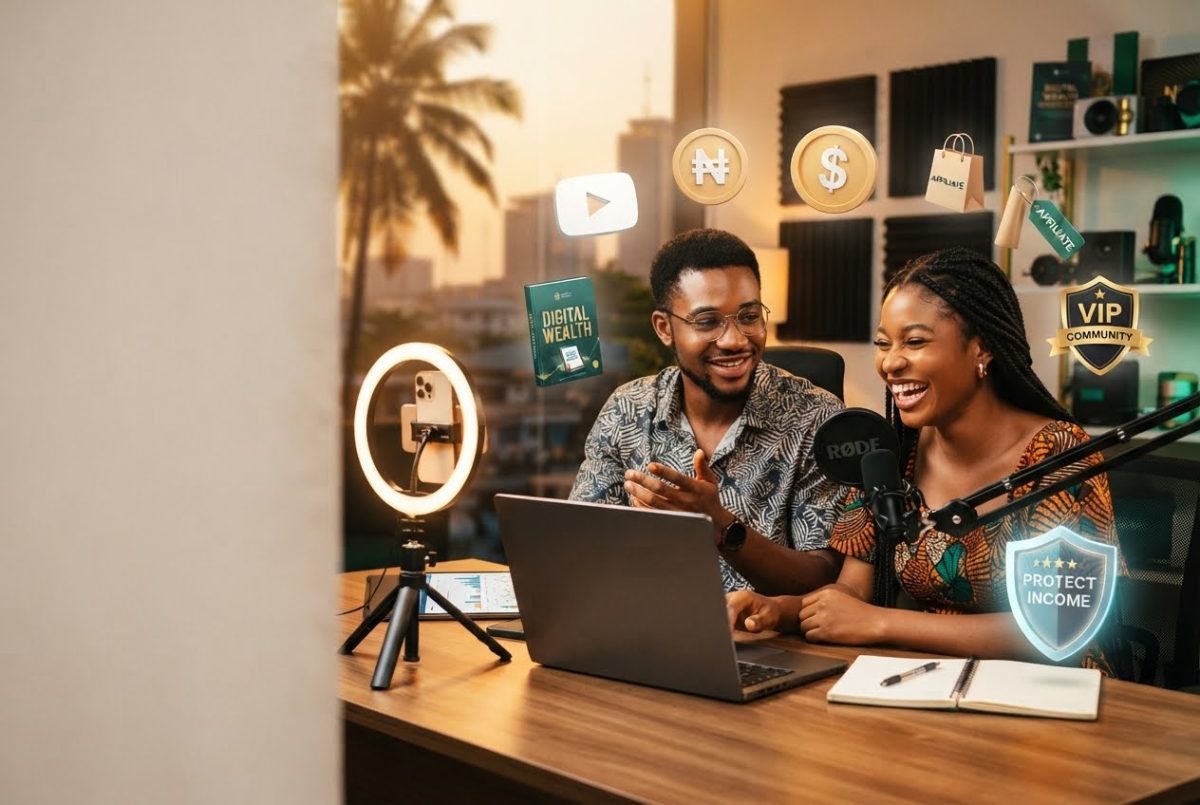
From YouTube monetisation and brand partnerships to affiliate marketing, online courses and paid communities, Nigerian creators are discovering that the real money in digital content comes from building an audience that is willing to pay for value.
A video can attract hundreds of thousands of views without putting meaningful money into its creator’s bank account. A social media post can generate thousands of likes but produce no sales. And a creator with a relatively small following can sometimes earn more than an influencer with a much larger audience.
That is the business reality of Nigeria’s expanding digital content market.
The opportunity is enormous, but the route to making money is frequently misunderstood. Many Nigerians concentrate on becoming popular on Facebook, Instagram, TikTok, YouTube and X, assuming that popularity automatically translates into income.
It does not.
The creators building sustainable businesses understand a different principle: content is not merely something to publish. It is an asset that attracts attention, establishes credibility, creates demand and generates revenue.
Nigeria’s digital audience provides a substantial commercial foundation. DataReportal’s Digital 2027 report estimates that 116 million people were using the internet in Nigeria at the end of 2026, while social media user identities reached 61.4 million in October. These identities should not be interpreted as 61.4 million unique individuals, but they demonstrate the scale of the potential digital market.
For entrepreneurs, journalists, educators, entertainers, photographers, professionals and business owners, the question is no longer whether digital content can generate income. It is how to build a business around it.
1. Make Money Through YouTube Monetisation
YouTube remains one of the clearest routes for Nigerian creators seeking direct revenue from their content.
Through the YouTube Partner Programme, eligible creators can earn from advertisements displayed on their videos, YouTube Premium revenue and other monetisation features.
Nigeria is among the countries where the programme operates.
YouTube has an expanded entry level that allows eligible creators to apply with:
- 500 subscribers.
- At least three valid public uploads within the previous 90 days.
- Either 3,000 qualifying public watch hours within the previous 12 months or three million qualifying Shorts views within 90 days.
This earlier access can unlock eligible fan-funding and shopping features, including channel memberships, Super Thanks and other supported tools.
Full advertising revenue sharing has a higher threshold: 1,000 subscribers and either 4,000 qualifying public watch hours within 12 months or 10 million qualifying public Shorts views within 90 days.
Creators should understand the difference. Reaching the earlier threshold does not automatically unlock advertising revenue sharing.
The most commercially attractive YouTube channels are not necessarily those producing the most entertaining videos. They are often those answering questions people actively search for.
Nigerian creators can build channels around:
- Personal finance and investment education.
- Business development and entrepreneurship.
- Technology and artificial intelligence.
- Careers, employment and professional development.
- Education and examination preparation.
- Beauty, fashion and lifestyle.
- Agriculture, food production and real estate.
- Entertainment, comedy and Nigerian culture.
A creator who consistently explains how to register a business, improve employability or manage personal finances can build a valuable audience among people with identifiable needs.
That audience can generate advertising income while creating opportunities to sell educational products, secure sponsorships and attract professional clients.
The important consideration is consistency, original content and audience retention, not merely uploading videos.
2. Monetise Facebook Content
Facebook remains an important commercial platform for Nigerian creators because it supports several content formats, including Reels, long-form videos, photographs, stories and text posts.
Meta’s Facebook Content Monetisation programme rewards eligible content based on performance and qualified engagement.
In March 2026, Meta disclosed that Facebook had paid creators nearly $3 billion globally through its monetisation programmes during 2025. It also reported that 60 per cent of its creator payouts went to Reels, with the remainder distributed across Stories, photographs and text posts.
There is an important qualification.
As of November 2026, Meta describes Facebook Content Monetisation as invite-only. Creators can express interest through the Professional Dashboard by selecting Monetisation and then Content Monetisation. Expressing interest does not guarantee acceptance.
For Nigerian creators, this means building a Facebook audience is worthwhile, but financial projections should not depend entirely on being admitted to the programme.
A stronger approach is to use Facebook to distribute original content, attract customers, promote products and secure paid partnerships while checking the account’s actual monetisation eligibility.
Professional Mode and a well-managed Facebook Page can help creators understand their audience, monitor performance and develop commercial opportunities.
3. Use TikTok to Attract Paying Brands and Customers
TikTok has become an influential platform for product discovery, entertainment, education and personal branding.
Its greatest value for many Nigerian creators is the ability to introduce their content to people who do not already follow them.
This can create opportunities in fashion, food, beauty, music, comedy, personal development, technology and small-business promotion.
However, creators need to distinguish between TikTok’s popularity and its direct payment programmes.
The TikTok Creator Rewards Programme has a restricted country list. The latest published eligibility list verified in October 2026 identifies the United States, United Kingdom, Germany, Japan, South Korea, France, Mexico and Brazil. Nigeria is not included.
Consequently, a Nigerian creator should not assume that millions of views will qualify for Creator Rewards payments.
That does not prevent Nigerian TikTok users from generating income.
Businesses can pay creators to demonstrate products, produce promotional videos, introduce services or create content for advertising campaigns.
For example, a food creator might work with restaurants and food brands. A technology creator could produce demonstrations for smartphone retailers and software companies. A fashion creator could collaborate with clothing businesses and beauty companies.
The commercial opportunity is to become valuable to advertisers and customers rather than depending entirely on a platform’s payment system.
4. Earn Through Brand Partnerships and Sponsored Content
Brand partnerships are among the most accessible income opportunities for creators who have developed a recognisable audience.
Companies increasingly need people who can explain their products, demonstrate their services and communicate with communities in a credible way.
A creator does not necessarily need hundreds of thousands of followers to attract a paying client.
A personal finance educator with 5,000 engaged followers interested in savings, banking and financial planning may be more commercially attractive to a relevant financial business than an entertainment account with a much larger but less defined audience.
Potential clients include:
- Banks and financial technology companies.
- Real estate businesses.
- Universities and training institutions.
- Restaurants and hospitality businesses.
- Fashion and beauty companies.
- Telecommunications providers.
- Technology companies.
- Retailers and consumer brands.
- Recruitment and professional services businesses.
Creators should develop a media kit containing their biography, niche, audience demographics, locations, engagement statistics, content formats and previous campaign results.
They should also establish clear rates for sponsored posts, videos, campaign packages and longer-term partnerships.
A professional agreement should specify the deliverables, payment schedule, publication dates, revisions, exclusivity and how long a brand may reuse the content.
The value of a creator’s work is not determined by follower count alone. Audience relevance, trust, production quality and measurable results all matter.
5. Make Money Through Affiliate Marketing
Affiliate marketing allows creators to earn commissions by recommending products or services through tracked links or referral codes.
Instead of creating a product, the creator helps a company attract customers and receives an agreed commission when qualifying purchases or transactions take place.
This model can work particularly well for Nigerian creators in:
- Technology and electronics.
- Books and educational resources.
- Fashion and beauty.
- Business software.
- Online courses.
- Travel and hospitality.
- Professional services.
For example, a technology creator could review laptops, explain their features and include an affiliate link to a retailer.
A business educator could recommend useful software to small-business owners and earn a commission when customers subscribe through a referral link.
The key is to recommend products that genuinely suit the audience.
Creators should disclose commercial relationships and avoid exaggerated claims. A recommendation that damages audience trust can destroy the long-term value of an account.
Affiliate marketing works best when it is supported by useful reviews, demonstrations, comparisons and tutorials rather than a continuous stream of sales messages.
6. Sell Digital Products Without Depending on Platform Payments
One of the strongest ways to make money from digital content is to create and sell products directly to an audience.
Unlike advertising revenue, direct product sales allow creators to build income around their own expertise and customers.
Possible products include:
Electronic books: Writers, journalists, business experts and educators can package their knowledge into downloadable publications.
Online courses: Professionals can teach photography, digital marketing, business management, personal finance, writing, fashion design and other marketable skills.
Templates: Graphic designers and business consultants can sell presentation designs, business plans, financial trackers, CV templates and social media content calendars.
Research reports: Analysts and industry specialists can sell market intelligence, sector reports, business guides and specialised research.
Photography and creative assets: Photographers, illustrators and designers can sell original photographs, graphics, design templates and other licensed materials.
Recorded training: Coaches and specialists can package workshops and practical tutorials into paid learning resources.
Consider a simple illustration.
A creator with 3,000 engaged followers develops a practical business guide and sells 40 copies at ₦5,000 each.
That produces ₦200,000 in gross sales.
The example is not an industry earnings benchmark or a guarantee of sales. It demonstrates that a creator does not necessarily need millions of followers to build a commercially meaningful business.
A smaller audience with a specific need can be more valuable than a much larger audience with no clear purchasing interest.
7. Build a Paid Community or Subscription Business
Some audiences want more than free social media posts.
They want direct access to expertise, regular learning materials, professional networks, exclusive information and opportunities to interact with the creator.
This creates room for paid communities and subscriptions.
A Nigerian business creator, for example, could develop a paid community offering:
- Weekly business intelligence.
- Practical entrepreneurship training.
- Job and career opportunities.
- Business networking.
- Exclusive interviews.
- Investment education.
- Monthly online workshops.
A professional newsletter can also generate recurring revenue through paid subscriptions.
Journalists and independent publishers can develop specialist newsletters covering business, energy, technology, politics, investment or other subjects where readers value consistent, well-researched information.
The challenge is maintaining quality.
Subscribers are unlikely to keep paying for material that simply repeats what they can find freely elsewhere. The subscription must offer exclusive insight, convenience, expertise or access.
Recurring revenue becomes particularly attractive when creators can retain subscribers over several months rather than continually searching for new customers.
8. Sell Digital Content Creation as a Service
There is another opportunity many aspiring influencers overlook.
A creator can make money by producing content for other businesses, even without owning a large social media following.
This is commonly known as user-generated content (UGC) production.
A company may pay a creator to produce a product demonstration, customer-style testimonial, short promotional video, photograph or tutorial that the company publishes on its own platforms or uses in advertising.
The company is paying for the quality and usefulness of the content, not necessarily access to the creator’s followers.
This creates opportunities for:
- Videographers.
- Photographers.
- Scriptwriters.
- Graphic designers.
- Social media managers.
- Editors.
- Presenters.
- Product reviewers.
- Animation specialists.
A young Nigerian creator with a smartphone, good presentation skills and an understanding of short-form video production can begin by approaching local restaurants, fashion businesses, hotels, retailers and technology companies.
The business proposition is straightforward: produce content that helps the company attract attention, communicate value and convert potential customers.
Creators can also expand into monthly content-production packages, social media management and digital marketing services.
9. Make Money by Licensing Your Content
Original digital content can generate income long after its initial publication.
Photographs, videos, music, illustrations, documentaries and written materials may have commercial value beyond the platform where they first appeared.
A photographer can license images to publishers and businesses. A videographer can negotiate the use of original footage. A musician can earn from authorised commercial use of recordings and compositions. A journalist or independent publisher can negotiate syndication and republication agreements.
Licensing arrangements should clearly explain where the material may be used, how long permission lasts, whether the licence is exclusive and what payment is required.
Creators should be cautious about giving away unrestricted commercial rights without understanding the value of their work.
An original photograph or video may become a valuable asset when businesses, publishers or production companies need permission to use it.
10. Make It Easy for Local and International Customers to Pay
A creator can attract customers from Lagos, London, Johannesburg, Toronto or New York and still lose business if the payment process is difficult.
A professional digital business should provide clear payment instructions and a reliable checkout process.
Nigerian businesses can use local payment providers to collect payments for digital products, subscriptions and services.
For example, Paystack’s November 2026 guidance confirms that eligible Nigerian businesses can receive international card payments using Mastercard, Visa and Verve, with American Express also supported for Nigerian businesses. International payments are subject to business activation and compliance approval.
Creators should check their account settings rather than assume that international payments are automatically enabled.
They should also provide clear invoices, order confirmations, delivery instructions and customer support.
For creators serving international customers, the ability to accept payments conveniently can make the difference between a large audience and an actual business.
11. Understand Copyright, Tax and Business Responsibilities
Digital content is not exempt from the ordinary responsibilities of running a business.
Nigeria’s Copyright Act 2022 protects eligible original literary, musical, artistic and audiovisual works, among other categories. Its provisions cover rights such as reproduction, publication and making works available to the public.
Creators should therefore avoid using music, photographs, videos, graphics and other copyrighted materials without appropriate permission or licensing.
They should retain original files, keep records of their work and agree in writing on how commercial clients may use commissioned content.
Tax compliance also deserves attention.
The Joint Revenue Board’s 2026 Personal Income Tax Guidelines specifically address the income of content creators and influencers. They state that income earned from within or outside Nigeria through a creator’s trade, business, profession or vocation is chargeable to tax.
The guidance expressly includes subscriptions, advertising, brand endorsements, platform revenue sharing, digital rewards and other forms of compensation.
The Nigeria Tax Act 2025 took effect on 1 January 2026. Creators should maintain proper records of earnings, business expenses, invoices and relevant deductions, and seek professional tax advice where necessary.
The fact that income arrives through a foreign platform does not automatically remove Nigerian tax obligations.
12. A Practical 90-Day Plan for Nigerian Creators
Building a profitable digital content business requires a plan that goes beyond posting whenever inspiration strikes.
Days 1–30: Establish your market
Choose one clearly defined audience and identify the problems, interests or needs your content will address.
Set up professional social media profiles, establish a consistent publishing schedule and identify at least one product, service or commercial opportunity you could eventually sell.
Create an email list or another permission-based channel through which interested followers can stay connected with you.
Days 31–60: Build credibility and test demand
Publish useful original content consistently. Combine short-form videos with longer educational materials, interviews, demonstrations or written guides.
Study which posts generate meaningful engagement, enquiries, website visits and potential sales.
Approach businesses with relevant audiences and offer clearly defined content-production or promotional services.
Test a simple digital product, such as an electronic book, template or recorded training session.
Days 61–90: Turn attention into revenue
Introduce a structured product or service offer.
Develop a professional rate card and media kit. Contact potential brand partners and explore affiliate arrangements.
Build an email or paid community strategy and establish a system for tracking revenue, expenses and customer retention.
At the end of the 90 days, assess which activities generate actual income rather than relying exclusively on views and followers.
The Real Opportunity Is Building a Digital Business
Nigeria’s digital content opportunity is much bigger than becoming an internet celebrity.
It extends to independent journalists, educators, business consultants, photographers, designers, entertainers, professionals, publishers and entrepreneurs who can turn knowledge, creativity and expertise into products and services.
The most sustainable creators will not depend on a single platform or an unpredictable advertising payout. They will build audiences across multiple channels, establish relationships with customers, develop intellectual property and create several sources of income.
A million views may attract attention. A well-designed product, trusted brand, loyal community and reliable payment system can turn that attention into a business.
For Nigerian creators, the next stage of digital opportunity is not simply about making more content.
It is about learning how to make that content pay.
Follow us on our broadcast channels today!
- WhatsApp: https://whatsapp.com/channel/0029VawZ8TbDDmFT1a1Syg46
- Telegram: https://t.me/atlanticpostchannel
- Facebook: https://www.messenger.com/channel/atlanticpostng



Join the debate; let’s know your opinion.