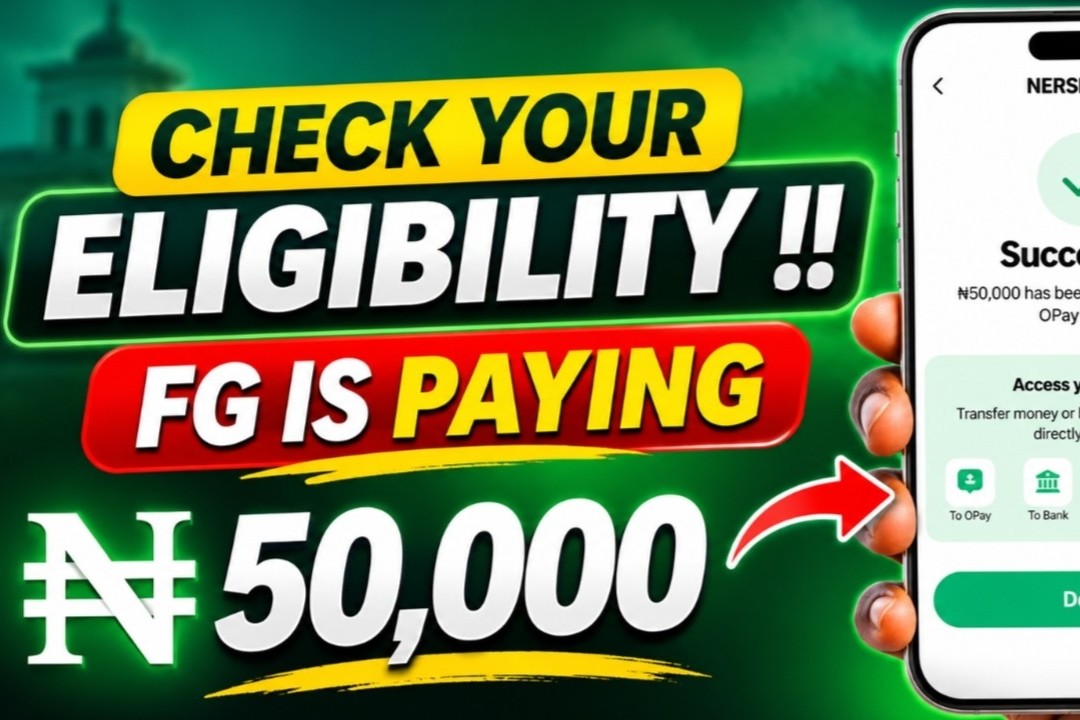
The Federal Government has commenced its N50,000 National Emergency Relief and Stabilisation Intervention, but questions remain about beneficiary selection, payment schedules and accountability. Here is how Nigerians can check their eligibility, accept the money and protect themselves from fraudsters.
Nigeria’s latest federal cash relief programme has begun reaching vulnerable households, offering selected beneficiaries ₦50,000 to help cushion the rising cost of food and other essential goods.
But for millions of Nigerians struggling with the cost of living, the immediate challenge is knowing whether they qualify, how to confirm their selection and how to receive the money without falling victim to fraudsters.
The Federal Government says beneficiaries do not need to apply, register through an agent or pay any fee. Instead, recipients are selected from existing government records and contacted directly through approved financial service providers.
The intervention, known as the National Emergency Relief and Stabilisation Intervention (NERSI), is managed by the Federal Ministry of Humanitarian Affairs and Poverty Reduction.
The ministry has published detailed instructions explaining how beneficiaries can verify their eligibility, accept the grant, access their mobile wallets and withdraw the money.
Yet the programme also raises important questions about how beneficiaries are selected, how many households will eventually receive support and how the government will demonstrate that public funds reach the people who need them most.
What is the N50,000 NERSI grant?
NERSI is a Federal Government cash intervention designed to provide immediate financial support to poor and vulnerable Nigerian households experiencing rising living costs.
Under the programme, selected beneficiaries receive ₦50,000 through mobile wallets operated by five approved financial service providers.
The Federal Government says the payment is a grant, not a loan. Recipients are not required to repay it, and the full ₦50,000 should be credited without deductions.
The Minister of Humanitarian Affairs and Poverty Reduction, Dr Bernard Doro, announced the programme’s commencement on 30 October 2026.
In his statement, Doro said:
“Under this intervention, eligible beneficiaries will receive ₦50,000 monthly, providing direct assistance to help meet essential needs and ease the burden of living costs.”
The minister also said the initiative would be reviewed regularly to reflect changes in the cost of living, with beneficiaries receiving direct notification before any adjustments.
Importantly, the minister described the payment as monthly support. However, the ministry’s published FAQ does not provide a detailed monthly payment calendar, duration of entitlement or dates for subsequent payments.
Beneficiaries should therefore distinguish the minister’s stated monthly commitment from a confirmed schedule for future payments.
Who qualifies for the N50,000 FG grant?
The government says beneficiaries are selected from the National Social Register and verified national identity records.
The selection process is intended to identify poor and vulnerable households based on need.
According to the ministry, beneficiaries are drawn from all six geopolitical zones, regardless of religion, ethnicity or political affiliation.
The programme is not designed around an open application process.
The government explains this clearly:
“You cannot apply, and no one can add you to the list.”
This means Nigerians cannot secure a place by completing an online application, visiting a government office or paying an intermediary.
The ministry also says payments are being distributed in phases. Consequently, some beneficiaries may receive notifications before others.
Not receiving an SMS immediately does not necessarily mean that someone has been excluded permanently.
Nevertheless, the government has clarified that not everyone will be selected in the current phase.
How to check whether you are eligible
Nigerians can check their eligibility through the USSD channels provided by the approved payment providers.
The five authorised providers and their codes, as published on the official NERSI portal, are:
| Payment provider | USSD code |
|---|---|
| ALAT by Wema Bank | *945*23# |
| MoMo PSB | *671*0# |
| NairaGram | *726*00# |
| OPay | *955*20# |
| Moniepoint | *5573*27# |
Beneficiaries should use the code associated with their assigned payment provider and follow the instructions to check their eligibility.
The ministry says recipients who are selected will receive an SMS notification from their respective providers.
Those who are not currently selected may receive a message stating:
“You are currently not selected to receive this relief support.”
The government advises Nigerians who have not received notifications to check their status rather than relying on rumours or forwarded messages.
Official programme information is available at the Federal Ministry of Humanitarian Affairs and Poverty Reduction’s NERSI website.
How to accept and receive the ₦50,000 payment
Being selected does not automatically mean the money will appear in a beneficiary’s wallet.
Recipients must first accept the offer.
The process involves the following steps:
1. Receive your notification
A selected beneficiary receives an SMS from one of the five approved payment providers.
The message explains that the Federal Government has selected the recipient for the N50,000 intervention.
2. Confirm the notification
Check that the message comes from the relevant approved provider. Do not click unfamiliar links or disclose personal banking information.
3. Accept the grant
Dial the USSD code contained in the notification and follow the instructions. Depending on the provider, the process requires the beneficiary to confirm acceptance.
The ministry states:
“Nothing is paid until you accept.”
4. Receive your money
Once the offer is accepted, the provider opens the beneficiary’s mobile wallet and credits the ₦50,000.
A confirmation message should follow.
The government encourages selected recipients to accept promptly after receiving their notifications.
Can people without smartphones receive the grant?
Yes.
One important feature of NERSI is that beneficiaries do not need smartphones or internet access to receive the money.
The government’s FAQ explains that a basic mobile phone is sufficient because the relevant USSD services work without an internet connection.
This is significant in a country where access to smartphones, reliable internet services and digital financial infrastructure remains uneven.
Customers of MoMo PSB, OPay and Moniepoint can also use their providers’ official applications to access their wallets and conduct transactions.
How to withdraw the N50,000 grant
After receiving the money, beneficiaries can withdraw their funds through Point of Sale agents, transfer the money to bank accounts or use the available payment services provided by their assigned operators.
The government has outlined the following options:
ALAT by Wema Bank: Beneficiaries can use the ALAT USSD service to transfer funds to a POS agent or a bank account. They can also visit a Wema Bank branch.
MoMo PSB: Recipients can use MoMo agents, POS operators, the USSD service or the MoMo NG application.
NairaGram: Beneficiaries can use the provider’s USSD service to transfer money to a POS agent or bank account.
OPay: Customers can use the OPay USSD service or official application to transfer funds.
Moniepoint: Beneficiaries can use the Moniepoint USSD service or official application to transfer money.
Recipients are not required to withdraw everything at once. They can take out part of the money and leave the remaining balance in their wallets.
The programme also permits transfers to personal bank accounts and other accounts.
However, beneficiaries should confirm transaction charges before withdrawing through POS operators.
The government says receiving and accepting the grant are free, although POS agents may charge their usual withdrawal fees.
N50,000 FG grant: Five ways to avoid fraud
The introduction of a national cash relief programme creates an opportunity for fraudsters to exploit Nigerians desperate for financial assistance.
The government has therefore issued specific warnings about fraudulent messages, fake registration websites and individuals claiming to have access to beneficiary lists.
Recipients should observe these precautions.
1. Never pay to secure the grant
The NERSI programme does not require registration fees, processing charges or payments to government officials.
Anyone demanding money to add a person to the beneficiary list or accelerate payment is attempting to defraud them.
2. Never disclose your PIN, OTP or BVN
No programme official, payment provider or agent should request these sensitive banking details to release the grant.
Beneficiaries should never disclose their security information over the telephone or through WhatsApp.
3. Avoid suspicious links
The ministry says genuine programme notifications do not contain links.
Do not click unfamiliar links, download unknown applications or provide personal details through websites claiming to offer NERSI registration.
4. Ignore fraudulent WhatsApp messages
Messages claiming that forwarding information to friends or joining a WhatsApp group guarantees access to the grant are fake.
Sharing a message does not make anyone eligible.
5. Never refund money to unsolicited callers
Fraudsters may contact beneficiaries claiming that money was transferred mistakenly and must be returned.
The ministry advises recipients not to send money to anyone making such a demand. Instead, contact the payment provider directly through its official customer service channel.
What happens if you lose your phone or SIM card?
Beneficiaries who lose their phones or SIM cards should contact their payment providers immediately to protect their wallets.
They should then request replacement SIM cards carrying the same telephone numbers from their network operators.
The government says losing a phone or SIM card does not mean losing the money because the funds remain in the mobile wallet.
Recipients should never hand their PINs or one-time passwords to anyone claiming to help recover their accounts.
Official NERSI and payment provider helplines
Nigerians experiencing payment difficulties, suspicious calls or problems accessing their wallets can contact the following support channels published by the government.
| Provider | Official contact |
|---|---|
| ALAT by Wema | 0803 900 3700 |
| MoMo PSB | 671 or 0803 106 7100 |
| NairaGram | 0201 330 0880 / 0201 330 0881 |
| OPay | 0700 888 8328 / 0201 888 8328 |
| NERSI programme helpline | 0700-022-2222 |
Questions concerning the grant itself should be directed to the NERSI programme helpline, while wallet and payment complaints should be directed to the relevant provider.
The bigger question: Who is accountable for selecting beneficiaries?
Beyond the immediate relief offered by the N50,000 payment, NERSI presents a wider public accountability challenge.
The government says beneficiaries are selected from the National Social Register and verified national identity records.
That approach may help the authorities distribute money without waiting for millions of people to submit individual applications.
But it also creates an important question: what happens to vulnerable households that are missing from the register or whose personal details are outdated?
Because individuals cannot independently apply or arrange to be included, the accuracy and completeness of the records become central to the programme’s credibility.
The published guidance does not provide a detailed appeals process for households that believe they have been wrongly excluded. Nor does it explain how individuals can correct inaccurate information affecting their selection.
There are also wider transparency questions.
The minister’s commencement statement refers to millions of vulnerable households but does not provide a precise beneficiary target, total programme budget or duration of monthly payments.
The ministry’s website says an independent verification agent will confirm that payments reach the right people. Yet the public-facing information does not identify that agent or provide independent verification reports.
These are not findings of wrongdoing. They are unanswered questions that deserve clear public responses.
For a programme funded with public resources, transparency should extend beyond confirming that money has been transferred into mobile wallets.
Nigerians should eventually be able to establish how many households benefited, how much was disbursed, how geographical coverage was determined and what safeguards prevented duplication or exclusion.
The government should also publish periodic performance reports showing whether the intervention is reaching its intended recipients.
NERSI may offer relief, but transparency will determine public confidence
For households struggling to afford food, transportation and other necessities, ₦50,000 can provide meaningful immediate assistance.
The decision to use mobile wallets and USSD channels also makes the intervention accessible to beneficiaries without smartphones or internet connections.
But the long-term credibility of NERSI will depend on more than its payment technology.
The government must demonstrate that beneficiary selection is fair, payments are verifiable and vulnerable households are not left behind because of weaknesses in existing records.
For now, Nigerians should check their eligibility through the approved channels, accept genuine notifications and avoid anyone demanding money or confidential banking details.
The Federal Government has promised relief. Its next responsibility is to show, with independently verifiable information, that the money reaches the households for whom it was intended.
Follow us on our broadcast channels today!
- WhatsApp: https://whatsapp.com/channel/0029VawZ8TbDDmFT1a1Syg46
- Telegram: https://t.me/atlanticpostchannel
- Facebook: https://www.messenger.com/channel/atlanticpostng


Join the debate; let’s know your opinion.