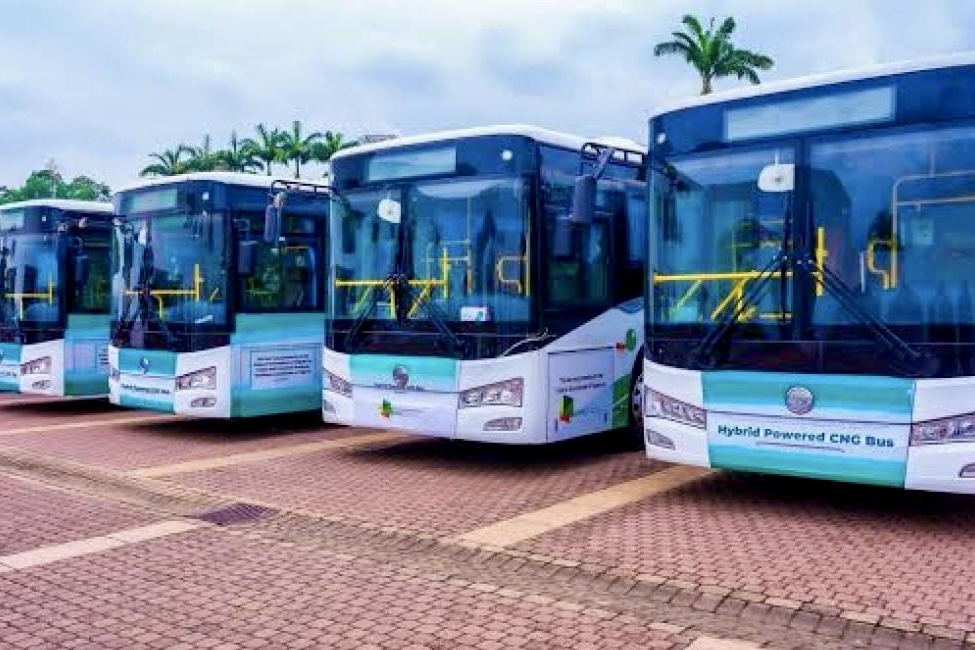
As Joe Ajaero and Festus Osifo trade accusations over the Federal Government’s ₦70,000 transport allowance, questions over 405 CNG buses, union representation and the next minimum-wage negotiations expose deeper weaknesses in Nigeria’s labour movement.
Nigeria’s two most powerful labour centres are fighting over who has the right to negotiate for workers. But beyond the increasingly bitter exchanges between Nigeria Labour Congress (NLC) President Joe Ajaero and Trade Union Congress (TUC) President Festus Osifo lies a more consequential question: who is accounting for the benefits, money and government-backed assets supposedly secured in workers’ interests?
The immediate dispute concerns a Federal Government promise to pay public servants ₦70,000 monthly in transport support for six months, beginning in November 2026.
The agreement could involve hundreds of billions of naira. Yet the number of eligible beneficiaries, detailed payment arrangements and total budgetary provision remain unclear.
There is also an unresolved question surrounding hundreds of compressed natural gas (CNG) buses delivered to organised labour to reduce transportation costs.
While Ajaero is demanding explanations about the deployment of buses allocated to the TUC, the dispute has escalated into personal accusations against Osifo, including allegations that he operates as an absentee labour leader based in the United States.
The danger is that the public argument between the two union presidents could overshadow the very issues they were elected to defend: workers’ incomes, purchasing power, employment conditions and economic security.
The emerging crisis is therefore bigger than a disagreement over an allowance. It is becoming a test of transparency and accountability within Nigeria’s organised labour movement.
The ₦465.7bn Question Behind the Transport Allowance
On 27 October 2026, the Federal Government and the NLC reached an agreement providing for a monthly transport intervention of ₦70,000 for public servants across all levels for six months.
The arrangement followed renewed labour pressure over rising transportation costs, outstanding welfare agreements and the declining purchasing power of Nigerian workers.
The agreement was contained in a memorandum of understanding signed by the Director-General of the Budget Office, Timi Yakubu; NLC President Joe Ajaero; the Permanent Secretary of the Service Welfare Office, Garba Abdul; and the Minister of Labour and Employment, Muhammad Maigari Dingyadi.
The intervention represents ₦420,000 for each eligible worker over the six-month period. It is separate from the existing national minimum wage and does not constitute a permanent salary increase.
But the potential financial exposure is considerably larger.
An analysis published by The PUNCH on 29 October, using 1,108,800 employee records on the Integrated Personnel and Payroll Information System (IPPIS) as of July 2026, estimated that the intervention could cost ₦465.7bn if every record represents an eligible beneficiary.
That translates into approximately ₦77.6bn monthly.
Crucially, this is an estimated exposure, not a confirmed government appropriation. The actual cost will depend on the verified number of eligible employees and the final payment arrangements.
The distinction is important.
A government commitment involving almost half a trillion naira should come with clear beneficiary criteria, an identified funding source, a payment timetable and an independently verifiable disbursement record.
Without those safeguards, workers could receive inconsistent payments while taxpayers remain unable to establish how much the intervention actually costs.
Chief Executive Officer of the Centre for the Promotion of Private Enterprise, Dr Muda Yusuf, welcomed the relief but argued that government should complement cash support with affordable mass transit.
He also suggested that government agencies provide buses for their employees and that private-sector employers consider similar arrangements.
Ayodeji Ebo, chief executive officer and partner at MDU Capital Limited, warned that the government needed to disclose how the intervention would be funded.
Approval, he argued, did not automatically establish that sufficient funds had been provided.
The wider economic question is whether Nigeria is spending hundreds of billions of naira to temporarily compensate workers for expensive commuting without investing sufficiently in the infrastructure that makes transportation affordable.
Why the NLC and TUC Want Different Things
The disagreement between the two labour centres reflects competing approaches to workers’ economic difficulties.
The NLC has defended the negotiated transport intervention as an immediate measure to cushion the impact of rising living costs.
The TUC considers it inadequate.
Following its National Administrative Council meeting on 8 October, the TUC submitted demands to the Federal Government through the Office of the Secretary to the Government of the Federation.
Its position was that government should increase workers’ salaries rather than introduce another temporary intervention.
The TUC argued that the Federal Government could raise the salary of its lowest-paid worker from ₦70,000 to ₦300,000 and implement consequential adjustments across other salary grades.
It maintained that government did not need to negotiate a new national minimum wage before increasing workers’ existing salaries.
In its statement, the congress declared:
“The Federal Government should review and increase salaries of workers. This was hinged on the fact that the government does not require the minimum wage to be negotiated before increasing workers’ pay, as there is no maximum wage law in the country.”
The TUC also demanded implementation of outstanding agreements with the Joint Health Sector Unions (JOHESU), particularly the adjustment of the Consolidated Health Salary Structure.
It rejected temporary wage interventions as insufficiently sustainable, arguing that previous arrangements had not benefited all eligible workers consistently.
The NLC’s position is different.
Ajaero maintains that the TUC was not part of the negotiations that produced the October agreement and should not attempt to invalidate an arrangement it did not sign.
The NLC president has also argued that the union had issued an ultimatum to the government before the negotiations that resulted in the transport intervention.
But Osifo disputes that account.
In an interview with Channels Television on 30 October, he claimed that the Federal Government had already engaged the TUC over its proposals before Ajaero’s meeting with the Ministry of Labour.
According to Osifo, a meeting involving the TUC and government representatives took place under the supervision of Secretary to the Government of the Federation George Akume.
He also said Akume subsequently discussed the proposed wage award with TUC Secretary-General Nuhu Toro.
Osifo insisted:
“Wage award was already rejected before Ajaero even went there.”
He further challenged Ajaero’s account of the negotiations, saying:
“He said he negotiated. It is a complete lie. He never negotiated.”
These are competing accounts of the negotiations. Osifo’s claim that the government discussed the proposal with TUC representatives raises a further question: was the TUC excluded from the final agreement, or had it already rejected the intervention before the NLC reached its own settlement?
The distinction is important because participation in preliminary consultations is not necessarily the same as participating in, or signing, a final agreement.
The government’s meeting records, correspondence and the submissions made by both labour centres would help establish precisely what happened.
The Minimum Wage Dispute Has a Legal Dimension
Ajaero’s comments about the establishment of a Minimum Wage Negotiation Committee have added another layer to the disagreement.
Speaking on Channels Television’s The Morning Brief on Monday, the NLC president argued that organised labour could not formally submit its minimum wage position before a properly constituted committee.
He said:
“You can’t present your position on what should be the minimum wage when a committee has not been set up.”
He also rejected the interpretation that figures mentioned publicly by labour leaders should be treated as formal demands.
Addressing suggestions that Nigerian workers should demand ₦500,000 or even ₦1m monthly, he explained:
“These are things that have been speculated in the media. You don’t send your submission to the media. It is at the resumed sitting of the minimum wage committee that every group will bring their own submission with justification.”
Ajaero also stressed the importance of considering inflation and the cost of living before determining an appropriate wage.
His argument raises a legitimate procedural point. Minimum wage negotiations require more than public declarations. They require organised submissions, economic justification and engagement between government, employers and workers.
But there is an important legal complication.
The National Minimum Wage (Amendment) Act 2024 shortened the statutory review cycle from five years to three years.
The Federal Government maintains that the existing ₦70,000 minimum wage is due for review on 1 June 2027.
In a letter dated 12 October, Labour Minister Muhammad Dingyadi reportedly rejected the NLC’s demand for an early review, describing another exercise barely two years into the current arrangement as premature and inconsistent with the law.
The NLC, in response, argued that preparations should begin immediately to avoid delays and maintained that negotiations should have commenced by 17 October 2026.
The government and the NLC subsequently agreed on 27 October to constitute a Minimum Wage Negotiation Committee and commence meetings immediately.
They did not agree on the effective date for implementing a new wage.
This leaves an important distinction.
Starting preparatory negotiations ahead of the statutory review date is not necessarily the same as implementing a new minimum wage before the existing arrangement expires.
There is also a question about implementation. Although the October memorandum promises immediate constitution of the committee, Ajaero’s 2 November remarks suggest that the process had not yet reached the stage where labour organisations could formally submit their proposals.
The government should clarify whether the committee has been constituted, who its members are and when its first meeting will take place.
Workers need a timetable, not another cycle of competing political and industrial statements.
Who Has the Authority to Speak for Nigerian Workers?
The NLC and TUC disagreement is also becoming a dispute about representation.
Osifo insists that the NLC cannot negotiate on behalf of TUC-affiliated unions without their participation or consent.
He said:
“You cannot negotiate for a body that is represented, for a body that has a trade union. You cannot negotiate for them on their behalf!”
He maintained that the two labour centres must sit together when negotiating matters affecting their respective affiliates.
Ajaero has taken the opposite position.
He argued that the NLC can negotiate independently, pointing to what he described as the principle of the most representative workers’ organisations under the International Labour Organisation (ILO).
He said:
“TUC can negotiate along with NLC but NLC can negotiate alone based on the principle of most workers representatives of the ILO.”
Ajaero further argued that the NLC has more affiliates and that the composition of the Joint National Public Service Negotiating Council supports its position.
According to him, seven of the eight union bodies in the council belong to the NLC, while one is affiliated with the TUC. This remains his account of the council’s composition and authority.
There is an international labour relations dimension to the disagreement.
Nigeria ratified ILO Convention No. 144 on Tripartite Consultation in 1994. The convention recognises representative workers’ and employers’ organisations and provides for representatives to be freely chosen by their respective organisations.
But the convention concerns consultation on international labour standards. It does not, by itself, settle every question about which Nigerian labour centre can negotiate or bind another organisation in a domestic agreement.
The precise domestic procedures, the organisations represented and the authority under which each agreement was reached remain important.
International Labour Organization+1
The deeper problem is that Nigeria’s labour movement risks becoming less effective when its constituent organisations cannot agree on the machinery through which they represent workers.
A divided labour movement gives government greater room to negotiate separate arrangements while workers struggle to establish whether the resulting agreements protect their collective interests.
The 90 CNG Buses: A Public Asset Without a Clear Public Record?
Perhaps the most revealing part of Ajaero’s latest interview concerned the CNG buses allocated to organised labour.
The NLC president questioned the deployment of 90 buses reportedly allocated to the TUC, demanding to know the routes they were operating.
He asked:
“Actually, where are the routes that the CNG bus, the 90 buses from TUC, the routes they are plying, where are they? Or did they develop wings?”
Ajaero maintained that the Federal Government provided funds to support the operation of the buses and said the NLC intended to deploy its own fleet across the geopolitical zones.
He argued that the vehicles were intended to ease the transportation burden on Nigerian workers and commuters.
But there is an important piece of information that gives the dispute a wider dimension.
The Presidential Compressed Natural Gas Initiative (Pi-CNG) confirms that 405 CNG buses were delivered collectively to the NLC and TUC in November 2025 as part of the agreements associated with the minimum-wage negotiations.
At the handover, Ajaero described the vehicles as assets belonging to Nigerian workers.
He said:
“These buses are not just vehicles — they are assets that belong to Nigerian workers.”
He also said they would generate income for the unions and provide affordable transportation for their members.
Yet the initiative’s published account does not provide a detailed breakdown of how the 405 buses were divided between the labour centres, their individual registration details or their current route utilisation.
It therefore does not independently establish the operational status of the 90 buses mentioned by Ajaero. Nor does his allegation prove that the vehicles are missing or deliberately being withheld from public use.
The infrastructure supporting those buses also deserves scrutiny.
The Presidential CNG Initiative’s published station register, updated on 15 October 2026, listed 105 refuelling stations across 24 states and the Federal Capital Territory.
But the geographical distribution is uneven.
The South-West had 36 stations and North-Central 32. The South-South had 17, while the North-West had 13.
The North-East had just four, and the South-East three.
This matters because handing over a CNG bus is not the same as establishing a sustainable commuter service.
The vehicles need reliable access to fuel, maintenance facilities, qualified drivers, depots, insurance, route management and transparent revenue arrangements.
Ajaero himself acknowledged that CNG infrastructure was not yet readily available, explaining that money had been provided to facilitate the purchase of fuel.
That raises further operational questions.
How much money was released for fuel? Which organisation received it? What proportion has been spent? How many buses are operational? What routes are being served? How much do passengers pay? What revenue has been generated?
The official CNG programme has published an overall fleet delivery figure. Workers deserve the operational records behind that figure.
Pi-CNG & EV Presidential Initiative
Osifo’s US Residency Claim Needs Evidence
Ajaero’s criticism has now moved beyond policy and institutional authority.
He described Osifo as an absentee TUC president and alleged that the TUC leader lives in the United States rather than Nigeria.
He said:
“He is an absentee president of TUC. He doesn’t live in Nigeria. He comes in from the U.S. to attend meetings and rush back.”
Ajaero also questioned Osifo’s attendance at meetings of the National Pension Commission (PenCom), where both leaders serve as representatives of their respective labour organisations.
He alleged that Osifo had made only one virtual appearance at meetings from his overseas base.
These are serious allegations, but they should not be treated as established facts without independent documentary evidence.
PenCom’s official board directory confirms that Osifo is listed as the TUC representative and Ajaero as the NLC representative.
The directory, however, does not provide attendance records or board meeting minutes that would establish whether Osifo has neglected his responsibilities.
Osifo’s reported response on 2 November focused on the authority of the NLC to negotiate for TUC members. The published account did not provide a substantive response to the specific allegations about his residency and board attendance.
National Pension Commission+1
The questions should be straightforward.
Has Osifo been resident outside Nigeria for extended periods? How many PenCom meetings has he attended physically or virtually? Does the commission maintain attendance records? Have the meetings he reportedly missed affected his responsibilities?
These questions can be answered through verifiable records.
A public argument between union presidents should not substitute for evidence.
Workers Need Results, Not Rival Labour Centres
The October agreement contains other important commitments beyond transport support.
The Federal Government approved payment of outstanding peculiar allowances effective from 1 May 2026, with arrears scheduled for payment in three equal monthly instalments beginning in November.
It also agreed to redeem 19 months of outstanding health workers’ allowances within three months from December 2026.
Further assessments are expected on the Consolidated Health Salary Structure adjustment and hazard allowances for agricultural officers.
The government and labour representatives also agreed to reconvene after one month to review implementation.
The Joint National Public Service Negotiating Council has defended the ₦70,000 transport intervention, describing it as welcome relief given the high cost of commuting.
This is significant because it shows that opposition to, and support for, the arrangement cannot be reduced to a simple contest between two union presidents.
The immediate issue is whether the commitments will be implemented and whether workers will receive the benefits on time.
For Nigerian workers, the difference between a temporary allowance and a permanent salary increase is substantial.
A six-month intervention offers short-term assistance. It does not necessarily improve long-term earnings, pension calculations or future salary progression.
Likewise, hundreds of CNG buses represent little benefit to workers if they cannot identify accessible routes or obtain affordable fares.
The NLC has a responsibility to demonstrate what its negotiations have achieved. The TUC must explain how its proposed salary increase would be funded and implemented. Both organisations should account for the government-supported assets entrusted to them.
The government, meanwhile, cannot escape responsibility by allowing labour leaders to fight over negotiations while payment arrangements, eligibility and public asset records remain unclear.
The most important question is no longer whether Ajaero can negotiate without Osifo or whether Osifo lives in America.
It is whether Nigeria’s organised labour movement can demonstrate that the money, agreements and transport assets secured in workers’ names are actually improving their lives.
A ₦465.7bn potential public expenditure demands accountability. A fleet of 405 government-backed buses demands verifiable deployment. A minimum-wage negotiation process demands legal clarity.
Nigerian workers should not have to choose between two competing labour leaders to obtain answers about benefits that belong to them.
Follow us on our broadcast channels today!
- WhatsApp: https://whatsapp.com/channel/0029VawZ8TbDDmFT1a1Syg46
- Telegram: https://t.me/atlanticpostchannel
- Facebook: https://www.messenger.com/channel/atlanticpostng
Join the debate; let’s know your opinion.