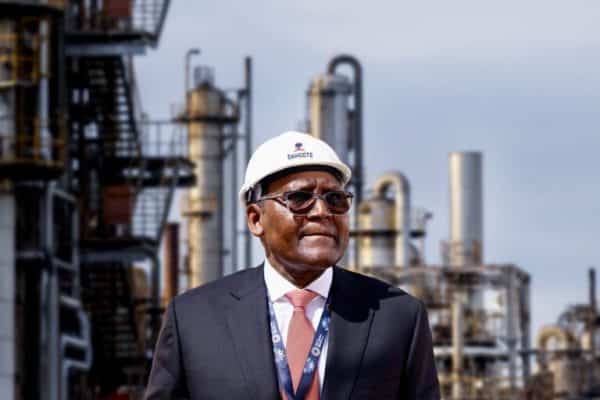
Dangote halts naira fuel sales, sparking panic-buying and market speculation. Will Nigeria’s fuel crisis plunge the economy into deeper turmoil?
LAGOS, Nigeria — In a dramatic twist that has sent ripples through Nigeria’s energy sector, the suspension of naira sales by the Dangote Petroleum Refinery has sparked widespread anxiety among fuel marketers, industry experts, and even government officials.
The move—allegedly designed to pre-empt a currency mismatch between domestic revenue and crude oil purchase obligations—has led to a frantic race among filling stations to stockpile Premium Motor Spirit (PMS).
This article delves into the complexities of the naira-for-crude deal, examines the key players involved, and explores the potential economic fallout, all while questioning whether this strategy will ultimately stabilise or further destabilise the nation’s already precarious fuel market.
The Genesis of the Naira-for-Crude Dilemma
Last week, the Dangote Petroleum Refinery, touted as a flagship project intended to revolutionise Nigeria’s refining capacity, announced that it would temporarily halt the sale of petroleum products in naira.
The announcement was prompted by a glaring discrepancy: the refinery’s sales revenue—collected in naira—had outstripped the volume of naira-denominated crude it received.
With its crude oil purchase obligations firmly tethered to the US dollar, Dangote’s management contended that continuing the practice of accepting payments in naira could result in a severe financial mismatch.
In an era when every naira counts, such a mismatch could expose the firm to significant foreign exchange risks, thereby imperilling its operational viability.
Critics argue that the suspension is less about prudent financial management and more about exerting pressure on the government to revisit the longstanding naira-for-crude arrangement.
This deal, once heralded as a breakthrough that would empower local refineries by ensuring that crude oil is purchased in the nation’s currency, now appears to be mired in bureaucratic wrangling and operational challenges.
The fallout from this decision has not only caught the attention of key stakeholders but has also exposed the deep fissures in Nigeria’s energy policy and regulatory framework.
Panic Buying and Market Speculation: The Domino Effect
Almost immediately following the suspension, an unexpected phenomenon occurred at the grassroots level. Filling stations across Lagos and other commercial hubs began stockpiling PMS, clearly anticipating a price hike in the near future.
With depot owners quick to capitalise on the uncertainty, the cost of loading petrol surged from below N850 per litre to approximately N900 per litre.
This sharp increase has been widely interpreted as both a defensive manoeuvre by private depots and a calculated attempt to profit from the impending market volatility.
Chinedu Ukadike, the National Publicity Secretary of the Independent Petroleum Marketers Association of Nigeria (IPMAN), was quick to criticise what he described as opportunistic profiteering.
In an interview with our correspondent, Ukadike warned that panic buying and excessive stockpiling might soon lead to significant financial losses for the very marketers hoping to secure a competitive edge.
“Some marketers are buying in large volumes at a higher rate with the expectation that prices will continue to climb,” he explained. “But if the Dangote refinery reverses its policy, these very same marketers could be left with unsold stock and enormous losses.”
The contrasting approaches of private depot owners and filling station marketers have thrown the entire downstream sector into a state of speculative frenzy.
While the former appear to be leveraging the situation for immediate gains, the latter face the very real risk of being caught in a precarious balancing act.
The overall uncertainty has not only cast a shadow on the immediate future of fuel pricing but also raised broader questions about the sustainability of a market where speculation could override genuine demand.
Behind the Scenes: Negotiations and the Naira-for-Crude Policy
In the wake of these events, both the Federal Government (FG) and Dangote Petroleum Refinery have been embroiled in high-stakes negotiations to revive the naira-for-crude arrangement.
The suspension of naira sales has sparked a flurry of meetings and consultations, with officials from the Federal Ministry of Finance and the Federal Ministry of Petroleum Resources working feverishly to resolve the impasse.
The Technical Sub-Committee on the Naira-for-Crude Policy is set to reconvene, tasked with re-examining the policy framework and proposing viable solutions that could restore market stability.
A key component of these negotiations involves addressing the mismatch between revenue currency and crude procurement obligations. The refinery, with a colossal capacity of 650,000 barrels per day, is acutely aware that its operational efficiency hinges on a well-calibrated financial model.
However, critics have pointed out that the underlying issues may be symptomatic of a broader malaise within the national oil sector—a malaise characterised by inflexible regulatory structures, bureaucratic inertia, and an over-reliance on volatile international currency markets.
The current deadlock, therefore, is not merely a short-term pricing anomaly but a reflection of deeper structural challenges. For instance, some industry insiders have speculated that the suspension might be a deliberate tactic to curb the monopolistic tendencies of the Dangote refinery.
By forcing the refinery to negotiate in a foreign currency, the FG might be signalling its intent to level the playing field, ensuring that domestic refiners are not unduly disadvantaged by a system that could otherwise encourage price manipulation.
The Ripple Effect: Economic and Currency Implications
The ramifications of the suspension extend far beyond the immediate concerns of fuel marketers and refinery executives. One of the most significant risks pertains to the potential pressure on Nigeria’s foreign exchange market.
With the Dangote refinery now sourcing crude in dollars, the ensuing demand for US currency is likely to exacerbate the existing pressures on the naira.
Experts warn that this could undermine the stability the currency has managed to achieve in recent months, thereby affecting a wide array of economic activities.
The scenario is further complicated by the interplay between domestic and international factors. On one hand, the continued reliance on the US dollar for crude procurement exposes the refinery—and by extension, the entire downstream sector—to fluctuations in international exchange rates.
On the other hand, the ongoing speculation and panic buying could induce short-term price hikes that have cascading effects on inflation and consumer spending.
In essence, the suspension of the naira-for-crude deal has transformed a technical financial adjustment into a potent economic disruptor with the potential to reverberate across multiple sectors.
The Industry’s Dilemma: Balancing Profit and Prudence
As the dispute intensifies, industry stakeholders are increasingly divided on the best course of action. While some private depot owners have taken the opportunity to elevate prices and secure immediate profits, many filling station operators and independent marketers remain sceptical.
The cautionary stance of IPMAN’s leadership highlights a broader concern: that aggressive stockpiling and speculative buying could ultimately backfire, leaving marketers burdened with excessive inventory when—and if—the Dangote refinery reinstates naira sales.
The sentiment is encapsulated in the warning issued by IPMAN’s Ukadike, who stressed that “the Dangote refinery may crash the price” once the issue is resolved.
Such a scenario would not only erode the gains made by the profiteers but could also trigger a broader market correction, with potentially severe financial consequences for those who have overextended themselves in anticipation of a sustained price increase.
International Intrigue: The Role of IOCs and Crude Supply Dynamics
Adding another layer of complexity to the situation is the contentious role of international oil companies (IOCs) in Nigeria’s crude supply chain.
The Dangote refinery has long maintained that IOCs have conspired to undermine its operations by insisting on selling crude oil through foreign agents at a premium above the official price.
Such claims, if substantiated, paint a picture of an industry where geopolitical considerations and profit motives intersect in ways that disadvantage domestic players.
Moreover, the controversy over the premium pricing of crude oil—a matter that once elicited sharp criticism from both domestic refiners and industry regulators—has resurfaced as a key point of contention.
With allegations that IOCs have consistently prioritised sales to Asian markets, there is growing concern that the domestic market is being systematically short-changed.
This, in turn, has lent credence to the FG’s decision to reconsider the naira-for-crude deal, as it seeks to insulate local refiners from the vagaries of international pricing and market dynamics.
A Tipping Point for Nigeria’s Energy Sector?
At its core, the current crisis is emblematic of the broader challenges facing Nigeria’s energy sector. The suspension of naira sales by the Dangote refinery is not an isolated incident but rather a symptom of a system under stress—a system where regulatory inflexibility, market speculation, and conflicting economic imperatives collide.
The immediate effects are already being felt on the ground, with price hikes and frantic stockpiling serving as stark reminders of how quickly market sentiment can shift in an environment characterised by uncertainty.
For policymakers, the imperative is clear: there is an urgent need for a comprehensive review of the nation’s energy policies, with a view to fostering a more stable and predictable market environment.
This involves not only reconciling the currency mismatch that has led to the current impasse but also addressing the systemic issues that have long plagued the sector, from the opaque dealings of IOCs to the regulatory bottlenecks that stifle innovation and fair competition.
The Road Ahead: Negotiations, Reforms, and Market Resilience
In the immediate term, all eyes are on the ongoing negotiations between the FG and Dangote Petroleum Refinery. With the Technical Sub-Committee on the Naira-for-Crude Policy set to reconvene, there is cautious optimism that a resolution may be on the horizon.
However, any lasting solution will require more than a mere adjustment of sales currency—it will demand a radical rethinking of how Nigeria manages its most vital economic asset.
For industry insiders, the current episode is a wake-up call. The challenges of currency volatility, speculative market behaviour, and international competition underscore the need for a more resilient and adaptive business model.
In this regard, the crisis may ultimately serve as a catalyst for much-needed reforms, forcing stakeholders to confront the deep-seated issues that have long undermined the country’s energy security.
As discussions continue and negotiations intensify, the question remains: will the suspension of naira sales by the Dangote refinery prove to be a calculated strategy that safeguards Nigeria’s economic interests, or will it backfire, plunging the nation into a deeper financial quagmire?
The stakes could not be higher. At a time when every naira counts and the global energy market is more unpredictable than ever, the outcome of this crisis will have far-reaching implications—not only for Nigeria’s energy sector but for its broader economic trajectory.
Conclusion: A Crucial Juncture in Nigeria’s Energy Saga
The unfolding drama around the naira-for-crude deal is a vivid illustration of the tightrope that Nigeria’s energy sector must walk in a volatile global environment.
On one side lies the promise of a robust, locally-driven refining industry capable of delivering affordable fuel to millions; on the other, a maze of financial, regulatory, and geopolitical challenges that threaten to upend even the most well-intentioned initiatives.
For the fuel marketers, refinery executives, and policymakers grappling with the fallout, the imperative is to balance short-term gains against long-term stability.
As negotiations proceed and market participants weigh their next moves, one thing is abundantly clear: the resolution of the naira-for-crude conundrum is not merely a technical adjustment but a defining moment that could reshape the future of Nigeria’s energy sector.
In this high-stakes environment, caution and strategic foresight are paramount. While the immediate focus is on managing the current market volatility, the broader challenge remains to create a regulatory and financial framework that can withstand the pressures of international competition and domestic uncertainty.
Only time will tell whether the steps being taken today will pave the way for a more stable and prosperous future for Nigeria’s fuel market—or whether the current crisis will serve as a harbinger of deeper economic challenges yet to come.
As the nation watches with bated breath, the coming days will be crucial in determining the ultimate fate of the Dangote refinery’s naira-for-crude policy.
In the volatile intersection of energy, economics, and politics, every decision matters, and the repercussions of today’s actions will undoubtedly be felt for years to come.
- Additional report from Taiwo Adebowale, Atlantic Post Senior Business Correspondent