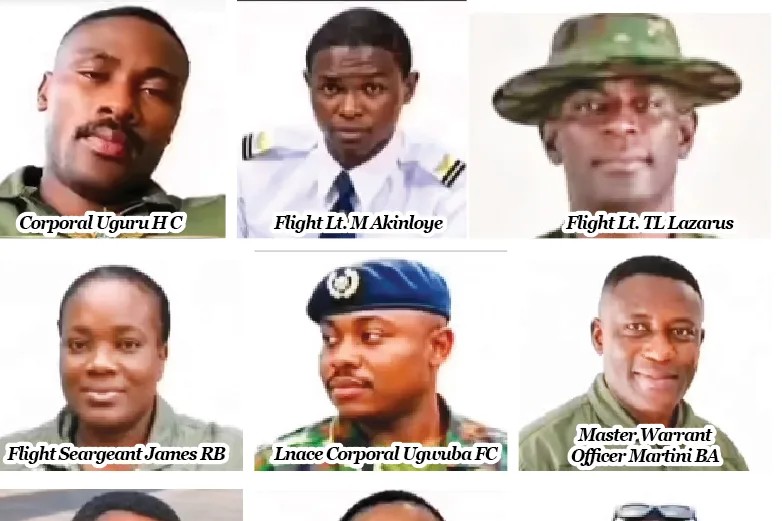
A couple travelling for wedding introduction rites, an HND graduate preparing for NYSC and a newly commissioned officer were among 25 people killed in the Ondo air crash. As families await their loved ones’ remains, questions about the aircraft’s maintenance history, its final hours and the transparency of the investigation demand answers.
The most painful part of the Nigerian Air Force’s ATR-42 crash in Ondo State is not only that 25 people died. It is that, days after the disaster, families are still waiting for the remains of loved ones they hoped to welcome home, bury with dignity and remember in peace.
Joy and Sunday Micheal were travelling to Lagos to begin the traditional introduction rites ahead of their wedding. Ukeme David had recently completed his Higher National Diploma in Accounting and was preparing for mobilisation into the National Youth Service Corps. Flying Officer IM Adeshina had been commissioned into the Nigerian Air Force barely nine days earlier.
Their journeys ended in the same swamp near Igbokoda, the headquarters of Ilaje Local Government Area in Ondo State, when aircraft NAF 931 crashed on Monday, 5 October.
The tragedy has left families mourning lives interrupted at different stages. It has also exposed urgent questions about the recovery of human remains, communication with bereaved relatives and the evidence needed to establish what happened aboard the aircraft.
The Nigerian Air Force has begun searching for the flight data recorder and cockpit voice recorder. Reports have also raised questions about the aircraft’s previous maintenance and a possible engine fault before its final departure from Benin City.
None of those reports establishes the cause of the crash. But each is a line of inquiry that investigators must pursue, document and explain.
Wedding plans turned into a desperate search for remains
For the Micheal family, the trip to Lagos was supposed to bring them closer to a wedding they had anticipated celebrating with relatives.
Instead, the family is confronting the loss of both Joy and Sunday.
Sunday’s sister, Damilola, told Saturday PUNCH that the family’s immediate priority was to recover their remains so they could be buried properly.
The family’s plea was simple: “reclaim the bodies of my brother and his wife”.
Their mother, according to Damilola, was struggling to bear the loss. The absence of their remains has added a further burden to a family already trying to comprehend how an ordinary journey ended in catastrophe.
Damilola also wrestled with the spiritual questions that often follow sudden and devastating deaths. Describing her brother as a committed Christian, she asked: “how can we escape life’s tragedies despite prayers?”
Her question reflects the helplessness of a family that cannot reverse what happened but still needs answers, support and the opportunity to mourn its dead.
Joy and Sunday were among the six civilians listed by the Nigerian Air Force as passengers aboard NAF 931. The others were Mrs Ezeh Nneka, Godstmine Tarabina, Ukeme David and Gideon Omotola.
The circumstances of their deaths differ, but their families share a common demand: clear information about the recovery operation and a credible explanation of the disaster.
Families say information has been inadequate
In Yenagoa, Bayelsa State, the family of Godstmine Tarabina was also grieving while seeking information about the search.
His sister, Perfection, told Saturday PUNCH that the family had not received an official briefing from the Air Force on the progress of the recovery operation.
The lack of direct communication, she said, had compounded their distress. Godstmine was a civilian passenger, not a serving military officer, and had been returning home when the aircraft crashed.
The distinction matters. The disaster involved military personnel and civilians, but every bereaved household needs timely, accurate information regardless of the victim’s employment or relationship with the armed forces.
By 10 October, Chief of the Air Staff Air Marshal Sunday Kelvin Aneke had publicly reaffirmed the Nigerian Air Force’s commitment to supporting the families of personnel killed in the crash. During a visit to the 107 Air Maritime Group at the NAF Base in Benin City, he promised emotional, administrative and institutional support.
That assurance is important, but it does not resolve the separate concern raised by civilian families about communication and the return of their loved ones’ remains.
The Air Force should establish a clear family liaison system, provide regular briefings on recovery progress and explain what relatives should expect regarding identification, release and burial arrangements.
Families should not have to depend on media reports or fragments of information from the crash site to understand what is happening.
A graduate’s NYSC plans and a football ambition cut short
Ukeme David had recently completed his HND in Accounting at the Federal Polytechnic, Ukana, in Akwa Ibom State. He was preparing for mobilisation into the NYSC scheme and hoped to pursue football alongside his career ambitions.
He had travelled to Benin to visit his father, who was stationed there, before boarding NAF 931 for the journey to Lagos.
His uncle, Hamilton Meko, said the family had expected a short trip, not a tragedy that would end a young man’s plans before they could properly take shape.
David’s parents were both master warrant officers serving at the Nigerian Air Force Base in Ikeja, Lagos. His death has therefore struck a family with close ties to the institution now investigating the aircraft’s final flight.
Meko called on the Federal Government, the Air Force and the relevant aviation safety authorities to ensure that the inquiry was thorough and independent, with its findings made public.
He also argued that any negligence, misconduct or safety breach established by investigators should attract “appropriate legal and professional consequences”.
The call is not a finding of wrongdoing. It is a demand for an investigation capable of distinguishing between an unavoidable technical failure, human error, procedural shortcomings and any preventable lapse.
For the David family, accountability would not undo the loss. It could, however, help establish whether the disaster revealed a failure that must be corrected to protect others.
A new officer and a co-pilot were also among the dead
The crash also ended the careers and personal plans of military personnel whose colleagues and relatives are mourning their loss.
Flying Officer IM Adeshina had been commissioned on 26 September, only nine days before the crash. An online tribute described him as the best graduating cadet of Branch Commission Course 3 and reflected on the promise of a career that had barely begun.
The tribute remembered him not simply as a name on a casualty list but as a son, brother, friend and colleague who had started his service to Nigeria.
Squadron Leader Ahamefule Aham Man-Ugwueje, the aircraft’s co-pilot, was another victim. Photographs shared online showed that he had celebrated his wedding at the NAF Base on 20 September, about two weeks before the disaster.
One family’s wedding journey was interrupted before the introduction rites. Another newly married couple was separated by a crash. A young graduate lost the opportunity to begin national service, while a newly commissioned officer’s military career ended almost as soon as it began.
These details matter because they reveal the human cost behind the technical questions the investigation must answer.
The aircraft was not merely a military asset lost in a swamp. It was carrying people with families, obligations and futures that depended on their safe arrival.
Black box search could hold the key to the crash
The aircraft crashed at about 9am on 5 October while travelling from Benin City, Edo State, to Lagos. It went down in a swamp near the Nigerian Navy’s base in Igbokoda, making the recovery operation difficult.
Local fishermen recovered personal belongings, clothing and aircraft parts, including a tail fin. Ondo State Governor Lucky Aiyedatiwa confirmed on 7 October that human remains and wreckage had been recovered, although divers had not located the aircraft’s main fuselage at the time.
Military personnel, security agencies, emergency responders, local authorities and community volunteers have been involved in the search.
The next critical stage is the recovery of the flight data recorder (FDR) and cockpit voice recorder (CVR), commonly referred to as the aircraft’s black boxes.
On Friday, 9 October, Air Vice Marshal Ebimobo Ebiowe, the NAF Superintendent of Standards and Evaluation, said the search was continuing. He explained the significance of the wreckage to the inquiry, saying: “the aircraft wreckage actually speaks to investigators”.
The FDR can preserve recorded flight parameters that help investigators reconstruct the aircraft’s movements and technical performance. The CVR can provide cockpit audio, including recorded conversations and relevant sounds, where the equipment and recordings remain usable.
Together with physical examination of the wreckage, maintenance documents and operational records, these devices may help investigators establish what happened during the aircraft’s final minutes.
As at 10 October, I found no official confirmation that either recorder had been recovered. The distinction is important: beginning a search for the devices is not the same as securing them, examining their contents or determining the cause of the accident.
The recovery operation must also preserve the location, condition and handling history of relevant evidence. Documentation will be essential if investigators are to distinguish physical findings from assumptions or accounts based on incomplete information.
Questions about an engine fault before departure
One of the most significant lines of inquiry concerns reports about NAF 931’s movements before its final flight.
According to reports citing sources familiar with the aircraft’s movements, NAF 931 had flown from Abuja to Lagos on Sunday, 4 October, with a stop in Benin. It allegedly developed an engine fault during the stopover and remained on the ground overnight while technicians worked on it.
The aircraft departed Benin for Lagos the following morning and crashed shortly after take-off.
The reported fault has not been established as the cause of the disaster. The Nigerian Air Force’s official account described the aircraft as being on a routine mission from Benin to Lagos and has not publicly confirmed the reported overnight repair episode in the material reviewed for this report.
That leaves several questions for investigators.
What defect, if any, was recorded in Benin? Which components were inspected or repaired? What work did technicians perform? Was a formal maintenance release completed before the aircraft was cleared to fly? Who authorised its return to service, and what checks were carried out before departure?
The answers should come from engineering logs, defect reports, work orders, inspection records, flight documentation and evidence collected from the aircraft and relevant personnel.
If the reported engine fault is confirmed, investigators must establish whether it was resolved, whether it was related to the crash and whether any subsequent warning signs were recorded. If the report is inaccurate, the official record should clarify that too.
Neither a rumour nor the timing of an alleged repair is enough to establish causation.
The purpose of the investigation must be to determine what the evidence supports, not to select a theory before the evidence has been examined.
The aircraft’s German maintenance history needs scrutiny
The reported engine fault is not the only issue that warrants examination.
An investigation by the International Centre for Investigative Reporting (ICIR), published on 6 October, found that NAF 931 had spent almost four years at Rheinland Air Service, a specialist aircraft maintenance facility in Mönchengladbach, Germany.
The ICIR reviewed aviation records and photographs showing the ATR 42-500MP at the facility. The aircraft was documented there in January 2021 and was still at the site in September 2024. It returned to Nigeria in late December 2024.
The reporting also indicated that the aircraft had been photographed at the facility with its right engine and other components removed.
This history does not prove that the previous maintenance was inadequate or contributed to the crash. Specialist maintenance can be necessary to keep aircraft operational and safe. A lengthy stay overseas is not, by itself, evidence of a defect.
But the duration and nature of the maintenance make the records relevant to the inquiry.
There is also an inconsistency in publicly reported dates that deserves clarification. The ICIR’s review of aviation records places the aircraft at the German facility in January 2021, while Military Africa reported in January 2025 that NAF 931 had been sent there for maintenance in January 2022. Both accounts indicate that the aircraft returned to Nigeria in late December 2024.
The Air Force should publish an authoritative maintenance chronology to clarify the dates and explain the work undertaken.
Investigators should examine the aircraft’s maintenance history before and after its return, the work performed in Germany, components replaced or overhauled, subsequent operating hours and any relevant defects recorded before the crash.
They should also establish whether the aircraft’s maintenance status and technical records were complete and current when it departed Benin on 5 October.
These are questions to be answered by the investigation, not grounds for an advance verdict against the technicians, commanders or pilots involved.
Why did the official passenger count change?
The crash has also raised a separate question about the accuracy of the initial information released to the public.
In his statement on 5 October, Aviation Minister Festus Keyamo said preliminary information indicated that 25 passengers and seven crew members were aboard the aircraft, bringing the total to 32.
The Nigerian Air Force subsequently identified 25 people on board: 20 passengers and five crew members. It released a manifest naming the victims and said there were no survivors.
The difference between the two accounts is seven people.
The later NAF figure is the reported official manifest count, but the discrepancy should not be allowed to disappear from the public record without an explanation.
It does not establish that seven people are missing or that the final manifest is incorrect. It does establish a need to clarify how the initial figure was obtained and why it differed from the subsequent official account.
Investigators and the relevant authorities should reconcile the flight manifest, passenger list, crew roster and departure documentation. They should explain whether the initial briefing relied on preliminary information that was subsequently corrected.
The question matters beyond arithmetic. Families depend on accurate casualty information during the most distressing hours of a disaster. Reliable public communication also helps prevent rumours from taking hold while rescue and recovery operations continue.
A corrected figure is useful. An explanation of the discrepancy is better.
A joint inquiry must deliver evidence, not assurances alone
President Bola Tinubu directed the Nigerian Air Force to begin a thorough investigation into the crash.
“This is a painful moment for our Armed Forces and for the entire nation,” he said in a statement on 5 October, also commending the initial response to the disaster.
The Air Force has constituted a high-level investigative team involving military and civilian aviation safety expertise. Reporting on the inquiry has identified participation by the Nigerian Safety Investigation Bureau and other relevant specialists.
That involvement is important because the case requires technical examination beyond a simple account of where the aircraft crashed. Investigators must establish the sequence of events and identify any technical, operational or organisational factors supported by the evidence.
There is also a relevant precedent. In 2021, the Nigerian Air Force and the then Accident Investigation Bureau conducted a joint investigation into a King Air 350 crash near Kaduna. The Air Force reported that an interim report contained 27 initial findings and eight immediate safety recommendations.
That precedent demonstrates the value of technical collaboration. It also provides a reason to insist that the Ondo investigation produces documented findings and practical safety recommendations, rather than relying on assurances that a comprehensive inquiry is under way.
At a minimum, the authorities should establish a clear timeline of NAF 931’s final movements, preserve and examine available flight records, reconcile the passenger-count discrepancy and investigate the reported pre-flight engine fault. They should also account for the aircraft’s maintenance history and explain the basis for any conclusions reached.
Where findings can be made public without compromising legitimate operational or investigative requirements, they should be disclosed in language ordinary Nigerians can understand. Any necessary restrictions should be explained rather than used as a substitute for accountability.
The investigation should also distinguish between the immediate cause of the crash, any contributing factors and broader safety issues that may require corrective action.
That distinction is essential. A mechanical failure, if established, would not automatically prove negligence. Equally, identifying a technical failure would not remove the need to examine maintenance decisions, operating procedures and the safeguards intended to prevent a single fault from becoming a fatal disaster.
The families need answers as well as support
By 10 October, the Chief of the Air Staff had renewed the Air Force’s commitment to supporting bereaved military families. But the civilian families’ accounts show why institutional support must include clear communication about recovery and identification.
For the Micheals, the immediate priority remains the recovery of Joy and Sunday’s remains. For the Tarabina family, the wait has been made harder by the reported absence of a direct update. For the David family, the loss of a young graduate has brought a demand for an investigation whose conclusions are supported by evidence.
Their needs are not separate from the crash investigation. Recovery, identification, communication and accountability are all part of how the authorities respond to a fatal disaster.
The Nigerian Air Force and the investigative team must therefore show progress through verifiable information: what has been recovered, what remains to be found, what evidence is being examined and how families will receive updates.
The swamp at Igbokoda may make the physical recovery slow and difficult. It must not become a reason for uncertainty to persist indefinitely about the investigation.
The victims were 25 people, not simply names on a military casualty list. Their families deserve the return of their loved ones’ remains, an honest account of the final flight and a public explanation of the findings that can safely be disclosed.
The credibility of the investigation will ultimately depend not on how firmly the authorities promise accountability, but on whether they produce evidence, explain the unanswered questions and act on whatever the inquiry establishes.
Follow us on our broadcast channels today!
- WhatsApp: https://whatsapp.com/channel/0029VawZ8TbDDmFT1a1Syg46
- Telegram: https://t.me/atlanticpostchannel
- Facebook: https://www.messenger.com/channel/atlanticpostng


Join the debate; let’s know your opinion.