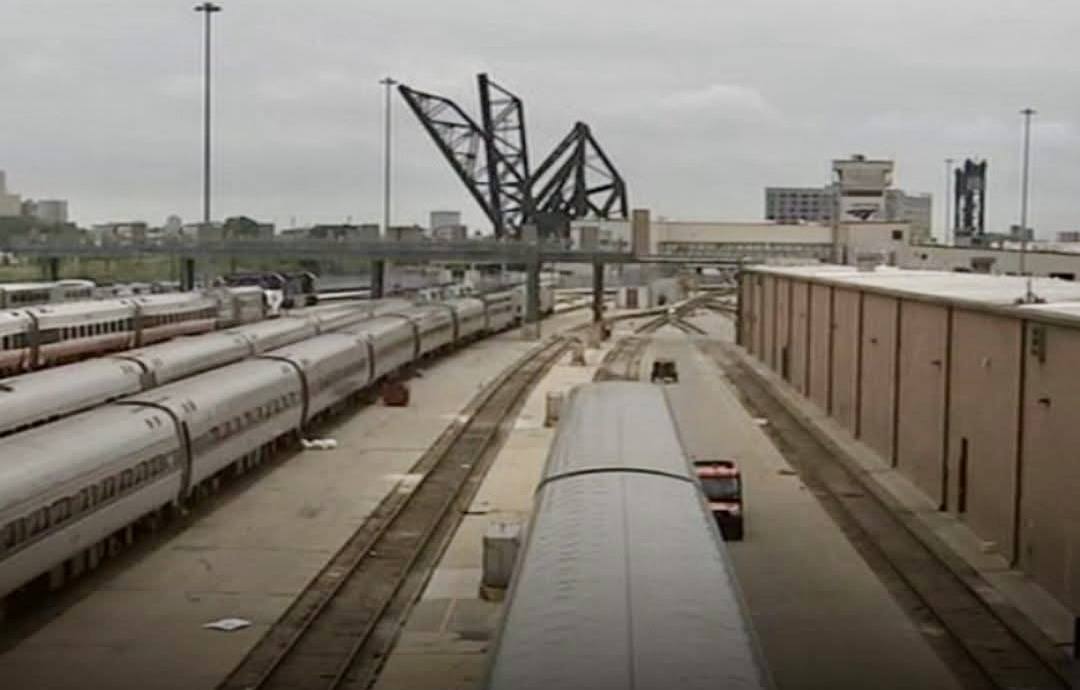
Amtrak’s decision to abandon its proposed Bridgeport maintenance facility and redevelop its existing South Loop rail yard has disrupted a major Chicago property development vision, exposing the financial and infrastructure risks behind a proposed new White Sox stadium.
Chicago’s proposed new White Sox stadium has encountered an unexpected obstacle, and it has little to do with baseball.
A federal infrastructure decision has effectively dismantled the railway relocation arrangement that was expected to unlock 47 acres of valuable South Loop waterfront property for a new ballpark and a wider mixed-use development.
At the centre of the reversal is an estimated $400 million in additional infrastructure costs associated with Amtrak’s proposed relocation of its Chicago maintenance operations to Bridgeport.
On November 24, 2026, Amtrak confirmed that it would abandon the relocation strategy and concentrate instead on redeveloping its existing 14th Street Rail Yard in Chicago’s South Loop.
The announcement followed a November 23 decision by the Federal Railroad Administration (FRA), which withdrew one federal grant and substantially revised another after previously unidentified infrastructure costs undermined the financial case for the relocation.
The consequences extend beyond railway operations. The decision threatens the redevelopment strategy associated with Justin Ishbia, minority owner of the Chicago White Sox, whose proposed development could have provided a new home for the baseball franchise.
More importantly, it raises questions about the financial assumptions behind a development arrangement that connected public railway investment, private real estate interests and the future of one of American baseball’s historic franchises.
The $659 million funding reversal
The financial turning point came when federal authorities reassessed the proposed Midwest Maintenance Facility.
The original arrangement involved two major federal funding allocations.
The FRA had awarded Amtrak up to $572 million towards the proposed maintenance facility at Canal Street Yard in Bridgeport. An additional $87 million had been allocated for bridge and viaduct improvements associated with the project.
Together, the allocations amounted to $659 million.
But subsequent investigations into the infrastructure requirements exposed a substantial financial weakness.
According to a letter from FRA Administrator David Fink to interim Amtrak President Byl Herrmann, an independent lifecycle assessment identified approximately $400 million in additional costs over 50 years to stabilise 17 bridges and viaducts at the proposed site.
Fink described the additional expenditure as:
“major, previously unquantified infrastructure costs that render the Canal Street relocation fiscally untenable.”
The distinction between the two grants is important.
The federal government withdrew the $87 million allocation for bridge and viaduct work, while the $572 million maintenance facility grant was rescoped to support more limited improvements at Amtrak’s existing 14th Street Yard.
The federal government’s permitting dashboard subsequently recorded the cancellation of the environmental review process for the proposed relocation to Canal Street Yard.
The financial implications are significant.
A project initially presented as an opportunity to modernise railway operations and unlock valuable urban land had encountered infrastructure obligations that substantially weakened its economic rationale.
For taxpayers and policymakers, the episode demonstrates why the headline cost of major infrastructure projects cannot be separated from the long-term maintenance liabilities attached to them.
A facility may appear commercially attractive at the construction stage while carrying substantial financial obligations over several decades.
The property development opportunity behind the railway relocation
The proposed relocation was never simply about moving trains from one Chicago neighbourhood to another.
It was also closely connected to a major property development opportunity.
Amtrak intended to move its existing Chicago maintenance operations from its 14th Street Yard, between Polk Street and 18th Street, to the existing Union Pacific Canal Street rail yard in Bridgeport.
The railway operator had described its existing facilities as outdated, undersized and operationally fragmented.
The proposed relocation would have allowed Amtrak to develop a modern maintenance complex capable of supporting contemporary train equipment and future expansion of passenger services.
Under the original arrangement, Amtrak also intended to sell its existing 14th Street property for separate non-rail development.
That 47-acre site, situated along the Chicago River between Roosevelt Road and 18th Street, became the centrepiece of the proposed Railyards development.
Canal Edge LLC, a development company owned by Ishbia, had secured the land under contract and presented plans for a mixed-use destination incorporating a potential new White Sox stadium.
The proposed development was designed to include residential, commercial and retail facilities, alongside a healthcare presence involving Northwestern Medicine.
It was a considerable urban development opportunity, particularly given the South Loop’s proximity to Chicago’s central business district and riverfront.
The railway relocation was therefore the critical piece of the commercial arrangement.
Without Amtrak moving its maintenance operations, the existing railway property would not become available in the manner envisaged by the development proposal.
Justin Ishbia’s $900 million railway project
Ishbia’s involvement makes the collapse particularly significant.
His company, Canal Edge LLC, was expected to contribute more than $125 million towards financing and delivering the proposed $900 million Amtrak maintenance facility in Bridgeport.
The arrangement connected Ishbia’s private investment interests with a major public railway infrastructure project.
The intended outcome was commercially attractive to several parties.
Amtrak would obtain a modernised maintenance facility. Bridgeport would receive a major railway development. The existing South Loop railway property could potentially become available for redevelopment.
Ishbia’s development company would also gain an opportunity to advance The Railyards, including the potential baseball stadium.
But the financial reassessment exposed a problem that the original investment calculations had not adequately captured.
The estimated $400 million in additional lifecycle costs associated with the 17 bridges and viaducts fundamentally altered the economics of the proposed relocation.
The FRA’s intervention therefore represents more than a funding adjustment.
It has disrupted the underlying commercial sequence on which the wider redevelopment opportunity depended.
Importantly, the available evidence does not establish misconduct by Amtrak, Canal Edge or any other participant. It does, however, raise legitimate questions about how the original infrastructure costs were assessed and why such substantial liabilities emerged during subsequent due diligence.
Why Bridgeport residents opposed the project
While the railway relocation encountered financial difficulties, it had also generated considerable resistance among residents.
The proposed maintenance facility would have introduced a major round-the-clock railway maintenance operation into an area surrounded by residential communities.
Residents in Bridgeport and neighbouring areas raised concerns about noise, diesel emissions, vibration, truck movements, hazardous materials and the potential effects of industrial activity on local living conditions.
Community organisations argued that the project had not given residents sufficient opportunities to understand its implications or meaningfully participate in the decision-making process.
Kathleen Hughes of the Armour Bridgeport Coalition described the experience at a November 24 news conference.
“Our neighborhoods deserve better. I hope that going forward, community involvement is a priority from the beginning, not an afterthought.”
Her remarks reflected the wider frustration among campaigners who believed that the community had been insufficiently consulted.
Alderman Nicole Lee and Cook County Commissioner John P. Daley also opposed the proposed location, arguing that a major maintenance facility should not be situated so close to residential neighbourhoods.
Their opposition was not simply about the railway itself. It concerned the distribution of the environmental and economic consequences of a major infrastructure project.
The controversy illustrates a recurring challenge in urban development: the benefits of large infrastructure investments can extend across a metropolitan area, while the immediate environmental and social burdens are concentrated in particular neighbourhoods.
Nevertheless, an important distinction must be made.
The available FRA explanation identifies previously unquantified infrastructure costs as the stated reason for the funding reversal. Community opposition preceded the decision, but the federal funding change should not be presented as proof that protests alone stopped the project.
Is the new White Sox stadium now impossible?
The immediate impact on the White Sox stadium proposal is substantial, but declaring the project permanently dead would be premature.
The Railyards concept was still in its early planning stages when Ishbia’s company unveiled it in September.
Although the proposed development included a new stadium, the White Sox had not formally committed to relocating there.
The team’s position was that the site would be considered alongside other possible locations if the relevant feasibility studies established that it was suitable.
The 47-acre site was attractive because of its Chicago River frontage, its proximity to downtown and the potential for a larger mixed-use development.
However, those advantages depended heavily on Amtrak vacating the land.
With Amtrak now prioritising redevelopment of its existing railway yard, the original route to making that property available has been seriously disrupted.
There is also a separate question of ownership.
In June 2025, the White Sox announced an investment agreement between Jerry Reinsdorf and Ishbia.
The agreement provides Reinsdorf with the option to sell controlling interest to Ishbia between 2029 and 2033. Ishbia also has an option to acquire controlling interest after the 2034 season.
The announcement explicitly stated that the Reinsdorf family would retain controlling ownership and that Reinsdorf would remain the club’s sole day-to-day decision-maker until any future transaction.
Consequently, Ishbia’s involvement in the South Loop development should not be confused with having present-day control over the White Sox’s stadium decisions.
Rate Field and the politics of public investment
The stadium controversy also exposes a difficult question about the use of public money in professional sports development.
The White Sox currently play at Rate Field, their home since 1991.
Their lease runs through the 2029 season, with an option for an additional year.
The existing stadium is publicly owned through the Illinois Sports Facilities Authority, a state government agency.
Local leaders have argued that Chicago taxpayers have already made a substantial investment in the facility and its surrounding infrastructure.
Lee and Daley previously pointed out that Rate Field was built with $137 million in taxpayer funding and argued that the stadium and surrounding neighbourhood still have considerable development potential.
They also warned against proposals that might eventually require tax concessions or tax-increment financing support.
The distinction between private stadium investment and public infrastructure investment is central to the debate.
Even where a developer proposes to finance a stadium privately, roads, bridges, transport links and other supporting infrastructure can generate demands for public expenditure.
That raises an important question for Chicago: should taxpayers help finance the relocation of a railway facility partly because doing so could unlock valuable land for private redevelopment?
The answer requires transparency about who receives the economic benefits and who carries the long-term costs.
It is a question that extends well beyond baseball.
What happens to Amtrak’s Chicago operations?
Amtrak is now directing attention towards the existing 14th Street Yard.
In its November 24 announcement, the company said it was:
“shifting its focus to redevelopment of our existing 14th Street Yard as a better long-term approach”
to modernising its Chicago maintenance facilities.
The railway operator also explained that the existing location provides better operational access to Chicago Union Station.
The revised strategy is intended to address critical infrastructure requirements, support newer trains and accommodate the future growth of Midwest passenger rail services.
This is a significant operational consideration.
Amtrak needs modern maintenance infrastructure to support efficient train servicing and dependable passenger operations.
The original relocation proposal was developed partly because the existing facilities were considered inadequate for future requirements.
The revised strategy therefore presents another challenge: how much modernisation can be achieved at the existing site, and will the revised funding be sufficient?
The FRA has indicated that the original relocation’s environmental review process will be terminated following the change in direction.
But the precise scope, timetable and final financial requirements of the proposed 14th Street redevelopment remain important matters for public disclosure.
The unanswered questions behind Chicago’s stadium setback
Several important questions now require answers.
First, what happens to Canal Edge’s existing contractual arrangements involving the South Loop property? The company had previously said the land was under contract, but the intended railway relocation and property transfer have been fundamentally disrupted.
Second, what will the revised federal grant actually finance at 14th Street? The public deserves a clear account of the new project scope, its cost and the expected operational benefits.
Third, how will the 17 bridges and viaducts be maintained, and which public authority will ultimately carry the financial responsibility?
Fourth, will the White Sox pursue another stadium location, remain at Rate Field or revisit the possibility of redevelopment around their existing home?
These questions are particularly important because the team has not publicly confirmed that the South Loop proposal will proceed following the Amtrak reversal.
The Sun-Times reported that an Ishbia spokesperson did not immediately provide a comment on the latest development, while the White Sox had not responded to requests for comment on the shift’s implications for their stadium plans.
A railway decision with consequences for an entire city
Amtrak’s decision is a reminder that ambitious urban development cannot be built on attractive architectural renderings and optimistic property valuations alone.
The proposal brought together railway modernisation, federal infrastructure funding, private investment, residential concerns and professional sports.
But the financial assumptions supporting the arrangement ultimately encountered a reality that could not be ignored.
The estimated $400 million in additional long-term infrastructure costs helped destroy the economic case for the Bridgeport relocation.
For residents, the decision represents relief from a proposed industrial development they had spent months challenging.
For Amtrak, it means returning to an existing facility that still requires modernisation.
For Ishbia, it introduces uncertainty into an ambitious waterfront development opportunity.
And for the White Sox, it means that one potentially transformative route to a new stadium has become considerably more complicated.
The central lesson is not that Chicago cannot build a new stadium or modernise its railway infrastructure.
It is that large urban development ambitions must account for the full cost of infrastructure, the consequences for surrounding communities and the public obligations that private investment can create.
The next question is whether Chicago will find a better way to reconcile those competing interests.
Follow us on our broadcast channels today!
- WhatsApp: https://whatsapp.com/channel/0029VawZ8TbDDmFT1a1Syg46
- Telegram: https://t.me/atlanticpostchannel
- Facebook: https://www.messenger.com/channel/atlanticpostng


Join the debate; let’s know your opinion.