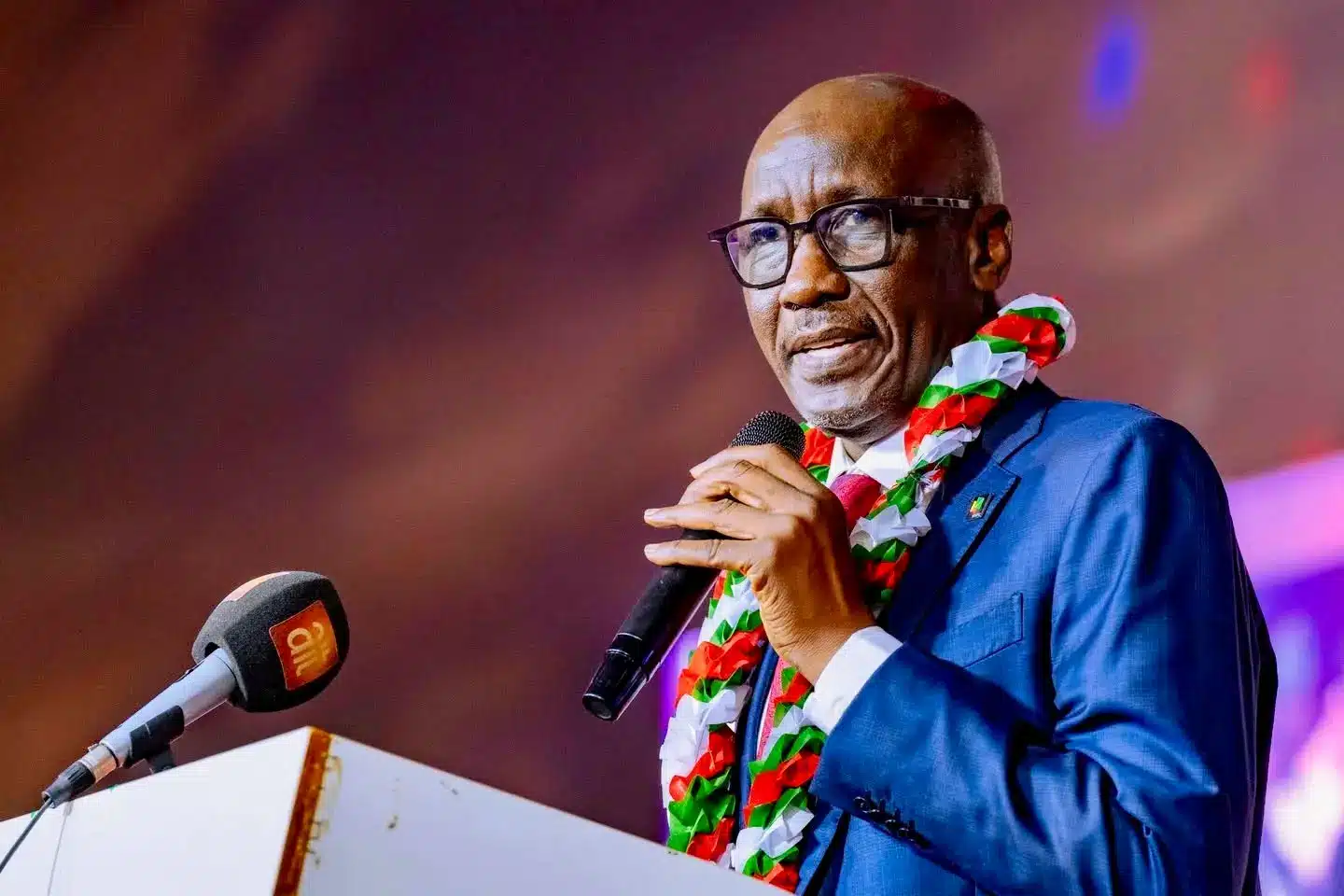
NNPC CEO Mele Kyari decries fuel quality controversies as baseless drama and bad marketing, asserting Nigeria’s Premium Motor Spirit meets global standards while debunking false importation claims.
ABUJA, Nigeria — In a fiery address at the 60th Nigeria Mining & Geosciences Society (NMGS) Conference in Abuja, Group CEO of NNPC Ltd, Mr Mele Kyari, launched a scathing rebuttal against mounting rumours concerning sub-standard fuel quality in Nigeria.
The controversial statement, which has since ignited a maelstrom of debate in both industry circles and the broader public domain, was delivered with the force and authority of a man who has weathered three and a half decades in the business.
A Stark Rebuttal to Fuel Quality Claims
Mr Kyari’s remarks were unequivocal. Describing the ongoing talks about fuel quality as “unfortunate drama” and “bad marketing practice”, he dismissed allegations of sub-standard Premium Motor Spirit (PMS) as nothing more than sensational entertainment aimed at undermining public confidence.
According to Kyari, such reports are not only unfounded but are a deliberate attempt to create a ripple of mischief that could potentially destabilise the nation’s energy sector.
Kyari went on to stress that Nigeria’s PMS meets rigorous quality standards, comparable with global benchmarks. He illustrated this by drawing attention to the differing regulatory practices across countries.
For instance, while European standards mandate the inclusion of an oxygenate additive to prevent fuel from degrading, in Nigeria, the very same additive would react adversely – turning into water upon exposure to air.
This, he argued, underscores that what is deemed necessary or even safe in one country might be entirely inappropriate in another, reinforcing that local conditions and legal frameworks must dictate quality standards.
Debunking Importation Myths
Adding further fuel to the fire, the NNPC chief categorically refuted claims that his organisation had imported 200 million litres of fuel in February of this year. “These are just lies,” Kyari stated firmly, emphasising that no such importation took place during the period in question.
He categorically linked these spurious claims to the broader narrative of fuel quality issues, labelling the alleged importation as a fabrication designed to bolster negative perceptions about Nigeria’s petroleum products.
Kyari’s defence extends to the assertion that importation is not an aberration but a standard practice observed worldwide – even in nations with robust refinery operations such as the United States.
He further noted that Nigeria, a nation blessed with abundant natural resources, has even supplied petroleum products to countries like Saudi Arabia and the UAE.
Such international trade, he argued, does not imply any compromise on quality but is rather a testament to the country’s adherence to global best practices and regulatory standards.
Regulatory Oversight and Industry Standards
Central to Kyari’s argument is the role of Nigeria’s regulatory agencies – notably the Standard Organisation of Nigeria (SON) and the Nigerian Midstream & Downstream Regulatory Agency (NMDPRA).
These bodies are entrusted with the critical task of ensuring that every petroleum product circulating in the country complies with stringent quality specifications.
“I believe these regulatory agencies are doing their job,” Kyari asserted, noting that the absence of any formal complaint from these authorities serves as a robust counter to the circulating rumours of sub-standard products.
This emphasis on regulatory oversight serves a dual purpose. Not only does it reaffirm the quality of Nigeria’s fuel, but it also aims to restore confidence among investors and consumers alike.
By highlighting the rigour with which quality standards are maintained, Kyari’s message seeks to reassure stakeholders that the controversies surrounding fuel quality are more about market hype than about any genuine technical or regulatory lapse.
The Broader Implications: Beyond Business as Usual
The controversies unfolding around fuel quality have broader ramifications. In an industry as vital as petroleum, public perception can dramatically influence market dynamics. False narratives – if left unchallenged – have the potential to erode trust, deter investment, and even impact government policy.
Kyari’s rebuke is, therefore, not just a defence of NNPC Ltd’s operational integrity; it is a clarion call against the spread of misinformation that could have far-reaching negative impacts on the entire economy.
Moreover, Kyari’s address at the NMGS Conference – an event that has increasingly become a nexus for discussions on innovation and transformation in Nigeria’s mineral, energy, water, and construction sectors – underscores the need for embracing technological advancements and continuous improvement.
By urging stakeholders to adopt new technologies and foster a culture of innovation, he positioned the controversy as an opportunity for the nation to reinforce its commitment to excellence in all areas of resource management.
A Sensational Narrative or a Strategic Defence?
The blunt language and aggressive tone of Kyari’s statements have undoubtedly added a sensational flavour to the ongoing debate. Critics may view his words as a strategic manoeuvre designed to deflect attention from underlying issues within the sector.
However, supporters argue that his forthright approach is necessary in an environment where rumours and unverified claims can quickly spiral out of control.
This dichotomy – between seeing the remarks as either a robust defence of Nigeria’s fuel quality standards or as an overzealous attempt to silence dissent – lies at the heart of the controversy.
It raises critical questions about how the energy sector communicates with the public and manages narratives in an increasingly interconnected world where information, both accurate and misleading, spreads at breakneck speed.
Conclusion: Navigating a Complex Energy Landscape
In an industry fraught with technical complexities and public sensitivities, the issues raised by NNPC’s Group CEO cannot be dismissed lightly.
While Mr Kyari’s emphatic statements serve to quash rumours of sub-standard fuel and baseless importation claims, they also highlight the perennial challenge of managing public perception in a market as volatile and critical as petroleum.
As Nigeria continues to navigate its energy future, the need for transparency, rigorous regulatory oversight, and proactive communication remains paramount.
Whether the controversy will subside with Kyari’s rebuke or evolve into a larger debate on industry practices remains to be seen. What is certain, however, is that in the battle for public trust, clear facts and robust dialogue will always be the most potent weapons.
- Additional report by: Taiwo Adebowale, Atlantic Post Senior Business Correspondent.