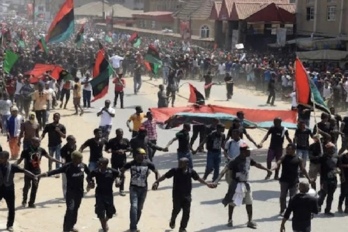
IPOB’s May 30 Shutdown Is Not Mourning. It Is Political Coercion in Funeral Clothes
IPOB has once again reached for the oldest and most corrosive weapon in its arsenal, the sit-at-home order, and it is dressing it up as remembrance. The group’s May 30 declaration for a South-East shutdown is being sold as a sacred tribute to Biafran dead, but the political reality is harsher.
This is not just memory. It is a command. It is an attempt to seize public space, silence normal life, and force an entire region to submit to one organisation’s version of history. The language is solemn, but the method is coercive. That is the real story.
IPOB says the date will honour what it calls Biafran heroes and heroines and that the observance is meant for reflection, mourning and prayer.
It also calls on residents across the South-East and the diaspora to comply, while urging governors in the 13 states it describes as Biafraland to lower the Nigerian flag to half mast.
On paper, that sounds ceremonial. In practice, it is a political test of who controls the street, the market, the school gate and the movement of ordinary people.
A remembrance day does not need to shut down livelihoods to prove sincerity. A movement that truly seeks moral legitimacy does not have to frighten traders into silence.
The group’s rhetoric leans heavily on the emotional weight of the Nigerian Civil War, foreign support for Nigeria, blockade warfare and the suffering of the Biafran side.
It is an old and effective strategy. Appeal to wounded memory, invoke sacrifice, then convert grief into obedience. But this is exactly where IPOB’s stated mission collides with its approach.
The organisation presents itself as a defender of a people’s survival and dignity. Yet its preferred instrument remains a shutdown that has repeatedly punished the very civilians it claims to defend. That contradiction is no longer theoretical. It is measurable, and it is ugly.
Kanu remains at the centre of a terrorism and treason case in Nigeria, while authorities continue to treat IPOB as an outlawed group. In November 2025, a Nigerian court convicted him on terrorism related charges and handed down a life sentence.
The court also stressed the distinction between political self determination and unconstitutional conduct.
That matters because IPOB’s remembrance politics is not operating in a vacuum. It is unfolding under the shadow of a legal battle that has already transformed the movement from a separatist agitation into a national security problem in the eyes of the state.
The damage caused by the wider sit-at-home culture is already well documented. Reuters reported in May 2025 that a report linked the campaign to more than 700 deaths over four years and losses of about 7.6 trillion naira. AP carried the same broad finding.
That is not activism. That is regional economic sabotage wrapped in ideological language. When traders cannot open, when schools cannot function, when transport shuts down and when residents remain indoors out of fear, the movement is no longer merely protesting. It is governing by intimidation.
This is why IPOB’s attempt to separate the May 30 declaration from the broader sit-at-home campaign will struggle to convince anyone outside its core base.
The group may insist that this year’s observance is about dignity and history, not the weekly shutdown regime. But the South-East has lived through too many forced closures to accept that distinction at face value.
Once a political movement proves that it can paralyse an entire region, every new shutdown announcement is read through the same lens of pressure and fear.
There is also a deeper problem in the way IPOB frames the dead. By invoking the Civil War, Nkpor, Onitsha and the martyrs of its own struggle, the group asks for empathy while simultaneously deploying a tactic that imposes fresh pain on today’s living. That is a dangerous moral bargain.
Historical grievance does not become cleaner because it is repeated loudly. It becomes stronger only when it is translated into a credible political case.
If IPOB wants the South-East and the wider country to take its claims seriously, it must confront the fact that coercion weakens every argument it says it is making for justice.
The truth is simple. A movement that says it speaks for a people cannot keep turning those people into hostages. A remembrance that depends on forced silence is not pure remembrance. It is political theatre with an armed edge.
IPOB may call May 30 a sacred covenant, but the region knows the price of these orders by now. It is paid in lost income, lost mobility, lost trust and, far too often, lost lives.
That is why this latest declaration should not be read as a harmless memorial statement. It should be read as another attempt to impose political authority where democratic consent is absent.
At the centre of this controversy is a movement still trying to convert grievance into legitimacy without answering for the wreckage left behind. That is the core failure of IPOB’s current approach.
It wants the emotional power of history without the discipline of politics, the authority of memory without the responsibility of restraint, and the symbolism of mourning without the consequences of coercion. The South-East has heard this script before. It is paying for it already.
Follow us on our broadcast channels today!
- WhatsApp: https://whatsapp.com/channel/0029VawZ8TbDDmFT1a1Syg46
- Telegram: https://t.me/atlanticpostchannel
- Facebook: https://www.messenger.com/channel/atlanticpostng



