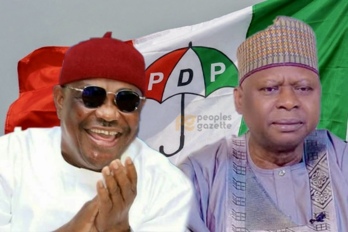
ABUJA, Nigeria — The People’s Democratic Party has moved to seize the narrative in its worsening leadership war, insisting that the Certified True Copy of the Supreme Court judgment now circulating online was not officially released and, even on the party’s own reading of it, does not strip Abdulrahman Mohammed and Senator Samuel Anyanwu of their positions.
The party’s National Working Committee, elected at the Abuja convention, said the document in circulation was missing the usual signs of formal court certification and argued that the apex court did not suspend Anyanwu, create any leadership vacuum, or hand the party to the Board of Trustees.
INEC’s public party page currently lists Abdulrahman Mohammed as National Chairman and Samuel Anyanwu as National Secretary. This is not a routine press release. It is the latest salvo in a battle that has turned the PDP’s internal dispute into a national political and judicial spectacle.
On 30 April 2026, the Supreme Court, in a split 3 to 2 decision, set aside the party’s November 2025 Ibadan convention, with the majority holding that the exercise breached subsisting court orders.
Justice Stephen Adah led the majority in dismissing the appeal filed by the Tanimu Turaki-led faction, while the court also dismissed the cross-appeals. The dissenting justices, Haruna Tsammani and Sadiq Abubakar Umar, took the opposite view and said the appeal should have succeeded.
The PDP camp led by Mohammed and Anyanwu is now leaning heavily on the distinction between what the party says the judgment actually covered and what its rivals claim it covered.
In the statement released on 8 May 2026, the party said the ruling did not suspend Senator Anyanwu, did not direct the BoT to take over, and did not declare any vacuum in the party structure.
The Nation’s report on the same statement captured the party’s insistence that the disputed paper was “not officially released” and that the pages were not “certified, stamped nor signed” by an authorised officer.
The party also argued that the cross-appeal dealt only with the right of Chris Uche, SAN, to appear as counsel, not with suspension or expulsion.
That legal framing matters because the PDP crisis is no longer just about who leads the party today. It is now about who controls the machinery that will choose candidates, issue notices, recognise officers, and face the courts ahead of 2027.
The party’s own public line is that the Supreme Court’s majority decision is binding, that the Turaki camp lost from the Federal High Court to the apex court, and that the public is being misled by selective readings of the minority opinion. The PDP also accused commentators and rival actors of distorting the judgment for “narrow political interests and personal relevance”.
The political fallout has already started to show. INEC recognised the Abdulrahman Mohammed-led national working committee after the March 2026 convention, with Mohammed as chairman and Anyanwu as secretary, alongside other officers named on the commission’s website.
That public recognition is central to the PDP camp’s argument that its structure remains intact. In other words, the dispute is not only in the courtroom. It is in the public register of party leadership, where recognition can shape who controls correspondence, nominations and internal administration.
The same crisis is also feeding defections and counter-manoeuvres. Punch reported on 3 May 2026 that Bauchi State Governor Bala Mohammed had dumped the PDP for the Allied Peoples Movement, saying the Supreme Court judgment was a turning point and left the party without clear legal and organisational direction.
The same report said Oyo State Governor Seyi Makinde was preparing to leave as well. Guardian reported on 4 May that the Makinde camp had set up an Interim National Working Committee and was challenging INEC to recognise it, a development that underlines just how fractured the party has become.
That is why the PDP’s latest statement reads less like a defensive memo and more like a political counteroffensive.
By asking critics to produce the exact portion of the judgment that suspended Anyanwu or transferred power to the BoT, the party is trying to force the argument back onto strict judicial text rather than factional spin.
By citing Bala Mohammed’s defection and Makinde’s reported manoeuvres, it is also trying to suggest that the real-world behaviour of senior stakeholders contradicts the claims of the Turaki bloc.
Whether that argument persuades the wider public is another matter, but it is clearly designed to harden the loyalty of members who are still wavering.
For now, the most striking feature of this latest episode is the scale of institutional confusion around one party’s leadership.
The PDP says the CTC in circulation is suspect; its rivals insist the ruling favours them; INEC’s public page still lists Mohammed and Anyanwu; and the Supreme Court’s judgment, as reported by major outlets, was split enough to fuel multiple interpretations.
That is a dangerous mix in a country where party stability often determines the temperature of national politics.
Unless the PDP resolves the dispute with speed and discipline, the fight over one judgment may continue to eat into its credibility, deepen defections, and weaken its 2027 prospects long before the ballot is printed.
Follow us on our broadcast channels today!
- WhatsApp: https://whatsapp.com/channel/0029VawZ8TbDDmFT1a1Syg46
- Telegram: https://t.me/atlanticpostchannel
- Facebook: https://www.messenger.com/channel/atlanticpostng