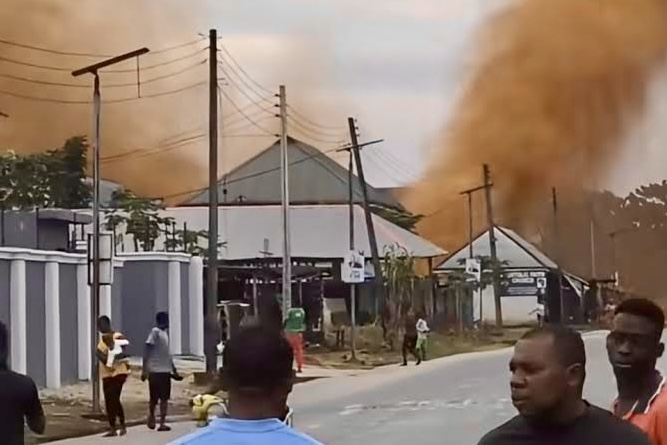
Uma, also known as Imoga, has become one of the most troubling security flashpoints in Edo North, after a fresh cycle of kidnapping, ransom demands, forest camps and alleged reprisals pushed the community into emergency action.
In January, the Okpahi of Imoga, Oba Patrick Obajoye, confirmed that eight indigenes were abducted in the Ibillo axis and that their captors first demanded ₦100 million before reducing it to ₦70 million.
He described the situation as “a very sad day for us in our community,” while warning that the kidnapping had the hallmarks of an inside job.
That January abduction did not happen in a vacuum. A major Vanguard investigation published in 2025 described Akoko Edo’s forest belt as a widening criminal corridor where kidnappers and armed herders had entrenched themselves around Aiyegunle, Eshawa, Imoga and neighbouring border communities.
The report quoted a vigilante leader saying the criminals were constantly shifting from one forest hideout to another, making them hard to track and harder to dislodge.
What makes the Imoga case especially explosive is the community’s claim that it responded without descending into mass violence. In the petition now circulating in the public space, residents say they mobilised after repeated kidnappings and moved through the forests to evacuate more than 20 camps peacefully, forcing occupants to dismantle their own shelters.
The same petition says the community had already warned the police, the Edo State CID and the relevant federal command structures about the threat, and then asked for a police station in Imoga, a military checkpoint linking Imoga and Okengwen, and stronger local vigilance.
That account fits a broader pattern of official acknowledgement that the forests are now part of the security problem. On 21 April 2026, the Edo State Government ordered farm settlers in forested parts of Etsako East to relocate to nearby towns and villages, saying the move was meant to strengthen security and community accountability.
Earlier, the state government had said the anti-open grazing debate was not “an issue between Edo and Fulani people”, but a question of enforcement, order and public safety.
Yet the calm did not last. By the latest report on the crisis, suspected herders attacked residents of Uma/Imoga, leaving several people injured and triggering panic among youths who reportedly moved into the surrounding forests in search of the attackers.
The same report said the community had warned security agencies repeatedly, but by Sunday evening there was still no official security statement, a silence that has deepened distrust in the area.
This is why the Imoga story cannot be reduced to a simple community-versus-herder quarrel. The deeper issue is the collapse of forest control in a borderland that sits between Edo, Kogi and Ondo, where communities, vigilantes and security agencies all say armed groups exploit the terrain, vanish into the trees and return at will.
Premium Times reported in March that Kogi, Ondo and Edo had all come under sustained attacks in recent times, with no trial or conviction yet matching the scale of arrests and public outrage.
Imoga’s latest crisis also reveals the widening gap between complaint and consequence. Residents say they have reported illegal occupation, raised ransom money, watched camps dismantled, and still found themselves back in the firing line.
That is why their latest demands are not for revenge but for prosecution, permanent security posts and a sustained forest sweep that does more than push criminals from one village to the next. In practical terms, the community is asking government to do what local people cannot do alone: hold the forests, protect the roads and break the kidnapping economy before it resets again.
For Edo State, Imoga is now a test case. If a community can remove camps peacefully, alert the authorities, lose sleep over ransom, and still face renewed bloodshed, then the real crisis is not just in the forest. It is in the state’s ability to turn warnings into action, action into arrests, and arrests into convictions. Until that happens, Imoga will remain a warning sign for the rest of Edo North.
Follow us on our broadcast channels today!
- WhatsApp: https://whatsapp.com/channel/0029VawZ8TbDDmFT1a1Syg46
- Telegram: https://t.me/atlanticpostchannel
- Facebook: https://www.messenger.com/channel/atlanticpostng