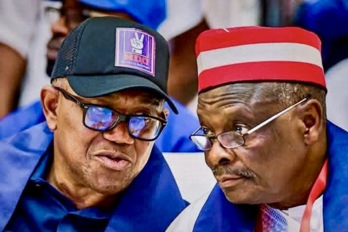
The Peoples Redemption Party has been thrust into the centre of Nigeria’s 2027 opposition chessboard after its National Chairman, Dr Hakeem Baba-Ahmed, said talks involving Peter Obi and Rabiu Musa Kwankwaso broke down over demands for automatic tickets and other conditions the party would not accept.
Baba-Ahmed, who was recently recognised by INEC as PRP chairman after the commission updated its portal, said the party’s position was simple: join first, compete later.
His account, delivered during a Hausa political programme on DITV Kaduna, points to a familiar fault line in Nigerian politics. Opposition alliances often begin with grand talk of coalition, reform and rescue, but many collapse when personalities try to turn negotiations into coronations. In Baba-Ahmed’s telling, that was exactly where the PRP line was drawn.
He said, “We told them no, this is PRP; we do not practice that kind of politics,” and added that the party would not “break” its rules for any aspirant.
The chairman said Obi and Kwankwaso had approached the party for possible collaboration, but discussions stalled once the issue of tickets came up. He alleged that their camp wanted guarantees in advance that the presidential and vice-presidential slots would be reserved for them, without internal contest.
In another blunt line, he said, “Before they joined, they told us that they were the presidential candidates, meaning they should be given the ticket.”
That is the most damaging part of the account for the two politicians, because it suggests the PRP was not rejected for lack of relevance, but for refusing to become a vehicle for pre-packaged ambition.
Baba-Ahmed insisted that the party acknowledged their political weight, yet still would not bend its constitution or its internal democracy to suit them. In his words, the PRP could see that “strong contenders had arrived”, but it could not abandon its own rules.
The episode is more significant because it comes only days after PRP publicly welcomed another high-profile defector, former Labour Party vice-presidential candidate Senator Datti Baba-Ahmed, who said he had not joined the party to chase a ticket.
He declared, “I came here to fix Nigeria.” That statement now sits awkwardly alongside Baba-Ahmed’s claim that Obi and Kwankwaso wanted the opposite kind of arrangement, one centred on guarantees before membership.
Datti Baba-Ahmed also gave the PRP chairman political cover by warning that Nigeria’s opposition had been weakened by legal battles and internal strain. L
He said the landscape was still fluid and that many major parties were damaged by court disputes, a remark that underlines why the PRP may be trying to present itself as an organisation built on structure rather than personalities.
The party has also been busy restoring its own administrative visibility, with INEC recently updating its portal to recognise Baba-Ahmed and other newly elected officials after the omission triggered alarm.
Yet there is another layer to the story that makes it less than closed. Rabiu Kwankwaso has separately said no final decision has been taken about his political future and that consultations have continued with the PRP, the NDC and other stakeholders.
He said: “no final decision has been taken regarding my political future”, and added that he had not declared for the 2027 race or endorsed any candidate.
That does not contradict Baba-Ahmed’s account of a breakdown; it suggests instead that the wider realignment project is still being tested, one party at a time.
For Obi, the optics are even more delicate. His politics has long depended on the language of discipline, inclusion and reform, while Kwankwaso’s influence is rooted in personal following and regional strength.
A PRP ticket would have offered both men a fresh platform, but only if they were willing to submit to contest. Baba-Ahmed’s allegation that they wanted automatic slots before entry tells a bigger story about the 2027 opposition race: not whether the coalition can exist, but who will control its machinery, its tickets and its narrative.
That, in the end, is the real political meaning of this failed courtship. PRP has chosen to cast itself as a party that will not mortgage its structure for star power. Obi and Kwankwaso, at least according to Baba-Ahmed, wanted something closer to a guaranteed landing strip.
The gap between those two positions is wide enough to sink an alliance, and perhaps wide enough to expose how much of Nigeria’s opposition politics still runs on ego, bargaining and ticket arithmetic rather than principle.
Follow us on our broadcast channels today!
- WhatsApp: https://whatsapp.com/channel/0029VawZ8TbDDmFT1a1Syg46
- Telegram: https://t.me/atlanticpostchannel
- Facebook: https://www.messenger.com/channel/atlanticpostng