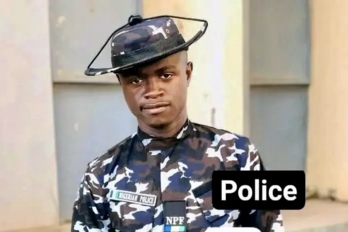
A grieving family in Abuja has thrown a painful spotlight on what may be one of the most troubling aftershocks of the latest insurgent violence in Nigeria’s North East: the reported delay in officially notifying relatives and releasing the body of a slain Mobile Police officer, Suleiman AbdulRazaq, after the Yobe State attack that has again exposed the cost of the country’s war against Boko Haram and ISWAP.
According to SaharaReporters, AbdulRazaq, a serving MOPOL officer attached to MOPOL 45, Abuja, was killed during the assault in Yobe in the early hours of Friday, 8 May 2026. The family says days later it still had no formal communication from the police and no clarity on where his remains are being kept.
The family’s anguish is sharpened by the fact that AbdulRazaq was not just another name on a casualty list. Relatives say he was the first son of the family, a young man who had long dreamed of wearing the police uniform and serving the country.
In their account, that dream ended in a raid they say should have triggered immediate official contact, transparent information and the prompt release of his body for burial under Islamic rites.
One family member, speaking to SaharaReporters, pleaded that those who know the location of his corpse should “release it so we can bury him according to Islamic rites”.
The family’s complaint is also a damning indictment of how the state often handles fallen security personnel. Beyond the emotional trauma, they say the police must pay the officer’s entitlements, compensate the family and stop treating those who die in active service as disposable.
That grievance lands in a country where security forces regularly praise the bravery of fallen personnel, yet families frequently complain that they are left to chase paperwork, burial permissions and welfare benefits on their own.
The present case has now become bigger than one household. It has become a test of whether the Nigeria Police Force can show urgency, empathy and discipline when one of its own is lost in combat.
The attack itself remains central to the wider controversy. SaharaReporters reported on 8 May 2026 that at least 36 soldiers and Mobile Police officers were said to have been killed when suspected Boko Haram insurgents launched coordinated attacks on two military formations in Gujba Local Government Area of Yobe State, including the Theatre Training Centre in Buniyadi and the 27 Task Force Brigade in Buni Gari.
Soldiers quoted in that report described a midnight assault that hit the camps almost simultaneously. One survivor said the attack on 27 Task Force Brigade began around 1 a.m. and that the insurgents were attacking that camp at the same time as a neighbouring one.
That account, however, sits beside a more formal military narrative that speaks of a repelled attack rather than a catastrophic breach.
In a statement carried by Channels Television, Operation Hadin Kai said troops repelled a coordinated night attack on the 120 Task Force Battalion in Goniri, Yobe State, between the late hours of 9 May and the early hours of 10 May 2026.
Lt. Col. Sani Uba said troops executed a “well-coordinated spoiling attack” and that “No part of the camp was breached”, while recovered weapons and battle damage suggested heavy insurgent losses.
Vanguard also reported an official briefing on a separate Yobe assault on 27 Brigade and Buni Gari Checkpoint, where the military said 50 terrorists were neutralised and two soldiers were lost.
For investigators and security watchers, the most disturbing issue is not only the violence itself but the recurring gap between battlefield events, public communication and family notification.
In the North East, insurgents continue to probe military and police positions, and official communiqués often arrive after the fact, sometimes with casualty figures that differ sharply from eyewitness testimony and local reporting.
Reuters has reported recent militant attacks on Nigerian army bases in the region, including the 8 May strike in Magumeri, Borno State, where security sources and the military said at least two soldiers were killed and others wounded.
The broader picture is one of a theatre under pressure, with insurgents exploiting darkness, terrain and operational fatigue.
The family’s appeal is therefore not merely about one body. It is about dignity in death, institutional accountability and the message the state sends to serving officers who risk their lives in the North East every day.
If a police officer can die in action and his family still be left asking where his remains are, then the system has failed at two levels at once: on the battlefield and in the barracks paperwork that should follow.
The family wants President Bola Ahmed Tinubu and the Inspector-General of Police, Olatunji Rilwan Disu, to intervene immediately.
The State House says Disu was ratified by the Police Council on 2 March 2026 and sworn in as IGP, making him the current chief expected to answer such a demand.
In a country already battling insurgency fatigue, such cases carry political weight. They feed public anger over sacrifice without care, service without welfare and heroism without administrative respect.
They also raise a harder question: whether Nigeria’s security architecture is still organised to fight insurgents effectively while also honouring those who fall.
Until the police clarify AbdulRazaq’s fate, release his body and address the family’s plea for compensation, this story will remain more than a tragedy. It will stand as another reminder that in Nigeria’s war zones, the battle does not end when the shooting stops. It continues in the waiting, the silence and the unanswered calls from grieving homes.
Follow us on our broadcast channels today!
- WhatsApp: https://whatsapp.com/channel/0029VawZ8TbDDmFT1a1Syg46
- Telegram: https://t.me/atlanticpostchannel
- Facebook: https://www.messenger.com/channel/atlanticpostng