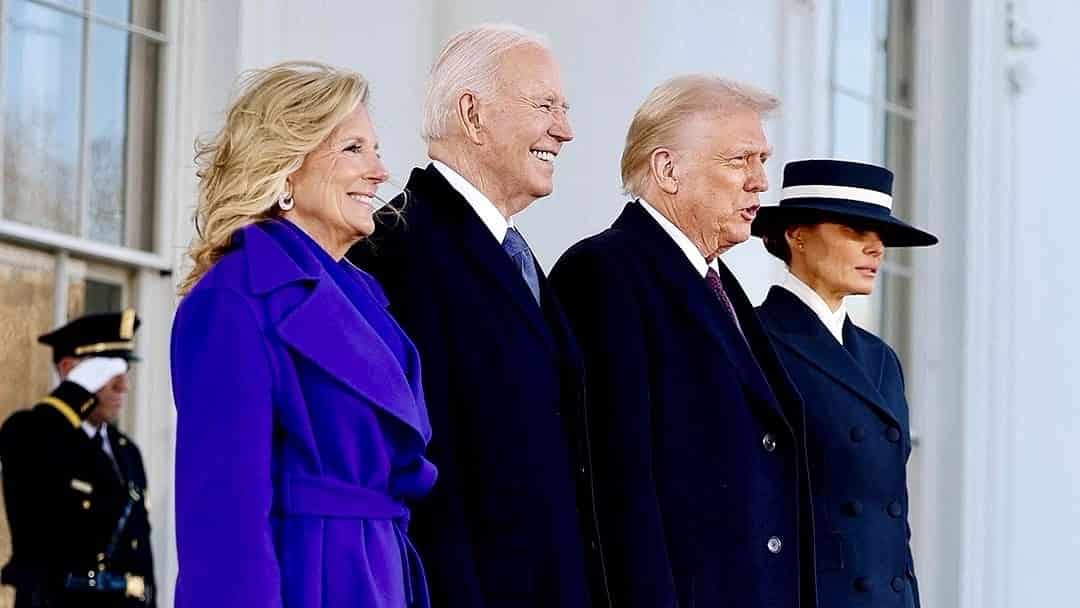
In a stunning return to tradition, Joe Biden and Donald Trump reunite at the White House after St. John’s Episcopal Church service, symbolising unity amid turmoil.
In a remarkable display of political decorum and adherence to democratic traditions, President Joe Biden and First Lady Jill Biden welcomed President-elect Donald Trump and his wife, Melania Trump, to the White House on January 20, 2025.
This significant event followed a service at St. John’s Episcopal Church, underscoring a commitment to the peaceful transfer of power—a cornerstone of American democracy.
A Return to Tradition Amidst Political Turbulence
The meeting at the White House harks back to a time-honoured tradition where outgoing and incoming presidents engage in a symbolic gesture of unity. This practice had been notably absent in recent years, particularly during the 2021 transition.
The reinstatement of this custom in 2025 serves as a hopeful indicator of a mending political landscape, striving to bridge the chasms that have deepened over the past decade.
St. John’s Episcopal Church: A Historical Prelude
The day commenced with a service at St. John’s Episcopal Church, often referred to as the “Church of the Presidents.” This church has been a spiritual haven for every president since James Madison, symbolising continuity and stability.
The choice of St. John’s for this occasion is particularly poignant, considering its history during the 2020 protests when it suffered damage and became a focal point of national discourse. The 2025 service signifies a restoration of its role as a unifying landmark in American politics.
The White House Tea: Symbolism and Significance
Following the church service, the Bidens hosted the Trumps for tea at the White House—a gesture laden with symbolic importance. This meeting not only marks the first encounter between the two leaders since the contentious 2024 election but also exemplifies a mutual respect for democratic processes.
Such interactions are vital in demonstrating to the nation and the world that, despite political differences, the leadership remains committed to the nation’s unity and stability.
Security and Ceremony: Navigating New Norms
The inauguration proceedings were notably influenced by external factors, including severe weather conditions that necessitated moving the swearing-in ceremony indoors to the Capitol Rotunda.
Additionally, heightened security measures were evident throughout Washington, D.C., reflecting lessons learned from past events and an ongoing commitment to ensuring the safety of such significant national ceremonies.
A New Chapter in American Politics
As President-elect Donald Trump prepares to take the oath of office, the nation stands at a crossroads. The events of January 20, 2025, particularly the interactions between the outgoing and incoming administrations, offer a semblance of hope for a more collaborative and less divisive political future.
The emphasis on tradition, respect, and unity sets a tone that many Americans hope will define the coming years.
A Positive Perspective
The convergence of these events—the service at St. John’s Episcopal Church, the White House tea, and the adjusted inauguration proceedings—collectively underscore a pivotal moment in American history. They reflect a conscious effort by both administrations to honour democratic traditions and promote a message of unity.
As the nation moves forward, these gestures serve as reminders of the enduring strength of its institutions and the importance of upholding the values upon which the United States was founded.

A Deep Dive Into the Biden-Trump White House Meeting
The reunion between President Joe Biden and President-elect Donald Trump transcends mere political symbolism. It encapsulates a return to civility, a reawakening of the American democratic ethos, and a dramatic shift in political dynamics.
This encounter, after a bruising election marred by controversies, reflects a nation yearning for normalcy amidst the chaos of deep-seated polarisation.
The American people have witnessed years of political rhetoric that often bordered on the incendiary, and the meeting between these two leaders marked a break from recent tradition, demonstrating that dialogue and respect remain pillars of governance. The gravity of this meeting cannot be overstated.
A Historic Church Service at St. John’s
The day’s events began at the iconic St. John’s Episcopal Church, a venue steeped in history and controversy. Known as the “Church of the Presidents,” this institution has endured its share of trials, most notably during the 2020 protests when its grounds became the centre of a divisive national conflict. The service this time, however, was a statement of resilience.
By choosing St. John’s, both Biden and Trump sought to send a message about continuity and the unifying power of shared traditions.
The presence of their families amplified this symbolism, suggesting a desire to move beyond the hyper-partisan bickering that has defined American politics in recent years.
Tea Diplomacy at the White House
When President Biden and First Lady Jill Biden welcomed Donald and Melania Trump into the White House, the scene was both surreal and poignant. The tea meeting, a private yet public affair, was loaded with political undertones.
Observers noted the stark contrast between this meeting and the fraught transition of 2021, where such gestures of civility were conspicuously absent. This moment sent a clear signal: no matter how bitter the election, the mechanisms of democracy must remain unbroken.
For Trump, whose return to power has been met with skepticism and scrutiny, this was an opportunity to demonstrate leadership and a willingness to engage constructively.
For Biden, whose tenure has been marked by calls for healing, it was a final act of statesmanship.
Challenges and the Road Ahead
While the day’s events were steeped in tradition, the challenges ahead for the Trump administration are formidable. The 2024 election saw unprecedented voter turnout, fuelled by economic instability, social unrest, and contentious debates over the direction of the country.
Trump’s victory, while decisive, has left a trail of unresolved issues, including a fractured electorate, rising partisanship, and global challenges that demand immediate attention.
For President Biden, the handover marked the end of a presidency defined by efforts to rebuild alliances, stabilise an economy battered by inflation, and address systemic inequalities. His legacy will largely depend on how the incoming administration carries forward these initiatives.
Additional report by Osaigbovo Okungbowa
Atlantic Post Senior Political Correspondent