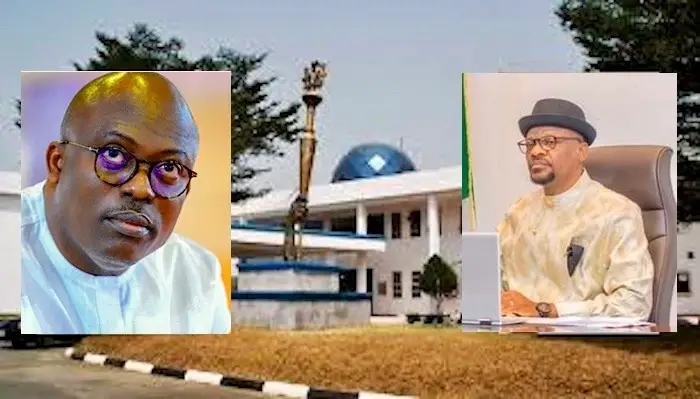
Governor Fubara’s recent letter to Speaker Amaewhule follows the Supreme Court’s ruling restoring the Rivers State Assembly after a period of legislative exclusion. The communication, while appearing conciliatory, raises doubts about its sincerity. It signals a critical moment for the state’s governance, as political tensions remain high and potential reconciliation hangs in the balance.
A Desperate Bid at Reconciliation or a Calculated Political Manoeuvre? Governor Fubara’s Controversial Communication to Speaker Amaewhule
PORT HARCOURT, Rivers — In an atmosphere thick with political tension and simmering discontent, the belligerent Governor Siminalayi Fubara’s latest official communication to the restored Speaker of the Rivers State House of Assembly, Rt. Hon. Martin Chike Amaewhule, has emerged as a focal point in Nigeria’s ongoing constitutional drama.
This communication—issued on 7 March 2025 by the Office of the Secretary to the State Government—comes on the heels of the Supreme Court’s landmark ruling on 28 February 2025 that restored the full assembly after 15 months of what many describe as an authoritarian onslaught that had effectively collapsed the legislative branch in Rivers State.
A Letter Laced with Dual Intentions
At first glance, the governor’s letter appears to adopt a conciliatory tone. It extends an invitation to the Speaker and his colleagues for a meeting scheduled on 10 March 2025 at the Government House in Port Harcourt.
The meeting’s agenda is deceptively mundane: discussions on providing a more befitting space for the assembly’s sittings, settling outstanding remunerations and allowances, presenting the state budget, and addressing sundry other matters essential to the state’s progress.
However, a closer reading of this document reveals a deeper, more calculated political manoeuvre.
Governor Fubara’s invitation, rather than heralding a genuine commitment to democratic renewal, seems to be a tactical attempt to regain political leverage after a 15-month period marked by his overt attempts to sideline and destabilise the legislative arm.
By summoning the reinstated assembly—a body that had been rendered inoperative by his own orchestrated exclusions—the governor appears to be making a desperate bid to re-establish a semblance of normalcy.
Yet, many political analysts remain sceptical about the sincerity of this outreach, arguing that it is merely a veneer intended to distract from the legacy of his despotic practices.
Historical Context: The Authoritarian Interregnum
To fully understand the significance of this communication, one must revisit the turbulent period that preceded the Supreme Court’s ruling.
For over a year, Governor Fubara’s administration was characterised by what many have termed a calculated campaign of legislative exclusion.
In a series of actions that many constitutional purists decried as blatantly undemocratic, the governor systematically isolated 27 members of the Rivers State House of Assembly.
His strategy was twofold: not only did he disrupt the normal functions of the legislature by preventing the full complement of elected members from exercising their mandates, but he also sought to establish a shadow assembly loyal solely to his political agenda.
This draconian approach culminated in the physical destruction of the legislative complex and the deliberate obstruction of access for dissenting lawmakers—a move that effectively reduced the Assembly to a mere façade.
The governor’s rationale for these actions rested on allegations of defection. He claimed that the 27 members had abandoned the People’s Democratic Party (PDP) for the All Progressives Congress (APC), thereby justifying their exclusion.
However, as the subsequent 62-page Supreme Court judgement would make abundantly clear, these allegations were devoid of any credible evidence.
The Supreme Court’s Verdict: A Rebuke of Despotism
In its detailed exposition, the apex court dismantled Governor Fubara’s entire narrative. Justice Emmanuel Agim’s judgement categorically stated that there was not the slightest shred of evidence to support the defection claims.
In fact, the governor himself had withdrawn these allegations at the Federal High Court in Abuja—a move that, in retrospect, only underscored his desperation to cling to power by any means necessary.
The court’s reasoning was rooted firmly in constitutional principles. It reiterated that the 1999 Constitution unequivocally prescribes the composition of the House of Assembly as per Section 96.
By attempting to recognise only a fraction of the assembly’s members, Fubara had not only contravened constitutional mandates but had also set a dangerous precedent for executive overreach.
The judgement made it clear that any attempt to validate the proceedings of a House of Assembly that had been deliberately and unlawfully reduced in numbers was tantamount to an abrogation of the democratic process itself.
Moreover, the ruling went so far as to condemn the governor’s reliance on Sections 102 and 109 of the Constitution and the doctrine of necessity—a feeble attempt to justify actions that had, in reality, collapsed the legislative structure.
The apex court’s decision was not merely a legal pronouncement but a resounding denunciation of the authoritarian methods that had been employed to subvert democratic governance in Rivers State.
Situating the Communication Within the Broader Crisis
Against this backdrop of judicial clarity, Governor Fubara’s communication takes on a layered and complex meaning.
While the letter ostensibly signals a willingness to engage with the reconstituted House of Assembly, it simultaneously serves as a stark reminder of the enduring scars left by his previous misdeeds.
The invitation, replete with its mention of mundane administrative issues, belies a deeper intent—to reassert control over a legislative body that had once been systematically muzzled.
The letter’s timing is particularly noteworthy. Coming immediately after the Supreme Court’s unequivocal restoration of the House, it appears as though the governor is scrambling to salvage his political credibility.
Many observers speculate that this is an effort to pre-empt further legal and political challenges by portraying himself as a cooperative stakeholder in the state’s governance.
However, the historical context of his previous actions casts a long shadow over any such claims of reconciliation.
The meeting scheduled for 10 March 2025 is thus seen by many as a critical juncture. It offers a platform for what could either be a genuine reset in the state’s political dynamics or yet another stage in a protracted power struggle.
For the 27 members who were unlawfully excluded—and for the people of Rivers State, who have long borne the brunt of executive despotism—this meeting represents a test of whether the spirit of democratic governance can truly triumph over authoritarian impulses.
The Political and Social Implications
The restoration of the full House of Assembly is a watershed moment in the political history of Rivers State. It signifies not only a legal victory but also a symbolic reclamation of democratic space.
In the eyes of many, the Supreme Court’s decision has redressed a grave injustice—a moment when the rule of law prevailed over the reckless whims of an embattled governor.
Yet, the implications extend far beyond the immediate context.
The financial sanctions imposed by the court—which direct the Central Bank of Nigeria and the Accountant General of the Federation to withhold funds from the state government until a proper Appropriation Law is enacted—are a clarion call for fiscal accountability.
This measure is designed to ensure that future governance in Rivers State is predicated on transparency, adherence to constitutional processes, and a genuine commitment to the welfare of the citizenry.
Critics of Fubara’s regime have long warned that the systematic exclusion of legitimate lawmakers would lead to a legislative vacuum, thereby crippling the state’s ability to enact policies that truly reflect the interests of its people.
The ensuing period of stagnation, marked by an inability to pass vital laws or oversee the executive’s activities, has had palpable repercussions on public administration and service delivery.
In restoring the full complement of the House, the Supreme Court has not only rectified a legal anomaly but has also set the stage for a potential revival of meaningful legislative oversight and democratic participation.
A Calculated Response or a Genuine Olive Branch?
It remains to be seen whether Governor Fubara’s invitation is a calculated manoeuvre to regain lost ground or a genuine attempt at conciliation.
The communication, with its seemingly benign agenda items, could be interpreted as an olive branch extended in a bid to normalise state affairs.
However, given the historical context of his administration’s actions, there is widespread scepticism regarding the sincerity of this outreach.
Political analysts argue that the governor’s previous actions—ranging from the illegal exclusion of assembly members to the physical obstruction of legislative proceedings—cannot be easily undone by a single letter.
Instead, they suggest that this communication is part of a broader strategy to co-opt the reinstated House of Assembly.
By inviting the assembly to deliberate on routine matters such as the provision of a suitable venue and financial settlements, Fubara may be attempting to re-legitimise his authority and defuse the momentum that has now swung in favour of democratic governance.
Looking Ahead: The Road to Democratic Renewal
The forthcoming meeting on 10 March 2025 is poised to be a litmus test for the future of governance in Rivers State.
For Speaker Amaewhule and his colleagues, this is an opportunity to assert their restored mandate and reaffirm their commitment to the principles enshrined in the 1999 Constitution.
It is equally a chance to establish a clear boundary between the authoritarian excesses of the past and a new era of accountability, transparency, and genuine legislative engagement.
For the people of Rivers State, who have endured 15 months of legislative paralysis and executive overreach, this juncture offers a much-needed glimmer of hope.
The reinstatement of the full House of Assembly is not merely a legal victory; it is a reaffirmation of the democratic process—a process that, despite recurrent challenges, remains the cornerstone of good governance.
In the wake of the Supreme Court’s decisive ruling, the stage is now set for a potential renaissance in the political life of Rivers State.
Whether this newfound momentum can translate into tangible improvements in governance remains to be seen.
What is certain, however, is that the court’s intervention has re-established the primacy of the rule of law and has signalled a clear message: authoritarian subversion, no matter how deeply entrenched, will eventually be met with the full force of democratic accountability.
Conclusion
Governor Siminalayi Fubara’s recent communication to Speaker Amaewhule is emblematic of a state in transition—torn between the vestiges of an autocratic regime and the burgeoning promise of democratic renewal.
While the letter’s overt content appears benign, its subtext reveals the ongoing power struggle that continues to define Rivers State’s political landscape.
As the reconstituted House of Assembly prepares to resume its rightful place in the governance of the state, all eyes will be on 10 March 2025, when the governor’s calculated outreach will either pave the way for genuine reconciliation or further entrench the divisions that have long plagued this troubled state.
For Atlantic Post, with years of insight into the intricacies of Nigerian politics, the unfolding events in Rivers State serve as a potent reminder of the resilience of democratic institutions—even in the face of relentless authoritarianism.
The coming days will be critical in determining whether this communication marks the beginning of a new era of accountable governance or is merely another chapter in a protracted saga of political subversion.