DHQ blames foreign herders for Benue and Plateau massacres, touts arrests but warns porous borders fuel endless carnage.
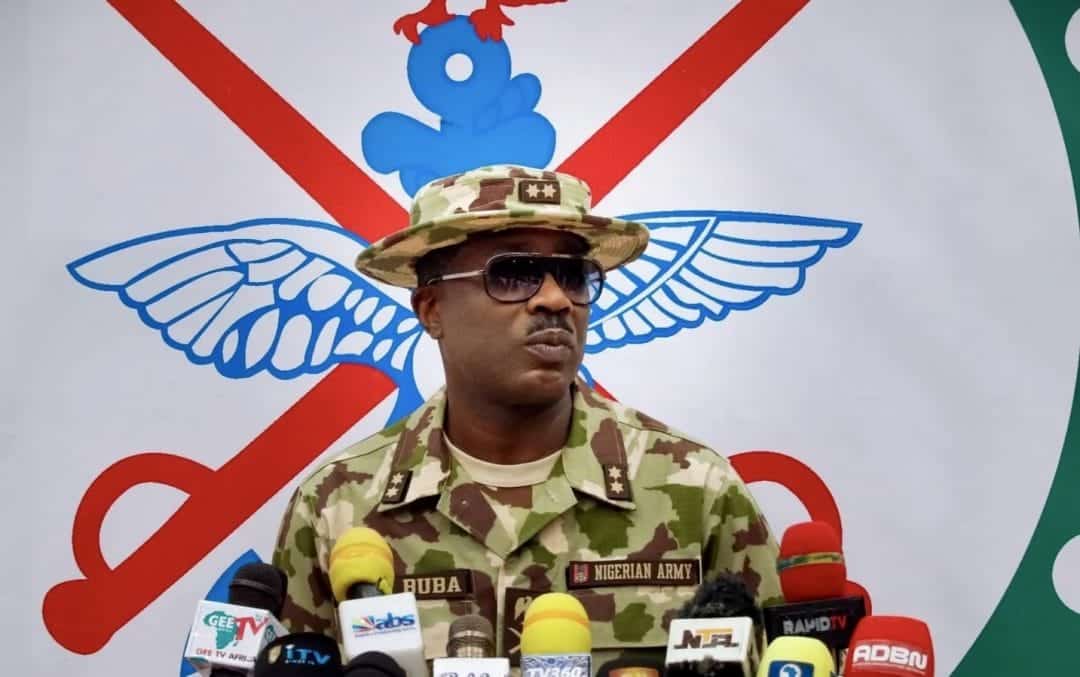
The Defence Headquarters, via Maj-Gen Markus Kangye, has unequivocally blamed foreign herders for the recent massacres in Benue and Plateau, citing linguistic and phenotypic evidence to distinguish infiltrators from Nigerian farmers.
Over 457,000 internally displaced persons (IDPs) now shelter in Benue alone, intensifying a humanitarian crisis amid porous borders.
Despite these assaults, the military has claimed major victories: the neutralisation of kidnapping kingpin Nkwachi “Onowu” Eze and the arrest of notorious gunrunner Buhari Umar, alongside the foil of oil theft valued at over ₦1.93 billion in one week.
Yet critics argue that these successes mask systemic failures in border security, inter-agency coordination and long-term protection of farming communities.
Background: A Surge in Farmer–Herder Violence
The Toll on Agrarian Communities
Between mid-April and early May 2025, at least 144 civilians were slaughtered in Plateau and Benue, with entire villages razed and scores injured.
These attacks have rendered hundreds of thousands homeless, many fleeing to IDP camps such as Gidan Gona in Nasarawa and host communities across the Middle Belt.
Exploiting ECOWAS Free-Movement Protocol
Governor Hyacinth Alia of Benue has accused foreign herders of abusing ECOWAS protocols on livestock mobility to infiltrate Nigeria’s borders and unleash terror on farmers.
While legitimate herders contribute to national food security, Kangye insists the most brutal assaults are the work of non-Nigerian assailants.
DHQ’s Linguistic and Phenotypic Evidence
Deciphering Dialects
Maj-Gen Kangye maintained that subtle differences in Hausa dialects betray non-Nigerian origins: “The Hausa of Mali, CAR and Ghana carries intonations alien to our Middle Belt”.
Such linguistic profiling, while controversial, forms a core part of the military’s identification strategy.
Phenotypic Markers
Beyond dialect, Kangye claimed hair textures and physical features—distinct from indigenous Fulani or Shuwa Arabs—confirm foreign infiltration.
These assertions have sparked debate over potential racial profiling and human rights concerns.
Border Security Under Scrutiny
Porous Boundaries and Inter-Agency Gaps
The South-Sahel corridor remains loosely policed. Despite multiple agencies—Customs, Immigration, NDLEA and the Nigerian Security and Civil Defence Corps—operating along the frontier, coordination is lamentably weak.
Experts call for a unified command centre, real-time data-sharing and biometric registration of livestock movements.
Recommendations from Security Analysts
Leading security think-tanks recommend:
Integrated Border Management: A single digital platform for all border agencies to track entrants and exits.
Community Vigilance Programmes: Training local vigilantes to report suspicious cultural or linguistic traits.
Bilateral Sahel Cooperation: Joint patrols and intelligence-sharing with Mali, Niger and CAR to stem cross-border criminal networks.
Military Operational Successes
High-Profile Arrests and Neutralisations
Nkwachi “Onowu” Eze Neutralised: The wanted IPOB leader, responsible for multiple South-East kidnappings, was either killed or captured in late April.
Arrest of Buhari Umar: The gunrunner terrorising Gombe, Bauchi, Plateau and Kaduna was apprehended, along with a five-man syndicate in Nasarawa—Hassan Mohammed, Saleh Sani, Idi Yusuf, Adamu Danmai and Hassan Bello.
Economic Sabotage Crackdown
Foiled Oil Thefts: Operation DELTA SAFE intercepted over 1 million litres of crude, 304,811 l of AGO, 19,875 l of PMS and 3,480 l of DPK, destroying 95 illegal refining sites and seizing equipment valued at ₦1.93 billion in one week.
Broader Impact: In February alone, troops neutralised 217 terrorists and nabbed 574 suspects, recovering vast arms caches and oil infrastructure.
The Humanitarian Fallout
IDP Crisis in Benue and Beyond
Benue hosts some 457,666 IDPs—35% of the North-Central total—living in camps or host communities deprived of basic services.
Accented malnutrition, disease outbreaks and psychological trauma plague these displaced populations.
Calls for Civil–Military Collaboration
Humanitarian agencies urge the DHQ to:
Guarantee Safe Farm Corridors: Deploy rapid-response units to escort farmers during planting and harvest seasons.
Expand Camp Services: Partner with IOM, UNHCR and UNICEF to bolster health, water and sanitation in IDP settlements.
While the military boasts tactical victories, these remain tactical. Without systemic border reforms and community resilience programmes, violence will recur.
The reliance on linguistic and phenotypic profiling raises ethical questions and risks alienating communities.
Political Will and Accountability
President Tinubu must translate directives into enforceable policies, backed by budgetary allocations for border control and rural development.
State governors in Benue and Plateau must also enhance their local security architecture and invest in farmer–herder dialogue initiatives.
The DHQ’s claim that foreign herders spearhead the Middle Belt carnage is persuasive yet partial.
Genuine progress demands a holistic strategy—strengthened borders, community engagement, humanitarian support and unwavering political commitment. Only then can Nigeria reclaim its agrarian heartland from the clutches of terror.