The Delta State Police Command is once again at the centre of a storm, this time over a killing that has triggered outrage, revived deep suspicions about police impunity and raised fresh questions about whether a dangerous officer was protected for too long.
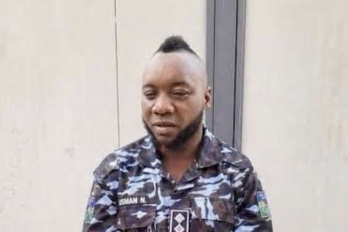
At the heart of the uproar is ASP Nuhu Usman, the officer accused of shooting dead Mene Ogidi in Effurun while the suspect was already handcuffed and pleading for his life in a viral video that has horrified Nigerians across the country.
The killing has done more than spark anger. It has pulled back the curtain on a much darker allegation that the police hierarchy knew far more about Usman’s past than it is now admitting. According to Efemena Umukoro, interim Delta State Coordinator of the Social Patriotic Youths Initiative and National Secretary of the Urhobo Progress Union, the officer was not a lone bad apple but a repeat offender whose trail of allegations was allegedly ignored, softened or buried through quiet transfers.
Umukoro’s claim is as damning as it is explosive. He says Usman had long been known in Jesse and the wider Sapele axis for alleged extortion and misconduct, and that the command failed to discipline him properly after previous complaints. Instead, he alleges, the officer was simply moved around.
That is the real scandal now. Not just the killing in Effurun, but the possibility that the system itself helped to produce it.
Speaking on News Central TV, monitored by SaharaReporters, Umukoro described Usman as an “evil” the police failed to destroy, insisting that the latest shooting was no accident. In his words, the officer acted to kill the line of investigation and protect his own criminal interests.
That is a grave accusation, and it cuts straight to the nerves of public trust. If true, it would mean the victim did not die in a random policing error but in an act allegedly designed to silence someone who knew too much.
Umukoro said the deceased suspect had been seen in a viral video crying and promising to lead officers to a location in Sapele. He alleged that the suspect was killed because he knew too much about the officer’s operations in Jesse and nearby communities.
“Nuhu worked in Jesse previously. Jesse has a close proximity to Sapele,” he said. “I guess that was the main reason Nuhu quickly killed him, because Nuhu knows that his crimes and criminality will be exposed since he has worked in that area and he tends to know too much in that area, hence this action of extrajudicial killing.”
The activist then recounted what he described as a disturbing episode in Jesse Town, Ethiope West Local Government Area, where he alleged that Usman and his superior at the time, CSP Shinde Nwabueze, then Divisional Police Officer in Jesse, collected ₦2.5 million to release a suspect caught with a cut to size gun.
According to him, the matter did not end there.
He alleged that after realising the suspect had money, the officer went on to extort the family again while the suspect remained in detention for seven days. He also claimed that when a Chief Magistrate visited the station and demanded to inspect the cell, the officers panicked because the transfer of the case to Asaba would expose the money already collected.
That allegation, if independently confirmed, would point to a police culture in which justice is negotiable and criminal investigations become bargaining sessions.
Umukoro said he reported the matter to the Delta State Commissioner of Police, but instead of facing the kind of sanction that should remove such an officer from service, Usman was allegedly transferred from Jesse to the Delta Area Command in Effurun.
“That is why I will continue to say that the Nigerian Police aided Usman Nuhu to this offence,” he said.
Whether every detail of the allegation can be proven or not, one thing is already beyond dispute. The Delta State Police Command did not stop this situation before it escalated into a public killing that has now shattered confidence in its internal discipline.
The police say the suspect’s body is being kept in a government mortuary in Warri, while the family has been invited for an autopsy. That may be an important forensic step, but it does little to answer the bigger question Nigerians are now asking. Why was an officer with such damaging allegations still on active duty in the first place?
This is the nightmare at the centre of police reform in Nigeria. Officers accused of brutality are too often not removed from the system. They are transferred, shielded, recycled and returned to service in another division, where old habits continue under a new name and new badge.
That is how impunity survives.
The Effurun killing has now become more than a local outrage. It is a test of whether the Nigerian Police Force is finally willing to confront the culture that allows rogue officers to remain armed after repeated complaints. If the allegations around Usman are true, then the institution must answer not only for the shot that killed Mene Ogidi, but for every missed warning that came before it.
For Delta State, the damage is severe. For the police, the embarrassment is national. And for the public, the message is painfully familiar. Too often, the system does not stop the bad officer. It protects him until the body count forces a response.
That is why this case is not closing with the arrest of one man. It is opening a far bigger question about how many more men in uniform are still being shielded by a culture of silence, transfers and delayed accountability.
Follow us on our broadcast channels today!
- WhatsApp: https://whatsapp.com/channel/0029VawZ8TbDDmFT1a1Syg46
- Telegram: https://t.me/atlanticpostchannel
- Facebook: https://www.messenger.com/channel/atlanticpostng