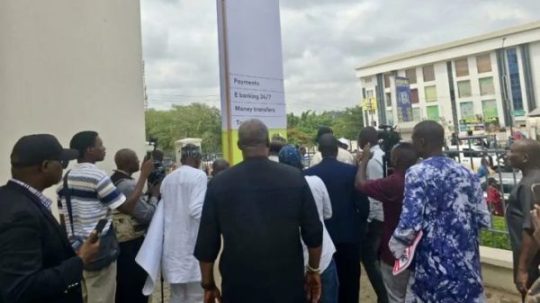
ABUJA, FCT – The Federal Capital Territory Administration’s (FCTA) dramatic sealing of an Access Bank branch, a Total petrol station and the Federal Inland Revenue Service (FIRS) office in Wuse exposes a staggering 34-year culture of impunity among Nigeria’s highest-profile occupants.
As Minister Nyesom Wike flexes powers under the Land Use Act of 1978, this enforcement blitz signals a no-nonsense dawn for Abuja’s property regime.
Official documents reveal that the Access Bank premises on Plot 2456, Wuse I, belong not to the lender but to Rana Tahir Furniture Nigeria Limited, which allegedly ignored annual ground-rent demands for more than three decades.
A letter dated 13 March 2025 from Director of Land Administration, Chijioke Nwankwoeze, bluntly revoked the right of occupancy: “Your continued contravention of the terms and conditions by failing to pay annual ground rents due for Thirty-Four (34) years” constituted the legal basis for seizure.
Similarly, the FIRS office on Plot 627, Wuse Zone 5, was padlocked over 25 years of accumulated arrears. Chijioke Nwankwoeze explained that this revocation marks the commencement of FCTA’s repossession of more than 4,794 defaulting properties across high-value districts in Abuja.
This crackdown follows repeated notices since 2023, yet the scale of compliance failure warrants deeper scrutiny of public-private accountability.
Total Energy’s filling station in Zone 1 had been delinquent for over a decade, illustrating a worrying tolerance for corporate non-compliance in Nigeria’s capital.
With every padlock and “Sealed by FCTA” notice, questions grow louder over why successive administrations failed to enforce ground-rent statutes, allowing multinationals and government agencies alike to flout obligations with impunity.
Critics argue that selective enforcement risks political bias, pointing to the recent sealing of the Peoples Democratic Party national secretariat.
Yet, the rule of law demands impartiality: defaulting on statutory dues—whether by a political party, a government agency or a private corporation—must invite uniform consequences.
As Abuja braces for further closures, stakeholders must ask: will this be a transformative reset or a fleeting spectacle?
For over 40 years, ground-rent revenue has underpinned FCT development; its recovery is not merely bureaucratic box-ticking but fundamental to public-sector integrity and fiscal sustainability.
The world is watching whether Wike’s FCTA will sustain this resolve or backslide under political and corporate pressure.
Additional reporting from Taiwo Adebowale, Atlantic Post Senior Business Correspondent.