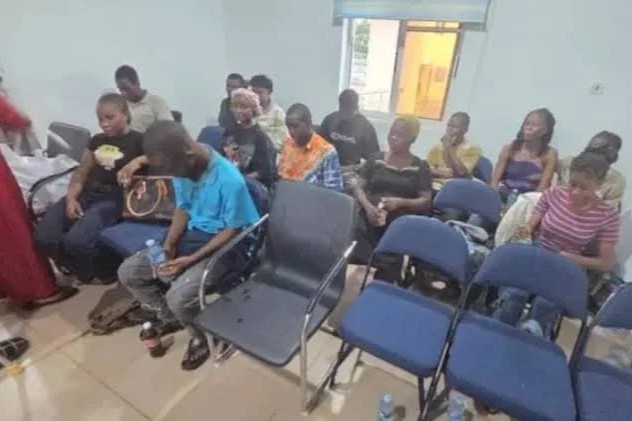
They boarded planes. They believed they were on their way to lucrative overseas jobs in construction sites, supermarkets, or private security posts. Instead, these Nigerians found themselves dumped in military camps in Eastern Europe, staring at Russia’s war in Ukraine. Those who refused to fight faced intimidation, detention or even abandonment in hostile terrain.
As the grinding conflict between Russia and Ukraine drags on, a disturbing syndicate is exploiting young Nigerians’ economic desperation. They supply “disposable” foot soldiers. These soldiers are recruited not by ideology, but by hunger and false promises.
Lured by Promises of Lucrative Jobs
One such victim was Benjamin Oloko. He is a 31-year-old trader from Ibadan in southwestern Nigeria. He thought his dream to “japa” (slang for emigrating to greener pastures) had come true last year.
A friend pointed him to a Facebook page of a recruitment agency advertising jobs in Russia. The offer sounded almost too good to be true. It was a private security job with a $1,500 monthly salary. There was also a $20,000 sign-up bonus. For Oloko – who sold clothing in a local market – this was a life-changing opportunity.
He was determined to seize it. He kept his plans secret from most family and friends. He feared they’d dissuade him by pointing out the obvious risk. Russia was at war with Ukraine.
He borrowed money and paid about $1,000 in fees, tickets and visa processing. By mid-September 2025, Oloko landed in Moscow, brimming with excitement at his new prospects.
The reality hit instantly. Upon arrival, airport officials confiscated his passport and phone, then told him to contact his “handler.”
A Belarusian middleman showed up after an eight-hour wait. He promptly demanded $500. This was allegedly to hand Oloko over to the main agent and arrange his accommodation.
Oloko paid. He was taken to a hotel. There, he found four other bewildered African job-seekers. Another Nigerian, a former member of Oyo State’s Amotekun security corps, was among them. He had quit his job for this opportunity. There was also a Ugandan, a Kenyan, and a Sudanese.
They spent five days at the hotel swapping stories. Gradually, the awful truth began to dawn. There was no high-paying private security job. They had been lured to Russia to join the military.
When Oloko frantically contacted the Nigerian agent who had arranged his trip, the story suddenly shifted. The job was no longer a private security role. Now, the agent claimed Oloko would work in the kitchen at a war camp. This role was safely away from the front.
Sensing betrayal, Oloko alerted his family and friends to where he actually was. They implored him: under no circumstances should he sign any contract presented to him. “Signing the contract would be signing your death warrant,” they warned.
After over a week in limbo, the group was moved to a Russian military training camp. Upon arrival, officials indeed presented service contracts. Three of the five unwitting recruits signed up on the spot. They instantly started taking cheerful photos in uniform. They sent these photos to the Russian agent as proof of their “happy” new lives.
This put added pressure on Oloko and the ex-Amotekun officer, who both refused to sign. At first, camp officials tried to entice them with promises of generous benefits if they joined. After two weeks, the carrots turned to sticks.
“We were threatened and put under serious pressure to sign,” Oloko recalls of the escalating intimidation.
The Russian agent – a middle-aged woman overseeing them – warned that if they refused, she would lose money.
She then demanded the two dissenters repay all expenses for their lodging and feeding. It was about $500 each. Only then would they be allowed to leave. Desperate to escape, Oloko and his compatriot paid up.
That “release” turned out to be another ordeal. The agent’s driver was ordered to take them away from the camp. After a couple of hours on the road, the driver abruptly stopped in a remote area. They tossed out their belongings and instructed them to get out.
He confiscated their wallets and passports. Then he drove off. He abandoned the two Nigerians in what felt like the middle of nowhere. They wandered lost for hours in the dark, foreigners stranded in a strange land.
“We trekked for seven hours till dawn before we got help,” Oloko says. Finally, a kind Belarusian truck driver picked them up and brought them to a town.
At the airport, however, they still could not leave. The agent withheld their passports. The agent flatly refused to return the documents even after the Nigerian Embassy intervened.
Oloko had to call home yet again to beg for money to buy a ticket back to Nigeria. Eventually, he and the ex-Amotekun officer made it home alive, shaken but safe.
The three Africans who did sign the contract and joined the fighting were not so lucky: according to Oloko, two have already been killed in action, and the third was gravely injured by a bomb blast and remains hospitalised.
“My saving grace was heeding my family’s advice not to sign,” says Oloko, soberly reflecting on how close he came to a likely death. “If I had, I would have died by now, just like the others.”
“No Way Out” – Tricked into Battle
Another recruit, Bankole Manchi, a 36-year-old auto mechanic from Lagos, endured an even more harrowing journey. Unlike Oloko, Bankole had informed his family of his plans to travel. He sought a better-paying job. It was a security position in Russia supposedly offering ₦500,000 (about $650) per month.
Through an agent, he obtained travel documents with surprising ease. Bankole later recalled that the visa process seemed suspiciously smooth. There were no rigorous interviews or verifications. It just involved some forms and an older “connection” who arranged everything.
He flew from Nigeria to Addis Ababa, then on to Moscow. Upon landing, Bankole was handed over to two men who reassured him all was well. He was taken, not to any workplace, but directly to a military-style camp deep in the countryside.
There he met dozens of other recruits from Nigeria, Ghana, Uganda, Kenya, France, Brazil, China and other countries. Many could barely communicate, lacking a common language, and relied on translation apps on their phones.
It quickly became clear that nobody was there for a civilian job. “Once you enter the camp, there is no way out,” Bankole remembers being told.
Training began almost instantly. First came basic military drills and marches. Then there were classroom lessons. This was followed by handling of AK-47 rifles and grenades. There were also night-time field exercises.
Some untrained recruits stumbled and got injured during drills, but the Russian instructors forced them to continue regardless.
After some weeks, Bankole’s group was secretly transferred under the cover of darkness. They crossed the border into Ukrainian territory. They were not informed of their destination.
Some realised they were now at the frontline of the Russia-Ukraine war. They figured this out only by covertly checking maps and compass bearings.
The very night they arrived at the battlefront, chaos erupted. Ukrainian forces engaged their unit with heavy gunfire. Bankole was shot in the leg almost immediately.
In the ensuing carnage, he witnessed how utterly expendable the foreign fighters were considered. For days he survived mostly on only water, with little food or medical care available for wounded recruits.
“We were treated as disposable fighters,” he says – cannon fodder in a war he never intended to join.
Bankole eventually received treatment for his leg. Through a stroke of luck, he managed to withdraw from the front. Eventually, he was evacuated from the conflict zone. He found his way back to Nigeria. He was one of the rare few to return home to tell the tale.

Bankole’s and Oloko’s stories are not isolated. Similar accounts have emerged from across Africa. A Ugandan man, for example, recounted in a video interview how he and others were promised jobs in Russian supermarkets, airports, and hotels. They were detained upon arrival. They were conscripted under armed guard.
He described recruits being confined in locked facilities. They were ignored when they protested. Later, they were forced into squalid underground shelters crawling with bedbugs. They were given barely any food.
This Ugandan eventually deserted and fled toward Ukrainian lines. He was captured by Ukrainian forces. After confirming he was essentially a trafficked fighter, they spared him.
Researchers have begun to uncover evidence that these scams are part of a coordinated recruitment network spanning several countries.
Nigerian investigative journalist Shola Akinlade (known online as Sholla Ard) alleges that a Russian company called ST3 Metal LLC has been funnelling African job-seekers into combat. They do this by issuing short-term employment contracts. Some contracts are as short as two weeks to help visas.
According to Ard’s findings, local brokers in countries like Kenya and Uganda recruit young men with promises of work abroad. They route them through transit points like Juba, Nairobi or Istanbul. Once they land in Russia, the newcomers are swiftly handed over to military handlers.
Recruits are often pressured to sign documents (many don’t understand Russian) that commit them to the war. Records of missing persons and reported combat deaths across Africa suggest hundreds may have fallen victim to this scheme.
War, Mercenaries and a “Meat Grinder”
The Russia-Ukraine war is now approaching its fourth year. Russia’s full-scale invasion began in February 2022. This conflict has been a magnet for foreign fighters on both sides. In the war’s early days, both Moscow and Kyiv openly solicited international volunteers.
Ukraine established an International Legion with a campaign called “Join the Brave,” inviting foreigners to help defend against the invasion. The requirements were straightforward. Candidates had to be between 18–60 years old. They needed to be physically fit and have no criminal record or chronic illness. They had to be able to legally enter Ukraine. Preferably, they had military experience.
Volunteers had to provide personal details, social media profiles, and commit to serve at least six months (or until “victory”). Thousands of people from Europe, North America, and elsewhere answered Ukraine’s call.
Russia, on the other hand, pursued a more covert approach to enlisting foreign fighters. Early in the conflict, Russian Defense Ministry officials issued a warning. They stated that any foreigners fighting for Ukraine would be deemed unlawful combatants and denied POW protections. At the same time, Russia quietly welcomed fighters to its own ranks. They did so notably via the private military contractor Wagner Group and other shadowy channels.
By mid-2022, reports indicated a significant presence of foreign combatants. Russia’s Defense Ministry tried to downplay Ukraine’s international support. They released figures claiming to track every “mercenary” entering the fray.
In June 2022, Moscow asserted that 6,956 foreign fighters from 64 countries had come to Ukraine. This number is far lower than the 20,000 touted by Kyiv. Of those, the Russians claimed 1,956 had been killed and 1,779 had fled Ukraine, leaving roughly 3,200 still active.
The Nigerian contingent, according to this Russian data, numbered 85 fighters. Of these, 38 had been killed. By that point, 35 had returned home. This left only 12 Nigerians still on the battlefield. (Notably, these figures referred to Nigerians fighting for Ukraine, as the data was released to undermine Ukraine’s “foreign legion.” It did not account for Nigerians or other Africans fighting on Russia’s side. Moscow did not advertise this possibility.)
The Russian ministry derided Ukraine’s claims of tens of thousands of foreign volunteers as “just plain lies.” It insisted its own tally was accurate. The ministry claimed that the “flow of mercenaries” had reversed. Many foreigners were deserting or dying despite Kyiv’s efforts.
Regardless of the propaganda war over numbers, the human cost of this conflict has been staggering. A United Nations human rights monitoring report in June 2025 indicated that over 13,300 civilians had been killed in Ukraine. Additionally, 31,700 civilians were injured since the invasion began in 2022.
Military casualties are even more sobering. In mid-2025, the Center for Strategic and International Studies (CSIS) conducted an analysis. It estimated that Russian military losses, both dead and wounded, were on track to reach one million by the summer of 2025.
Ukrainian forces, too, have suffered brutally – around 400,000 total casualties since 2022, including roughly 60,000–100,000 soldiers killed. The frontline has earned grim nicknames like “the meat grinder,” where waves of troops are chewed up in relentless bombardments and trench warfare.
By late 2025, Ukraine began spotlighting Russia’s reliance on foreign fighters as evidence of Moscow’s desperation. In November, Ukraine’s Foreign Minister Andriy Sybiha made a revelation. He stated that more than 1,400 citizens from 36 African countries were fighting for Russia in Ukraine.
Ukrainian officials accused Russia of bolstering its ranks “through subterfuge” – tricking or enticing foreigners to sign contracts “equivalent to a death sentence”. “Foreign citizens in the Russian army have a sad fate,” Sybiha wrote on social media, noting most are immediately sent in “meat assaults” – wave attacks on fortified positions – where they are quickly cut down.
He warned African governments to publicly discourage their nationals from taking up such offers. These disclosures prompted alarm in several African capitals.
South Africa announced an investigation into how 17 of its citizens ended up as mercenaries in Ukraine. This comes after a group of South African men sent distress messages home. They were begging for help to return.
Kenya similarly reported a troubling situation. Some of its young men had been “unknowingly” caught up in Russia’s war. They were lured abroad and then detained in military camps across Russia. Both countries indicated they would look into the trafficking networks that facilitated this.
Warnings from Abuja: “You’re On Your Own”
Right from the war’s outbreak, the Nigerian government had tried to shield its citizens from the danger. In early March 2022, as Russian tanks rolled toward Kyiv, Nigeria swiftly organised the evacuation of its nationals in Ukraine. Over 1,000 Nigerians, most of them students, were airlifted to safety.
The Nigerians in Diaspora Commission (NiDCOM) and the Foreign Ministry repeatedly urged Nigerians to stay out of the conflict zones.
“It is baffling that any Nigerian would seek employment in Russia or Ukraine while war is ongoing,” remarked Abdur-Rahman Balogun, NiDCOM’s spokesman, in a media briefing.
He stressed that two years earlier Nigeria had spent considerable resources to bring citizens home from Ukraine.
“As far as Nigeria is concerned, we have completed the evacuation from danger zones – Ukraine, Russia, even Sudan. Whoever decides to go back or remain there now does so by choice,” Balogun said.
He warned starkly. Any Nigerian who joins a foreign army in a war is “on his own.” If caught or in peril, they would face the consequences without any expectation of Nigerian government intervention.
NiDCOM officials cite the case of Kehinde Oluwagbemileke. He is a final-year Nigerian student in Russia who enlisted in the Russian military. Ukrainian forces captured him in July 2025.
“His mother reached out to us,” Balogun said. “You were sent to study, but you enlisted yourself into the army… There is nothing wrong with military service as a career – but not in a war situation like this,” he lamented.
Families of those who secretly left to fight have been speaking out as well – often with tragic stories. Oyetunde Philip remembers his younger brother leaving his post in the Nigerian Air Force to join the conflict in 2024. He recalls that “he died in December.”
The grieving brother now urges others never to contemplate such rash moves.
“I will never advise anyone to do this. It’s far deeper than what we see online,” he said, implying that the true horrors of the war are being downplayed on social media.
Another Nigerian, Akin Olaoye, recounted hearing about six Mobile Police officers. They had resigned and taken up mercenary contracts to fight in Ukraine.
“They were reportedly contracted for $1,500 monthly – about ₦2.25 million. That is two years’ wages [in Nigeria] earned in one month,” he noted.
The tantalising math of war profiteering has tempted even employed servicemen. (Officially, Nigeria’s military and police say any personnel who left to fight in Ukraine did so without authorisation. Nigeria, like many countries, did not deploy any troops to the Russia-Ukraine war.)
Not only Nigeria, but the governments of Russia and Ukraine have been questioned about these recruitment schemes targeting Africans.
So far there has been little formal public response from either Moscow or Kyiv. This concerns agents tricking Africans into the war under the guise of legitimate jobs.
It remains a murky aspect of the conflict, with much of the activity happening in the shadows via third-party brokers.
Desperation and Danger: Why They Go
Experts in international affairs say that, ultimately, those Nigerians (and other Africans) who have ended up in the Russia-Ukraine war chose to go. Yet, their choices were driven by dire circumstances.
Prof. Olufemi Otubanjo of the Nigerian Institute of International Affairs explains. An ever-growing number of young Nigerians feel pushed to extremes. They are driven by economic hardship and hopelessness at home.
“Nigerians are daring, mobile and willing to take risks for better pay,” he observes.
With youth unemployment soaring and little prospect of a comfortable life for many, thousands look outward for opportunities. (In late 2022, Nigeria’s National Bureau of Statistics reported over 133 million Nigerians – 63% of the population – living in multidimensional poverty .)
“There is no Nigerian law preventing citizens from travelling anywhere in the world,” Prof. Otubanjo notes – the only real barriers are visas and finance.
So if an attractive offer in a far-off land appears, many will pursue it, even if it involves great peril.
“Young people, in particular, feel abandoned by a society that has failed to provide opportunities for them. So they are ready to go anywhere and do anything,” he says.
It’s not uncommon to find Nigerian graduates and professionals doing menial jobs abroad just to make ends meet. In that context, it is understandable that some would even accept work in a war zone. They do so for a chance at relatively big money.
“If Nigerians can cross the Sahara Desert and the Mediterranean, and die in thousands trying to reach Europe, then there is nowhere they will not go,” Otubanjo adds, highlighting the extreme risks people are willing to take to escape hardship.
Another analyst, Prof. Sylvester Akhaine, a political scientist at Lagos State University, points out that Russia’s and Ukraine’s pressing manpower needs have increased demand. This situation has created a market for global fighters.
“This war has been described as a meat grinder. Casualties on both sides are massive,” Akhaine says.
Ukraine has mobilised its population to the point that many of its youths have fled abroad to avoid the draft. Russia faced significant domestic backlash over forced conscription. When mobilisation was announced, tens of thousands of young Russian men bolted for the borders. They fled to Finland, Georgia, and elsewhere to avoid being sent to the trenches.
“Putin cannot afford a domestic uprising,” Akhaine notes, which is one reason Russia leaned on groups like Wagner and covert recruitment to fill the ranks.
Ukraine, for its part, has received an influx of Western volunteer fighters. It has also received ex-military advisors. Russia has looked to allies like North Korea, which reportedly sent contingents of “volunteers.” Russia also targets vulnerable foreign populations it can lure or coerce.
“Both countries need manpower as long as the war remains conventional,” Prof. Akhaine says – and that demand has fed into the unscrupulous recruitment of outsiders.
Human rights advocates are calling for action to stop the exploitation. Ayode Longe is the deputy director of Media Rights Agenda, a Nigerian NGO. He urges NiDCOM and the Nigerian government to use diplomatic channels. They should press Russia to halt the recruitment of Nigerians.
“It is worrying that people would agree to fight in a war they have no part in,” Longe says. He emphasises that many of those going are deceived. Others are under extreme duress.
He suggests Nigeria’s Foreign Ministry should register strong protests. They should perhaps work with other African nations. Together, they can expose and crack down on the networks ferrying young Africans to the frontlines.
“From what we have seen, many are deceived or coerced,” Longe said.
He specifically mentioned NiDCOM’s chair Abike Dabiri-Erewa. She has been vocal on diaspora protection issues. He sees her as someone who should champion this cause.
A Gamble with Life and Death
For the likes of Oloko, Bankole and the Oyo State ex-guardsman, returning home was an immense relief. Yet, it was also a humiliation.
They left Nigeria full of hope. They barely escaped with their lives from a war they never intended to fight. Now they are back in their towns and villages. They consider their survival a blessing. Their japa gamble turned into a brush with death.
Many others have not been so fortunate. Across Africa, families are grieving sons who vanished in search of jobs. These sons reappeared in coffins from the killing fields of Ukraine, if their bodies were recovered at all.
This unfolding saga of job scams feeding a distant war reveals a collision of tragedies. It shows the desperation of unemployed African youth and the predatory reach of human traffickers. It also exposes the unending appetite of a brutal conflict for fresh bodies.
This situation serves as a stark warning. When a deal sounds too good to be true, such as $1,500 a month to be a “security guard” in a war-torn region, it almost certainly is. And in this case, the price paid may be the ultimate one.
Follow us on our broadcast channels today!
- WhatsApp: https://whatsapp.com/channel/0029VawZ8TbDDmFT1a1Syg46
- Telegram: https://t.me/atlanticpostchannel
- Facebook: https://www.messenger.com/channel/atlanticpostng