DHQ claims sweeping victories under Gen. Musa, yet rights groups flag civilian risk and foreign infiltrators—Nigeria’s security at a crossroads.
In a dramatic pronouncement this weekend, the Defence Headquarters (DHQ) announced that Nigerian troops, bolstered by hybrid forces and sister security agencies, had “sustained offensive operations in all theatres” between 8 and 15 May 2025, in line with President Bola Tinubu’s directive to secure farming corridors and bolster national food production.
Under the watchful command of Chief of Defence Staff General Christopher Musa, the Armed Forces portrayed themselves as both sword and shield: cutting down insurgents while carving out safe zones for beleaguered agrarian communities.
Yet beneath the triumphant rhetoric lies a far more complex battlefield—one where rights groups decry civilian harm, local communities voice mixed gratitude and suspicion, and lingering questions over foreign militants and porous borders threaten to undermine the AFN’s narrative of unassailable success.
A Week of “Renewed Vigour”
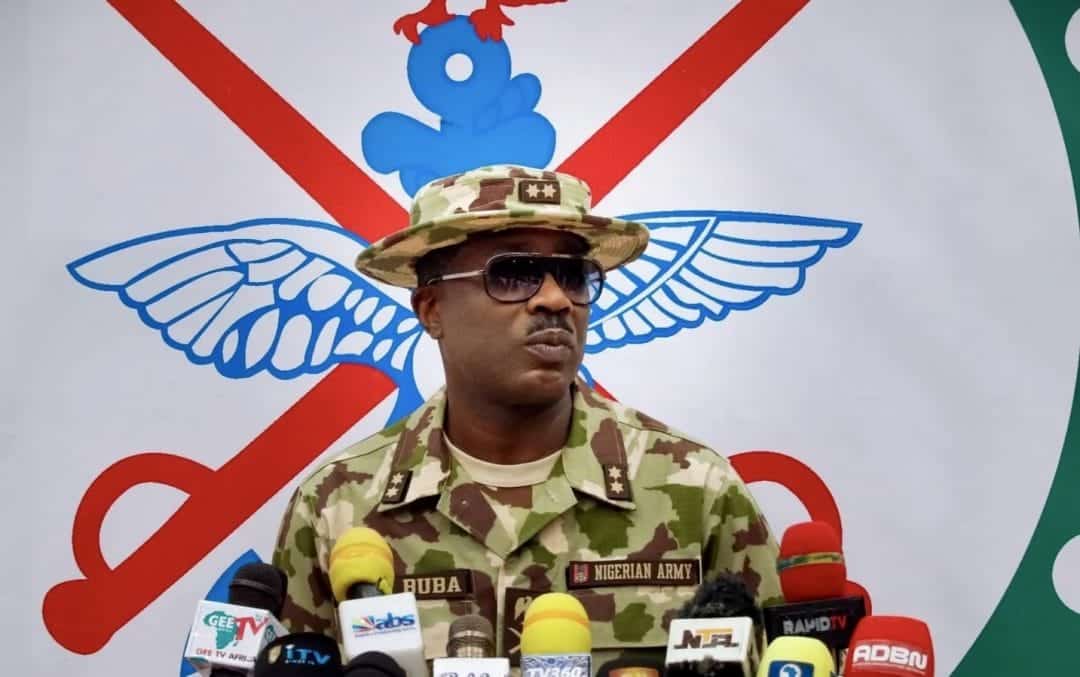
Director of Defence Media Operations Major-General Markus Kangye, in a terse Abuja briefing, detailed the week’s operational highlights. Troops reportedly destroyed multiple terrorist camps, rescued kidnapped victims, and rehabilitated conflict-affected civilians—achievements framed as critical to “attainment of food security” and the nationwide revival of farming.
Kangye emphasised that, far from negotiating on “issues of national security and welfare of troops,” the military remained “resolute and ever determined” to safeguard Nigeria’s territorial integrity under Gen. Musa’s leadership.
Indeed, with staple-food shortages looming and inflation biting hard, the Tinubu administration has repeatedly linked security to economic stability.
By securing farmland and deterring raids, the military argues, it ensures agrarian productivity—a lifeline for Nigeria’s majority rural population. The DHQ’s narrative dovetails with the government’s broader campaign to frame the military as a guarantor of both sovereignty and sustenance.
North East: Operation Hadin Kai’s “Notable Gains”
In the North East, troops under Operation Hadin Kai reportedly “neutralised scores of terrorists” during patrols, raids and clearance missions across Mafa, Dikwa, Gwoza and Damboa Local Government Areas of Borno State.
The operation also claimed the rescue of 17 abducted victims and the recovery of assorted arms, ammunition, hand grenades and extra magazines.
On 16 May alone, forces in Gwoza repelled a sporadic Boko Haram attack, killing five insurgents and seizing weapons—an action coordinated with Civilian Joint Task Force units and vigilantes.
But these battlefield statistics mask a more ambivalent reality on the ground. Amnesty International and local NGOs have repeatedly documented allegations of civilian casualties, mass detentions and forced displacements under the guise of counter-insurgency.
While the DHQ refutes such claims, insisting all measures comply with rules of engagement, human-rights defenders argue that the fog of war obscures abuses that risk fuelling fresh cycles of violence.
North West: Fansan Yamma’s Mixed Record
Meanwhile, Operation Fansan Yamma in the North West—lauded for “killing scores of terrorists and rescuing 129 victims” across Kaduna, Katsina, Sokoto and Zamfara States—paints another picture of military resolve.
Joint Air Force strikes and ground sweeps are said to have dismantled bandit enclaves, thwarted mass kidnappings, and recovered cattle and equipment vital to local livelihoods.
Yet the operation’s own side-effects have drawn fire. In January 2025, an airstrike in Maradun LGA (Zamfara) mistakenly targeted Community Protection Guards, killing at least two local volunteers and injuring others—an incident FIJ labelled a glaring military blunder that left grieving families and exposed coordination failures between air and ground units.
Critics warn that such errors not only endanger civilians but erode trust in security services, pushing communities toward self-help militias and further destabilising the region.
Niger Delta: Delta Safe’s Oil-Theft Crackdown
Down south, Operation Delta Safe is officially celebrated for foiling oil theft worth over ₦103 million—seizing 68,875 litres of crude, 31,166 litres of Automotive Gas Oil and 2,250 litres of Dual Purpose Kerosene—while discovering and destroying 16 crude-cooking ovens, 31 dugout pits, 19 boats, 34 storage tanks, 79 drums and 18 illegal refining sites.
Troops subsequently apprehended dozens of perpetrators, touting the operation as a blow against Nigeria’s notorious pipeline vandals.
Nonetheless, endemic challenges persist. Local activists accuse security personnel of complicity in bunkering rackets, alleging that high-level collusion enables large-scale theft to flourish despite military crackdowns.
Former Rivers State Governor Nyesom Wike has publicly accused serving officers of profiting from stolen crude, raising uncomfortable questions about the honesty of the military’s enforcement campaign.
With Nigeria losing up to 200,000 barrels per day to theft in recent years—costing billions in revenues—the Delta Safe operation, while laudable, may be fighting a hydra whose heads sprout anew with every refinery destroyed.
The Human and Political Costs
Beyond tactical wins and seized contraband, the DHQ’s week of feats underscores a persistent tension between security and rights. The rights group HURIWA slammed Kangye’s depiction of foreign terrorists—based on accents and hair texture—as a “scandalous admission” that Nigeria’s borders are “porous” and its sovereignty compromised.
Meanwhile, Amnesty International has condemned the military’s alleged overreach, citing incidents of detention without trial, forced displacement and unaccounted-for fatalities.
Politically, the Tinubu administration stands at a crossroads. On one hand, public impatience with insecurity demands showy victories and restored order; on the other, civil-liberties advocates insist that sustainable peace requires respect for human rights and meaningful community engagement.
The military’s top brass must reconcile these imperatives or risk undermining the very planting corridors they strive to protect.
Community Collaboration: A Double-Edged Sword
Notably, Kangye praised local collaboration as “invaluable” to intelligence gathering—a nod to Joint Task Force models that embed Civilian Joint Task Force and vigilante elements alongside conventional troops.
Such partnerships yield tips that thwart ambushes and pinpoint logistical hubs. Yet critics caution they can blur command lines, embolden unregulated militias, and sow seeds of post-conflict retribution if a community falls out of favour with authorities.
For farmers in Maiduguri’s outskirts, military “safe corridors” have restored rice planting and vegetable cultivation after years of siege. But in Zamfara’s villages, where airstrikes and raids are felt as much as in the farm fields, some youths whisper of taking up arms as vigilantes to guard their hamlets—an unsettling echo of the very banditry the operations purport to vanquish.
Beyond the Headlines: What Next?
As Nigeria grapples with overlapping threats—Boko Haram, ISWAP affiliates, bandit syndicates, oil-theft networks—the DHQ’s recent report offers both hope and warning.
The scale of operations from the Sahel to the creeks demonstrates capacity and resolve. Yet, without rigorous oversight, transparent investigations into civilian-harm allegations, and credible anti-corruption measures within security ranks, the gains risk proving ephemeral.
President Tinubu’s food-security gambit hinges on more than empty farmland; it demands hearts and minds. Can the military transform itself from a hammer into a builder, hammering out security while laying the bricks of public trust?
Or will the next viral video—true or recycled—rekindle fears that the armed forces, in defending the nation, have lost sight of the people they swore to protect?
Only time and accountability will tell. For now, Major-General Kangye’s victory rollouts resonate in Abuja’s halls and social-media feeds alike.
But for millions in Borno’s farms, Zamfara’s villages and Delta’s waterways, the real battle is not for tactical bragging rights—it is for the day-to-day peace that turns seeds into harvest, oil into revenue, and soldiers into guardians rather than occupiers.
- Additional reports from Suleiman Adamu, Peter Jene and Kalada Jumbo