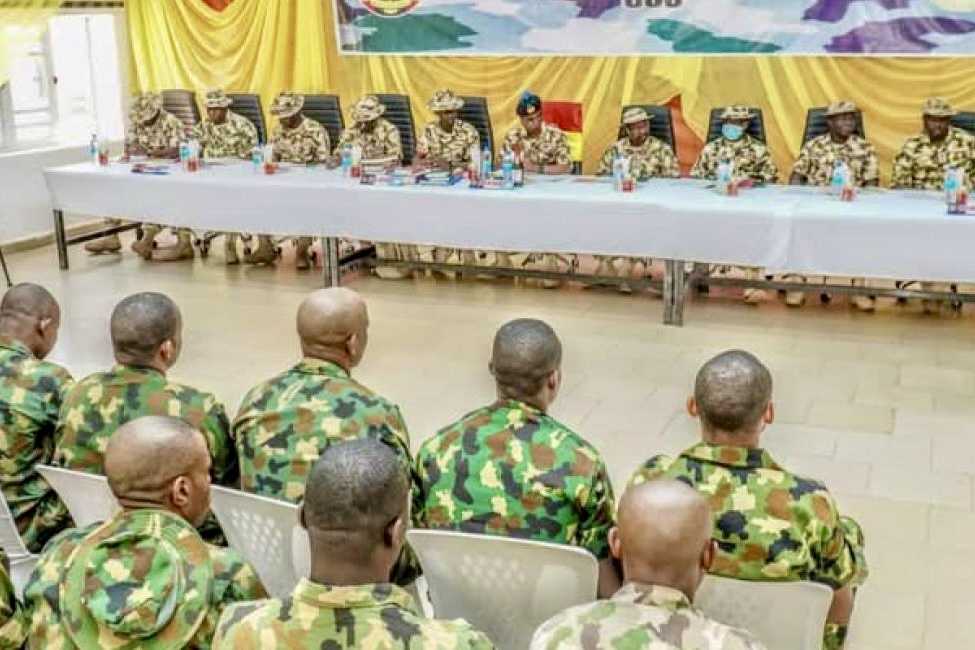
ABUJA, Nigeria — The most consequential evidence in Nigeria’s alleged coup trial may no longer be the alleged plot itself, but what happened inside the rooms where military intelligence officials obtained the statements now being presented against serving officers.
On Wednesday, September 30, 2026, a General Court Martial in Abuja is scheduled to rule on the admissibility of statements allegedly made by military officers accused of plotting to overthrow President Bola Tinubu’s administration.
The ruling follows a trial-within-a-trial lasting several weeks, triggered by defence objections to statements tendered by the prosecution.
The officers have alleged that some statements were extracted through coercion, intimidation, inducement and physical abuse. Some also told the court that intelligence officers had prepared statements which they were subsequently compelled to copy or sign, including passages they said contained allegations or admissions they did not know about.
Those allegations have not been established as facts. They are disputed claims forming part of the evidence the military court must assess.
The prosecution has presented evidence intended to show that the statements were made voluntarily.
That leaves the court with a question that reaches beyond the immediate fate of the documents: what standard should govern evidence obtained during a military intelligence investigation when the accused says the process itself was compromised?
The Question Behind the Question
The defence has argued that the statements fail the legal requirements for admission, pointing to the absence of lawyers or other witnesses chosen by the accused officers when the documents were allegedly made.
It has also challenged the absence of video recordings showing the officers writing the statements in the presence of their chosen witnesses and questioned whether some officers were properly cautioned or informed of their rights before making the statements.
SaharaReporters reported on September 29 that the court had scheduled Wednesday’s ruling after hearing evidence on whether the statements were voluntary. The report also said the ruling, initially fixed for September 23, had been adjourned three times.
Yet there is an important legal wrinkle that could make the ruling more complicated than a simple question of whether investigators followed the Administration of Criminal Justice Act.
The ACJA does contain safeguards on the taking of statements. Section 17 provides for a statement to be taken in the presence of a legal practitioner or another person of the suspect’s choice, while section 15 addresses the recording of confessional statements. But section 2(2) of the same Act expressly provides that the Act does not apply to a Court Martial.
That is an important distinction.
The military tribunal is operating under the Armed Forces Act and its applicable rules of procedure. Section 143 of the Armed Forces Act provides that, except where the Act itself provides otherwise, the rules of evidence before a court martial are the same as those observed in criminal courts in Nigeria. Section 181 also preserves the applicable service rules of procedure.
So the legal battle over the disputed statements is not necessarily as simple as asking whether every provision of the ACJA was complied with.
The deeper question is whether the prosecution can establish that the evidence satisfies the applicable rules governing admissibility and voluntariness.
What the Evidence Act Says About Coercion
Section 29 of the Evidence Act provides a more direct statutory safeguard against coerced confessions.
It states that a confession may be admitted where relevant, but where it is represented to the court that it may have been obtained by oppression, or following conduct likely to make it unreliable, the court should not admit it unless the prosecution proves beyond reasonable doubt that it was not obtained in breach of the section.
The Act defines oppression to include torture, inhuman or degrading treatment, and the use or threat of violence.
That provision gives particular significance to the allegations made during the trial-within-a-trial.
If an officer merely disputes the contents of a statement, that is one evidential issue.
If an officer alleges that the statement was produced through threats, inducement or physical abuse, the issue changes. The court must then examine the circumstances in which the statement was obtained and whether the prosecution has established voluntariness to the required standard.
The Supreme Court has previously recognised the importance of that process. In Eteng Otu Ujang v The State, the court explained that once the voluntariness of a confession is challenged on grounds such as oppression or inducement, the prosecution bears the burden of proving that the confession was voluntarily obtained. The court also recognised the statutory role of a trial-within-a-trial in resolving such disputes.
Nigeria’s Constitution provides another layer of protection. Section 34 guarantees the dignity of the human person and states that no person shall be subjected to torture or inhuman or degrading treatment.
That protection does not disappear because the person making the allegation is a serving soldier.
The Video Question Is More Complicated Than It Appears
One of the most striking issues raised by the defence is the alleged absence of video recordings showing how the statements were made.
For years, Nigerian courts wrestled with whether the word “may” in the ACJA’s provisions on electronic recording and the presence of a lawyer was mandatory or merely permissive.
In 2024, the Supreme Court’s decisions in FRN v Nnajiofor and FRN v Akaeze were widely understood as strengthening the mandatory nature of those safeguards in ordinary criminal investigations. Legal commentary and judicial materials published after those decisions described the rulings as requiring law-enforcement agencies to record confessional statements electronically and take statements in the presence of the persons specified in the legislation.
But the law has continued to develop.
A recent August 2026 review of Supreme Court authorities reported that Iwah v State placed greater emphasis on the Evidence Act as the controlling statute for admissibility, holding that failure to record a confession on video does not automatically make it inadmissible
Follow us on our broadcast channels today!
- WhatsApp: https://whatsapp.com/channel/0029VawZ8TbDDmFT1a1Syg46
- Telegram: https://t.me/atlanticpostchannel
- Facebook: https://www.messenger.com/channel/atlanticpostng