A Friendship Turned Political Fault Line
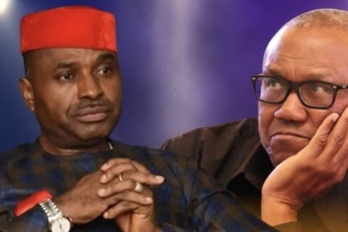
The widening feud between Peter Obi and Kenneth Okonkwo has now crossed from political disagreement into a high-stakes legal showdown, with the former Anambra State governor demanding N5 billion in damages, a public apology and a formal withdrawal of what his lawyers describe as damaging and reckless allegations.
What makes the dispute more explosive is not only the size of the claim, but the symbolism. Okonkwo was once among Obi’s most visible allies, a fiery public defender during the 2023 election cycle. Today, the two men stand on opposite sides of a bitter public rupture that is increasingly being fought through broadcast interviews, online circulation and legal threats.
According to the demand letter dated June 9, 2026, Obi’s legal team, Chief Alex Ejesieme (SAN) & Co., accused Okonkwo of making statements on Channels Television’s Sunrise Daily on June 8 that they say were false, malicious and defamatory. The lawyers insisted the remarks were capable of portraying Obi as a corrupt political actor who “demands, solicits, organises and collects bribes”, and who allegedly extorts and swindles aspirants.
That language is not merely legal theatre. In Nigerian politics, where perception often travels faster than proof, such allegations can harden reputational damage in hours. For a politician like Obi, whose brand has long rested on personal discipline, public frugality and a reformist image, the stakes are obvious.
What Obi’s Lawyers Are Actually Demanding
The legal team is not asking for a quiet correction behind closed doors. It wants a public retreat, and it wants that retreat to match the original blast radius.
The letter, which SaharaReporters said it obtained, demands that Okonkwo immediately withdraw the statements, publish an “unequivocal and unreserved” apology, and give that apology the same or greater prominence across the same channels where the remarks were made and amplified. That includes Channels Television and Okonkwo’s social media platforms.
The letter also demands that Okonkwo issue a written undertaking never to repeat the allegations. If he refuses, Obi’s lawyers say they will seek damages, injunctive relief, public retractions and the cost of litigation.
At the centre of the complaint is a set of allegations Obi’s legal team says Okonkwo made on live television. These include claims that Obi and some South-East party leaders allegedly demanded N10 million from House of Representatives aspirants after expression of interest fees had been paid, that documentary evidence and receipts existed, and that Obi personally compiled a candidates’ list from a hotel room.
The lawyers also say Okonkwo went further by suggesting Obi warned aspirants that he would “scam” them, travelled abroad to collect money from people, and was involved in criminal conduct with some party leaders.
That is why the letter frames the dispute not as a mere quarrel among former allies, but as a reputational attack with criminal overtones. In legal terms, that is a serious escalation.
Why This Case Matters Beyond The Two Men
This fight matters because it sits at the intersection of politics, media and law, three arenas now tightly fused in Nigeria’s public life.
First, it highlights the fragility of political alliances. Okonkwo and Obi’s relationship has been deteriorating for some time. In 2024, Channels Television reported that Okonkwo publicly criticised Obi over leadership and party matters, making clear that the old alignment had already fractured. More recently, Channels has continued to feature Okonkwo in interviews in which he takes hard lines on Obi and the wider opposition field.
Second, the matter raises the question of how far televised commentary can go before it becomes legally dangerous. Nigerian law recognises freedom of expression, but not a licence to publish what another side says is a false allegation of criminality. Obi’s lawyers leaned hard on that distinction, arguing that expression does not extend to “the reckless destruction of another person’s reputation.”
Third, the episode reflects a broader political culture in which reputational warfare has become a strategy. In that space, one television appearance can trigger a thousand reposts, clips, counter-clips and commentary threads. Once that cycle begins, the original allegation often stops mattering as much as the narrative it creates.
For Obi, this is also a test of control. By moving fast with a heavyweight demand of N5 billion, his camp is signalling that it will not tolerate what it sees as a deliberate attempt to stain his image with the language of criminality. For Okonkwo, the challenge is whether he can substantiate what he said, or whether he will now be forced to defend comments that may have been made more for political effect than legal precision.
The Political Meaning Of The Fallout
The deeper story here is not simply defamation. It is the collapse of trust inside one of the most visible political circles in the country.
Obi’s rise has depended heavily on a movement built around loyalty, moral contrast and disciplined messaging. Okonkwo once helped project that image. His estrangement from Obi therefore carries symbolic weight because it suggests that even the most prominent voices in the Obi orbit are no longer aligned on strategy, loyalty or political destination.
This also arrives at a time when the opposition landscape is already crowded with coalition talk, migration between platforms and loud accusations of betrayal. In that atmosphere, former allies often become the most dangerous critics because they know the internal arguments, the private meetings and the emotional fault lines.
That is why the N5 billion demand reads like more than a legal notice. It is also a warning shot to everyone around the former Labour Party presidential candidate that public criticism now carries a price.
Whether the matter ends in a retraction, a negotiated settlement or full litigation, the damage to the relationship is already done. The public now sees two men who once marched in the same political lane as locked in an open and hostile duel.
And in Nigeria’s high-pressure political arena, once that kind of rupture reaches the courts, it rarely ends as a private misunderstanding.
Verification note: This report is based on the demand letter as reproduced by SaharaReporters and Daily Review, and on Channels Television coverage showing Okonkwo’s recent Sunrise Daily appearances and his earlier public criticism of Obi.
Follow us on our broadcast channels today!
- WhatsApp: https://whatsapp.com/channel/0029VawZ8TbDDmFT1a1Syg46
- Telegram: https://t.me/atlanticpostchannel
- Facebook: https://www.messenger.com/channel/atlanticpostng