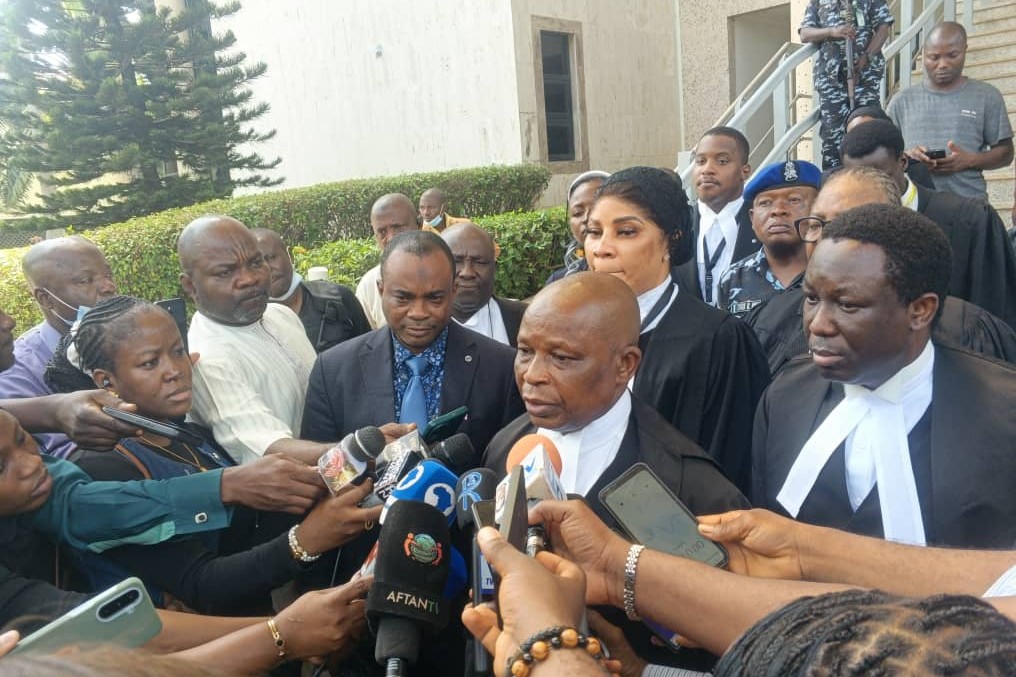
The Rivers State House of Assembly has accused Governor Siminalayi Fubara and Deputy Governor Ngozi Odu of gross misconduct, undermining constitutional norms. This claim, backed by over two-thirds of lawmakers, demands accountability following the governors’ alleged refusal to present a budget bill. This confrontation signals rising tensions between the Assembly and executive power in Nigeria.
PORT HARCOURT, Nigeria — In a move that has sent shockwaves through the political corridors of Rivers State, the Rivers State House of Assembly has formally accused Governor Siminalayi Fubara and his deputy, Ngozi Odu, of gross misconduct.
The explosive notice—issued by 26 lawmakers, amounting to over two-third of the Assembly’s membership—claims that the conduct of the executive duo is in flagrant violation of the Nigerian Constitution.
This latest development not only intensifies the standoff between the Assembly and the executive but also adds another chapter to a saga of governance struggles that have plagued the state over the past 15 months.
A Constitutional Mandate Under Scrutiny
In strict adherence to Section 188 of the Constitution of the Federal Republic of Nigeria, 1999 (as amended), the Assembly’s notice accuses the deputy governor of gross misconduct in the performance of her official duties.
Speaker Martin Amaewhule, the custodian of the Assembly’s legislative integrity, wasted no time in forwarding the notice to Governor Fubara.
In his correspondence, he reminded the governor that the Constitution mandates a response within 14 days of the notice’s presentation. Failure to comply would see the Assembly move to resolve the matter by motion without debate, as prescribed by Section 188(3).
This constitutional provision is designed to safeguard the checks and balances essential to Nigeria’s democratic system, ensuring that no officeholder is above the law.
By invoking this clause, the Assembly is asserting its authority to hold the executive accountable—a principle that is at the very heart of Nigeria’s constitutional democracy.
The Notice of Gross Misconduct: Allegations and Implications
According to sources, the notice obtained by Atlantic Post lays bare the allegations of gross misconduct levelled against Deputy Governor Ngozi Odu.
While the exact details of the misconduct remain undisclosed in the public domain, insiders suggest that the accusations are linked to actions taken in the wake of the recent Supreme Court judgement on the state budget.
This judgement, which rocked Rivers State by mandating the governor to present an appropriation bill, exposed a litany of executive excesses that have since defined the state’s political landscape.
Speaker Amaewhule, in his communication with the governor, emphatically stated that the allegations are not merely political rhetoric. Rather, they are rooted in a series of documented incidents that have marred the administration’s credibility.
Among the many grievances is the governor’s persistent refusal to submit the appropriation bill—a critical document necessary for the timely release of funds, which have been withheld by the Federal Government in light of the Supreme Court’s decision.
A History of Executive Overreach
To fully grasp the magnitude of the current allegations, one must revisit the tumultuous events that have characterised Governor Fubara’s tenure.
Following the Supreme Court’s judgement on the state budget, the Assembly had repeatedly called on the governor to adhere to his constitutional obligations. Letters and official communications were dispatched to the Government House, only to be met with brutal rejection.
In one instance, Assembly staff attempting to deliver correspondence were reportedly brutalised at the gate of the Government House, forcing the legislators to rely on courier services to ensure that their messages reached their destination.
Moreover, the governor’s actions in disbanding the traditional structures of governance did not stop at the budget. In an earlier press briefing, the Assembly recounted how the governor had made unlawful and invalid appointments of numerous Commissioners, leaving a gaping void in the executive’s administrative framework.
The Assembly’s repeated entreaties for the submission of a revised list of Commissioners were similarly rebuffed, with the governor even going so far as to instruct his aides to take legal action against the Assembly.
These actions, seen by many as a deliberate attempt to consolidate power and marginalise the legislative branch, have set the stage for today’s explosive notice.
The Assembly’s decision to accuse both the governor and his deputy of gross misconduct is a bold assertion of its constitutional prerogative—a stance that resonates with citizens who have long grown weary of executive overreach.
The Political Fallout: A Battle for Accountability
The implications of this notice extend far beyond the immediate confrontation between the Assembly and the executive. For the people of Rivers State, this is yet another reminder of the pervasive mismanagement and disregard for constitutional norms that have defined recent years.
The Assembly’s move is being hailed by opposition figures and civil society activists as a courageous stand against tyranny—a desperate bid to restore accountability and transparency in a state long plagued by autocratic governance.
Political analysts suggest that the notice could have far-reaching consequences. Should Governor Fubara fail to respond within the stipulated 14-day period, the Assembly is poised to initiate proceedings to investigate the allegations by motion, bypassing lengthy debates.
This swift procedural mechanism is designed to prevent any further delay in holding the executive accountable, signalling to all officeholders that the rule of law is paramount.
Furthermore, the notice is expected to galvanise public sentiment. With the Assembly’s history of struggles—ranging from the burning down of their chamber and the demolition of the House Complex, to the brutal assault on their Speaker’s residence—today’s action is seen as a culmination of pent-up frustrations.
Citizens, who have borne the brunt of the administration’s neglect, now have renewed hope that their voices will no longer be silenced by unchecked executive power.
A Question of Legitimacy and Governance
At its core, the notice of gross misconduct raises a fundamental question about the legitimacy of Governor Fubara’s administration.
By refusing to abide by the constitutional dictates—be it through withholding the appropriation bill or making invalid appointment of key officials—the governor has not only undermined the legislative process but also jeopardised the very foundation of governance in Rivers State.
Speaker Amaewhule’s message to the governor is unambiguous: the Assembly demands accountability, and any deviation from constitutional norms will be met with decisive action.
“Reply to the allegations made against you in the said Notice of Allegations of Gross Misconduct accordingly,” he instructed, invoking the authority of the Constitution as the ultimate arbiter in this high-stakes battle for control.
This confrontation is emblematic of a larger crisis—a clash between the old guard of autocratic rule and a new wave of democratic resurgence determined to reclaim Nigeria’s democratic institutions.
The Assembly’s bold stance against gross misconduct is not merely a procedural exercise; it is a clarion call for all Nigerians to stand united in the pursuit of a transparent and accountable government.
The Road Ahead: Uncertain, Yet Unyielding
As Rivers State braces for what could be a watershed moment in its political history, all eyes are now on Governor Fubara’s next move.
Will he address the notice in accordance with the constitutional provisions, or will he continue to defy the Assembly’s mandates, further entrenching his administration’s isolation?
The answer to this question will undoubtedly shape the trajectory of governance in the state for years to come.
For now, the Assembly remains steadfast. Their resolve, honed through months of resistance against brutal suppression and constitutional defiance, is clear: they will not allow the executive to operate unchecked.
The notice of gross misconduct, issued by 26 determined lawmakers, stands as a testament to the enduring spirit of democratic accountability—a beacon of hope in an era marred by authoritarian excesses.
In a state where the struggle for power has often resulted in the marginalisation of democratic institutions, this latest development is a rallying cry for reform.
The Assembly’s actions echo the sentiments of a populace tired of executive arrogance, and they signal a renewed commitment to the principles of good governance.
As the drama unfolds, one thing remains certain: Rivers State is at a critical juncture, and the battle for its democratic soul has only just begun.
Atlantic Post will continue to provide incisive and comprehensive coverage of this unfolding crisis.
The coming weeks promise to be a defining period for Rivers State—one where the tenets of accountability, transparency, and constitutionalism must prevail over personal ambition and unchecked power.