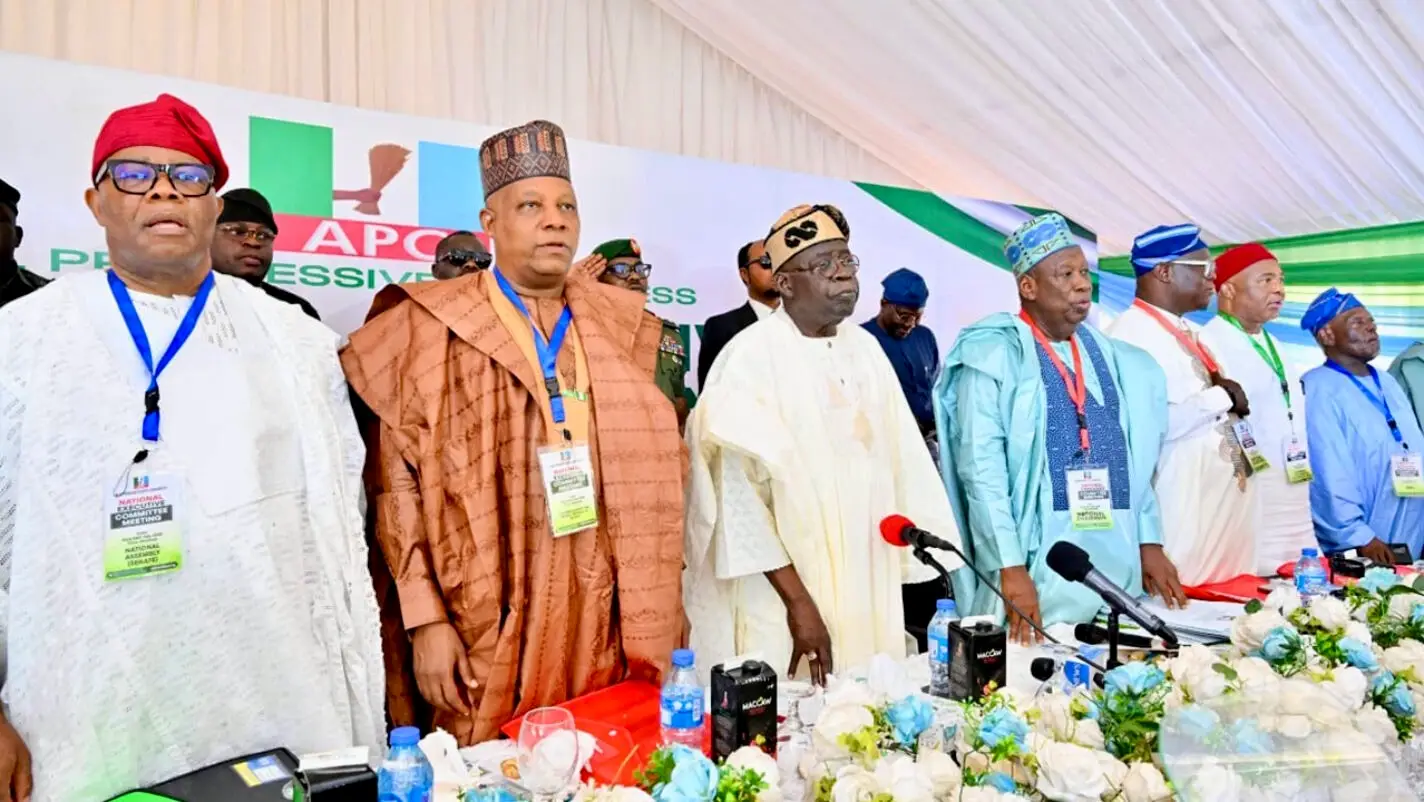
In a high-stakes political manoeuvre, the APC has endorsed President Tinubu and Chairman Ganduje amid regional rifts and internal discontent, setting the stage for a potential second term bid. Discover the detailed analysis and strategic implications in our comprehensive report.
APC’s Power Play: Tinubu and Ganduje Endorsed Amid Zonal Rift and Political Intrigue
ABUJA, Nigeria — In a dramatic display of political fortitude and internal realignment, the All Progressives Congress (APC) has reaffirmed its confidence in President Bola Tinubu and National Chairman Umar Ganduje – a move widely interpreted as a prelude to a potential second term bid for Tinubu.
The endorsement, passed by the party’s National Executive Committee (NEC) at its Abuja meeting on Blantyre Street, comes against a backdrop of simmering discontent, factional disputes, and strategic manoeuvring designed to consolidate the party’s power across Nigeria’s complex geopolitical landscape.
A Theatre of Political Showmanship
The NEC meeting, held at the APC National Secretariat in Wuse 2, Abuja, was nothing short of a political theatre. High-ranking governors and stalwarts from various regions converged in what can only be described as an arena of both celebration and simmering tension.
Among the attendees were incumbent governors from Edo, Ondo, Benue, Ekiti, Kaduna, Nasarawa, Yobe, Kogi, Ogun, and Niger States, alongside former governors from Zamfara, Kebbi, and other regions.
Their presence underscored the extensive reach of the APC and the high stakes involved as the party gears up for the forthcoming electoral contest.
The endorsement of Tinubu and Ganduje was moved by Senator Hope Uzodimma, Chairman of the Progressive Governors Forum (PGF), and seconded by former national chairman, Adams Oshiomhole.
Oshiomhole’s vociferous support for Tinubu’s policies was not merely a vote of confidence; it was a clarion call to the masses, signalling that Tinubu’s vision – characterised by aggressive economic reforms, a robust security agenda, and a promise of infrastructural development – resonated with a significant segment of the electorate.
The North-West Conundrum: Zoning and Reconciliation
Perhaps the most controversial aspect of the meeting was the deliberate endorsement of the North-West geopolitical zone’s claim to the APC’s top echelons, particularly the chairmanship.
This decision is seen by many as a tactical response to the disquiet among key North-West stakeholders. The controversy ignited when President Tinubu, in a move that many considered an affront to the region’s political expectations, selected Senator Kashim Shettima from the North-East as his running mate during the 2023 presidential poll.
This decision triggered a wave of resentment among North-West leaders, notably among outgoing state governors including Atiku Bagudu of Kebbi and others from Kaduna and Nasarawa.
Tinubu’s subsequent explanation – that after nearly 16 years of political ascendancy, it would not be proper to continuously offer the North-West the vice-presidential ticket – has done little to allay the fury.
Critics argue that his stance not only undermines the principle of equitable representation but also risks alienating a crucial vote bank that has historically been a pillar of APC’s electoral success.
In a bid to mollify these disgruntled factions, the NEC’s ratification of the zoning for the National Chairmanship to the North-West is seen as an attempt to re-establish balance and placate aggrieved leaders.
The Internal Discord: Absentees and Aggrieved Voices
Notably, the political drama was accentuated by the conspicuous absence of some heavyweight figures. Former Vice President Prof Yemi Osinbajo, ex-Transportation Minister Chibuike Amaechi, former Ekiti State Governor Dr Kayode Fayemi, and ex-Senate President Dr Ahmed Lawan chose to shun the NEC meeting.
Their absence is a tacit protest against what they perceive as a process mired in regional bias and opportunism. Such departures from the mainstream narrative not only deepen the internal rift but also raise questions about the long-term cohesion of the APC.
Former President Muhammadu Buhari’s non-attendance further underscores the growing disconnect between the party’s old guard and its current leadership.
Buhari, who once commanded immense respect and loyalty, has remained silent on the matter. His absence, while perhaps strategic, leaves a vacuum that accentuates the emerging fissures within the party’s ranks.
Economic Burdens and Institutional Challenges
Beyond the political manoeuvring, the NEC meeting also spotlighted the institutional challenges confronting the APC.
National Chairman Ganduje disclosed that the National Working Committee (NWC) has inherited staggering liabilities to the tune of N8.98 billion, accrued from pre-election litigations and election-related disputes across various offices – from the legislature to the gubernatorial and presidential elections.
This financial quagmire poses a significant operational challenge for the party and raises pertinent questions about its administrative efficiency and future fiscal management.
In a related development, Ganduje unveiled plans for a new national secretariat building – a project envisioned to not only provide the party with a permanent home but also symbolise its aspirations for long-term dominance.
He emphasised the need for immediate intervention from the President to expedite the acquisition of land from the Federal Capital Territory Administration (FCTA), thereby underscoring the intertwined nature of political and infrastructural ambitions.
Tinubu’s Defiant Promise Amid Crises
President Tinubu’s address during the meeting was both defiant and conciliatory. Amid chants of “on your mandate, we stand, no vacancy in the villa”, he acknowledged the challenges facing his administration – from security concerns to the escalating cost of living.
Yet, he remained resolute in his commitment to the progressive ideals that have defined his tenure. His remarks were punctuated by an appeal to calm and reconciliation, as he called on aggrieved leaders to engage in dialogue through newly proposed reconciliatory committees.
Tinubu’s insistence on addressing the economic shocks and security issues – issues that he attributed to global trends rather than isolated domestic failures – is a calculated effort to reframe the narrative.
By drawing parallels with other nations grappling with similar challenges, he sought to project an image of steady leadership amid global economic turbulence.
A Strategic Move for Electoral Fortification
The ratification of the zoning for the chairmanship to the North-West is not merely a conciliatory gesture; it is a strategic manoeuvre designed to fortify the APC’s electoral prospects in a fiercely competitive political arena.
With the looming challenge posed by the New Nigeria Peoples Party (NNPP) and its candidate, Dr Rabiu Kwankwaso, the APC is clearly betting on regional loyalty as a bulwark against emerging opposition forces.
The formation of a seven-member committee, chaired by Governor Mai Mala Buni, tasked with inclusively expanding the NEC membership, is another testament to the party’s commitment to internal reform.
The committee’s mandate to engage and integrate aggrieved leaders is viewed as a necessary step to restore unity within the party and ensure that internal dissensions do not undermine its broader electoral ambitions.
Analysis: The Road Ahead for the APC
As Nigeria edges closer to another high-stakes electoral cycle, the APC finds itself at a crossroads. The endorsement of Tinubu and Ganduje signals a clear commitment to continuity, yet the internal divisions – particularly those stemming from regional grievances – could prove to be a double-edged sword.
The party’s success in placating the North-West factions while maintaining national cohesion will be pivotal in determining its electoral fortunes.
Critics argue that the APC’s internal discord is symptomatic of a broader malaise within Nigerian politics, where regional interests often clash with national ambitions.
The apparent sidelining of key figures like Osinbajo and Fayemi may alienate sections of the electorate who see their exclusion as a betrayal of the democratic principle of inclusive governance.
Moreover, the financial liabilities inherited by the NWC could hamper the party’s ability to execute its developmental agenda, thereby feeding into narratives of governmental inefficiency and mismanagement.
Conversely, proponents of Tinubu’s policies point to the tangible developmental strides made during his tenure – from infrastructural projects to security enhancements – as evidence of his leadership acumen.
The recent defections from the opposition, with more than 18 National Assembly members reportedly joining the APC, are cited as a testament to the party’s growing appeal and the effectiveness of its political strategies.
Conclusion: A Battle for the Future of Nigerian Politics
In this volatile political landscape, the APC’s vote of confidence in Tinubu and Ganduje is both a bold assertion of continuity and a calculated bet on reconfiguring regional allegiances.
The party’s ability to navigate the intricate web of regional interests, financial burdens, and internal rivalries will ultimately determine its ability to secure another term in office.
For now, as the APC rallies its base and seeks to forge alliances across the geopolitical spectrum, the coming months promise to be a defining period in the annals of Nigerian politics.
With every strategic move and every contentious decision, the APC is not just shaping its own future but also setting the stage for a broader national debate on governance, equity, and the direction of the nation.
- Additional report by Osaigbovo Okungbowa, Atlantic Post Senior Political Correspondent



