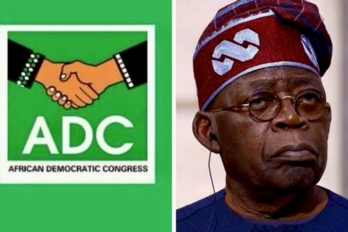
The African Democratic Congress has escalated its confrontation with President Bola Tinubu’s ruling All Progressives Congress, accusing the federal government of deliberately weakening opposition parties and shrinking Nigeria’s democratic space.
In a hard hitting statement posted by its National Publicity Secretary, Bolaji Abdullahi, the ADC described the Tinubu administration as “the most shameless government in Nigeria’s history” and claimed a pattern of interference in rival party affairs.
The allegation comes at a time when the opposition is already battling internal fractures, legal uncertainty and a tense race towards 2027.
Abdullahi anchored his latest attack on the Peoples Redemption Party, arguing that the PRP had remained stable until its leaders visited the ADC leadership and rumours spread that it might be drawn into a wider coalition.
He said that the mere whiff of speculation was enough to trigger a factional revolt, which he presented as evidence that opposition organisations are being destabilised from outside rather than merely failing from within.
The ADC also warned that the strategy could deepen national instability, insisting that a politics built on sabotaging every alternative platform is ultimately self destructive.
The accusation did not emerge in isolation. Only days earlier, Abdullahi had accused the APC of planning to disrupt an opposition summit in Ibadan and of blocking venue access for the ADC in Abuja, claims the ruling party rejected.
APC National Secretary Ajibola Basiru countered that the ADC should “put your house in order” and stop blaming Tinubu for its own disputes, while APC spokesman Felix Morka said the ruling party had no role in the opposition’s internal troubles.
That exchange shows how the battle between both camps has moved beyond normal partisan sparring into a broader fight over legitimacy, access and control of political space.
The PRP itself has become central to the controversy because its leadership is no longer politically simple. The party elected Dr Hakeem Baba Ahmed as national chairman at its convention in Abuja on 28 March 2026, according to reporting from The Nation.
Yet by 20 April, the ADC had publicly denied claims that it was in talks with the PRP, saying no such coalition discussions were taking place.
By 27 April, a faction within the PRP was already denouncing Baba Ahmed’s leadership, accusing him of unauthorised engagements with the ADC and of trying to hijack the party through what it described as an illegitimate alignment.
That sequence strengthens the impression that the issue is not one rumour alone, but a fast moving contest over who controls the PRP’s future.
This is where the wider legal and institutional background matters. INEC suspended recognition of the rival ADC leadership blocs on 1 April 2026 after receiving conflicting claims and letters from the factions, saying it would wait for a substantive court judgment before dealing with either side.
The Supreme Court then reserved judgment on 22 April in David Mark’s appeal over the ADC leadership dispute, leaving the party in a precarious position just as opposition alliances were being reorganised for the next general election.
In practical terms, this means the ADC is still trying to project itself as the nucleus of a national coalition while also fighting to stabilise its own command structure.
That is why Abdullahi’s warning about a “shrinking democratic space” has found traction beyond his party’s base. The ADC is now portraying itself as a victim of systematic political pressure, while the APC insists the opposition is collapsing under the weight of its own contradictions.
Both narratives contain a degree of political calculation, but the facts on the ground show a crowded battlefield. There are court cases, disputed conventions, suspended recognitions, factional accusations and repeated claims of covert interference.
For voters, the danger is obvious. When parties spend more time fighting themselves and accusing rivals of sabotage, the democratic contest can quickly become less about ideas and more about survival.
In that sense, the ADC’s latest outburst is not just another press release. It is a warning shot in a wider struggle over whether Nigeria’s opposition can survive long enough to challenge the APC meaningfully in 2027.
Abdullahi’s message was blunt: a political system that leaves people with no options eventually leaves them with no choice.
Whether that is a fair description of today’s Nigeria is open to debate, but the present mood in the opposition suggests that the battle for the soul of the next election has already begun, and it is being fought as much inside party secretariats as in the public square.
Follow us on our broadcast channels today!
- WhatsApp: https://whatsapp.com/channel/0029VawZ8TbDDmFT1a1Syg46
- Telegram: https://t.me/atlanticpostchannel
- Facebook: https://www.messenger.com/channel/atlanticpostng