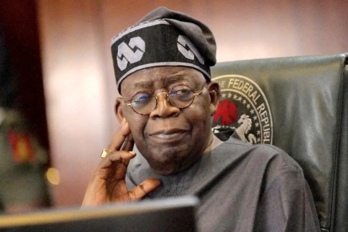
The former NERC chairman’s viral social media remarks praise Tinubu’s political instinct while accusing him of profiting from defections, weak opposition and fragile election rules.
Prof Sam Amadi’s latest social media intervention has reopened one of the most uncomfortable debates in Nigerian politics: whether President Bola Tinubu is being judged by the wrong standard.
In the post, Amadi described Tinubu as “a smart politician” who “can beg and can draw blood when he needs to”, while also arguing that the President has not been strong on governance but remains formidable in political manoeuvring.
The remarks, posted on X, are already resonating because they land at a moment when Tinubu is battling defections, electoral controversy and renewed accusations that Nigeria is sliding towards one-party dominance.
The core of Amadi’s message is simple but explosive. He is not calling Tinubu a successful administrator. He is calling him a ruthless political operator who understands the difference between sentiment and structure, and who knows how to assemble power when it matters.
That distinction matters in Nigeria, where political survival is often decided less by policy delivery than by coalition control, elite bargaining and the ability to dominate the machinery of elections.
Tinubu’s critics say that is exactly what is happening now: the presidency is being defended by political muscle, not public trust.
The evidence for that reading is visible in the legislature and among state political actors. In March 2026, three senators defected from the PDP to the APC, citing internal crises in their party.
The next day, nine senators from several parties moved to the ADC, while the House of Representatives later saw 28 lawmakers switch parties in a single wave of realignment.
The APC’s legislative advantage has therefore grown in tandem with a wider reshaping of the opposition landscape, leaving the impression that Nigeria’s political centre is being narrowed by force of attraction, pressure and calculation.
This is where Amadi’s sharpest accusation bites. He argues, in effect, that Tinubu first lured federal legislators into his political orbit and then left them stranded, while choosing governors whose real value lies in ground-level election delivery.
That critique becomes more serious when placed against Nigeria’s still-contested electoral framework. The Senate first rejected mandatory real-time electronic transmission of results before reversing itself under pressure from labour unions, civil society and lawyers.
Tinubu then signed the amended Electoral Act on 19 February 2026. Reuters reported that the collation process remains largely manual and opaque, which is precisely why reformers see the transmission battle as central to credibility.
Tinubu, for his part, has repeatedly pushed back against claims that he is building a one-party state. The Associated Press reported in June 2025 that he denied any plan to turn Nigeria into a one-party system, saying he was being accused of using state power to lure opposition figures across the aisle.
He repeated that line in March 2026, insisting at the APC convention that the ruling party did not seek a one-party state and that healthy opposition was essential to democracy. But the denials have struggled to outrun the optics, especially as defections continue and the opposition remains fractured.
That is why Amadi’s post has struck a nerve beyond its blunt language. It is not just praise disguised as criticism. It is an indictment of the Nigerian political economy itself, where the smartest leader is often the one who can bend institutions without appearing to break them.
Tinubu’s defenders point to economic reform and his ability to keep allies together. His critics see the same talent and read it as a capacity for elite capture, transactional loyalty and political engineering.
Reuters reported in May 2025 that Tinubu’s party had already endorsed him for a second and final term in 2027, while recent reporting has shown fresh defections continuing to tilt the battlefield in his favour.
The timing is especially sensitive because Nigeria’s political competition is now intertwined with deeper security anxieties. On 22 April 2026,
Reuters reported that six former security officials pleaded not guilty in Abuja to charges tied to an alleged plot to overthrow Tinubu’s government, in what it described as the most serious treason prosecution since he came into office.
That case, alongside the continuing debate over election rules and the flood of defections, shows a polity in which power is being contested through law, fear, loyalty and institutional pressure at the same time.
So, what did Sam Amadi really say? He said Tinubu is not merely surviving Nigerian politics but mastering it. He said the President can charm, pressure, bargain and strike when necessary.
He also implied that this political genius is being deployed in a system where weak opposition, unstable party structures and disputed election rules make such tactics highly effective.
Whether that amounts to statecraft or democratic sabotage is now the larger question his remarks have forced back into the national conversation.
Follow us on our broadcast channels today!
- WhatsApp: https://whatsapp.com/channel/0029VawZ8TbDDmFT1a1Syg46
- Telegram: https://t.me/atlanticpostchannel
- Facebook: https://www.messenger.com/channel/atlanticpostng