The killing of Abdussamad Ohida is a major security gain. But the deeper story is a three-year intelligence trail that shows why driving terrorists out of southern forests is harder than issuing an ultimatum.
The gunfire in the Owo forest may have ended one terrorist commander’s career.
It has not answered the more uncomfortable question.
How did a man whom Nigerian authorities had publicly designated as a senior Islamic State West Africa Province commander in 2024 appear to remain active long enough to establish a hideout in the same broad part of Ondo State where ISWAP had already been blamed for one of the country’s deadliest attacks?
That is the question buried beneath the headline of Abdussamad Ohida’s killing.
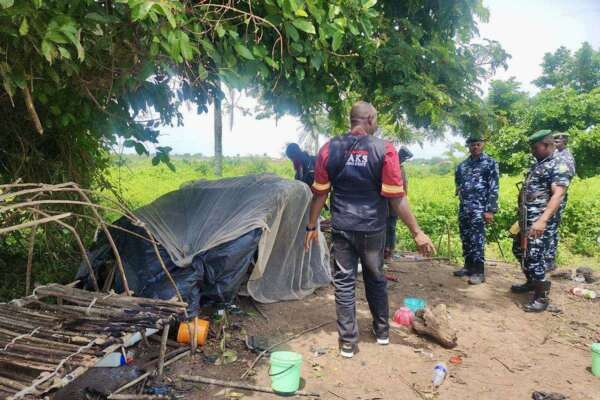
Ohida, also known as Anwar, was killed during an intelligence-led operation in the Owo forest axis at the weekend, according to security sources and the Nigerian Army.
The operation involved the Nigerian Army, Department of State Services and the Western Nigeria Security Network, Amotekun. Several other members of the group were also reportedly killed.
The Army has confirmed the operation.
Maj. Innocent Olamale, Assistant Director, Army Public Relations, 32 Artillery Brigade, Akure, said: “Yes, it was a joint operation which intelligently led to the execution of the ISWAP commander.”
The operation came shortly after Governor Lucky Aiyedatiwa’s warning that criminal groups occupying Ondo’s forest reserves had to leave.
But the dates matter.
Aiyedatiwa’s 14-day order was announced on September 16. The deadline would have expired around September 30. Ohida was reportedly killed on Sunday, October 4, making the operation 18 days after the governor’s directive and about four days after the stated deadline.
The timing makes the operation politically significant.
It does not, by itself, prove that the ultimatum produced the raid.
The intelligence trail described by security sources is much older.
The 14-day ultimatum may not be the real story
When the governor’s aide announced the ultimatum, the stated target was broad.
Kidnappers.
Bandits.
Other criminal groups using the forests as hideouts.
Bidemi Joshua Obayangban, Senior Special Assistant to the governor on Forestry, said the administration had concluded plans to tackle criminal activity in the reserves.
“Consequently, the primary focus of the Aiyedatiwa administration is to flush out criminal elements from our forests. We are taking the battle directly to them.”
He added:
“The government is fully committed to this objective and has finalised comprehensive plans to eliminate kidnapping and other illegal activities within our borders.”
The ultimatum was also tied to an economic objective.
The government wants the forests opened for farmers, timber operators and investors.
Obayangban put it bluntly:
“A vision without maximum security to ensure the safety of investors, farmers, timber contractors and those conducting legitimate business across Ondo State’s forest reserves is effectively meaningless.”
That strategy now faces a much harder test.
The enemy identified in Owo was not merely a kidnapping gang.
It was an alleged ISWAP command structure.
Nigeria had already named Ohida
The most important piece of evidence predates the governor’s September announcement by more than two years.
On March 18, 2024, the Nigeria Sanctions Committee designated Abdulsamat AbdulKareem Ohida as a terrorist financier.
The official record described him as a senior commander, or Quaid, of ISWAP operating in Okene.
It also specifically identified him as a suspected attacker in the June 5, 2022 St Francis Catholic Church attack in Owo and the July 5, 2022 attack on Kuje Correctional Centre in Abuja.
There is an important detail here.
The official sanctions document spells the name Abdulsamat AbdulKareem Ohida.
The reports of the October 2026 operation identify the slain commander as Abdussamad Ohida, also known as Anwar.
The available evidence strongly suggests the reports concern the same individual, but the discrepancy should not simply be ignored.
Counter-terrorism investigations depend on precise identity records.
That matters even more after Nigerian authorities themselves had to clarify a separate case involving ISIS commander Abu-Bilal al-Minuki in May 2026 after an earlier report of his death was attributed to mistaken identity.
In Ohida’s case, the existence of the 2024 sanctions record gives the state a much stronger foundation for identifying him than the fresh claims circulating after the forest operation.
It also creates the most difficult question of all.
If authorities knew his identity and assessed him to be an important ISWAP commander in 2024, what happened between that designation and the operation in Owo?
The forest was already sending warnings
The evidence suggests Owo’s forests did not suddenly become attractive to violent groups in September.
In October 2025, police arrested five suspected kidnappers inside Amurin Forest in the Owo-Ifon axis while searching for suspects linked to the killing of a police officer.
Police said a firearm and live ammunition were recovered.
Then, in December 2025, Amotekun announced the arrest of 39 suspected terrorists around the Elegbeka axis.
The suspects reportedly told authorities they had moved into Ondo forests after security pressure in northern Nigeria.
Amotekun commander Adetunji Adeleye described the area as a persistent security hotspot and said the agency had established a permanent control post there.
That episode deserves more attention than it received.
A forest can become a sanctuary without becoming a battlefield.
Groups can use it for temporary shelter, weapons storage, recruitment, hostage movement, reconnaissance and meetings.
The absence of daily gunfire can therefore create a false sense of control.
Then came Ipele
Nine months before the latest operation, a violent attack hit a police formation in the same broad Owo area.
On December 31, 2025, between 20 and 30 armed men attacked the Ipele Divisional Police Headquarters at about 9:41pm.
The Ondo State Police Command said the attackers used assault rifles and explosives, set the facility on fire and destroyed the station and exhibits.
No life was lost, according to the police statement. A joint response team arrived after the attackers had fled.
The police statement is important because it provides a contemporaneous account of what officers could establish that night.
The newer intelligence narrative goes further.
Security sources now allege that Ohida planned and executed the attack and that eight AK-47 rifles were stolen before the station was destroyed with explosives.
That allegation may prove correct.
But the distinction matters.
The contemporaneous police account did not publicly state that eight AK-47 rifles had been stolen or identify Ohida as the organiser.
That gap between contemporaneous evidence and later intelligence claims deserves examination.
What weapons were actually missing?
Were serial numbers recorded?
Were ballistic examinations conducted?
Were the rifles later traced to other attacks?
Was forensic evidence recovered from the site?
Did suspects arrested subsequently provide information independently linking Ohida to the operation?
Those questions are more valuable than simply declaring the case solved.
The 2022 Owo massacre still carries unresolved layers
The Ohida file also touches the deadliest terrorist attack in Ondo’s recent history.
On June 5, 2022, gunmen attacked worshippers at St Francis Catholic Church in Owo.
More than 40 people died and many others were injured.
The Federal Government announced days later that ISWAP was responsible.
At the time, the then Ondo governor, Rotimi Akeredolu, publicly questioned that conclusion, arguing that the attribution was premature.
The evidence picture became more detailed years later.
In 2026, the Federal High Court in Abuja convicted four defendants over the attack and sentenced them to death. A fifth defendant was discharged and acquitted.
DSS witnesses presented intelligence, forensic and communications evidence during the trial.
Yet those convictions do not automatically establish that Ohida personally carried out the attack.
That distinction is crucial.
Nigeria’s sanctions record identifies him as a suspected attacker.
Current security sources now attribute the attack to him.
Those are significant allegations.
They should not be presented as though a court has already adjudicated Ohida’s personal role.
A wider network stretching from Kogi to the South
Current security sources also attribute a long list of attacks to Ohida.
They include the February 7, 2022 attack on the Okene Area Command in Kogi State.
Contemporaneous reporting confirmed that more than 30 gunmen attacked the formation with firearms and explosives. One attacker was killed and others fled wounded.
On April 23, 2022, gunmen attacked Ogaminana Police Station in Adavi, Kogi State, killing police officers.
The attack itself is independently documented in contemporary police and media reports.
The later allegation connecting it specifically to Ohida comes from the current security narrative.
Security sources also link Ohida to the July 28, 2022 attack on a military checkpoint along the Suleja-Zuba road, the Kuje Correctional Centre attack and a December 2020 attack on a naval checkpoint in Okene.
The official NIGSAC record independently supports only part of that wider attribution, specifically listing the Owo church and Kuje attacks alongside his ISWAP command role.
That difference between an official designation and later operational attribution should remain visible in the public record.
The Kuje date is another warning about evidence
There is also a small but revealing discrepancy in current reporting.
Several reports following the Owo operation described the Kuje attack as occurring on July 11, 2022.
The Nigeria Sanctions Committee’s official record gives the date as July 5, 2022. Contemporary reporting also places the attack on July 5.
Six days may look insignificant.
In counter-terrorism work, it is not.
A date determines alibis, communications records, travel movements, phone-cell evidence and the sequencing of intelligence.
The same principle applies to names, aliases, weapons and locations.
The more serious the allegation, the less room there is for casual discrepancies.
The alleged 2027 plot raises the stakes
The intelligence claim that Ohida was planning attacks during the festive period and wanted to disrupt the 2027 elections carries particular significance.
INEC has scheduled the presidential and National Assembly elections for January 16, 2027.
Campaigning for those elections began on August 19, 2026.
So the alleged threat is not being discussed in an empty political calendar.
Nigeria is already inside the campaign season.
An attack during the Christmas and New Year period could generate fear, restrict movement, expose security weaknesses and deepen public anxiety before the election.
Yet the intelligence claim also needs independent scrutiny.
Security sources told Channels Television and other outlets that information obtained from the interrogation of Abu Ikrimah, also known as Abu Uwais, helped expose Ohida’s alleged plans.
They further claimed that British intelligence partners corroborated the information and supported the operation.
No public British government statement confirming that operational role was identified in the material reviewed for this report.
That does not prove the claim false.
It means it remains a claim attributed to security sources rather than a publicly documented British confirmation.
The forest problem is bigger than Ohida
Governor Aiyedatiwa has every reason to call the operation a success.
His administration has now demonstrated that forest-based threats can be reached.
But forest security cannot be measured only by the number of camps raided.
The real test begins after the raid.
Who occupies the abandoned hideout next?
Who supplied food, fuel and ammunition?
Who provided information about security patrols?
Who helped terrorists move between Kogi, Niger and Ondo?
Who rents vehicles?
Who handles money?
Who provides safe houses outside the forest?
Who recruits local guides?
Those are the links that turn a forest camp into a network.
A camp can be destroyed in one morning.
A network can survive for years.
That is why the Ohida operation should be treated as an intelligence opportunity, not merely a battlefield victory.
Every weapon recovered should be traced.
Every mobile phone, document, vehicle, financial account and communication trail associated with the camp should be exploited.
Every person who supplied the hideout should matter as much to investigators as the commander who was killed.
The dangerous lesson is that the forests were never empty
The most significant revelation from Owo may not be that ISWAP had a camp there.
It may be that the state’s forests had become contested security spaces long before the latest operation.
Kidnappers were there.
Suspected terrorists were there.
Police had been attacked.
Security agencies had already reported arrests and forest sweeps.
And a man officially identified by Nigeria as a senior ISWAP commander had been on the national sanctions list since 2024.
The governor’s ultimatum therefore arrived in an environment that had already generated years of warning signs.
That changes the meaning of the October raid.
It was not simply criminals being chased out after a government deadline.
It was the state finally bringing together intelligence, military capability and local forest knowledge against a threat that appears to have been evolving for years.
The unanswered question is whether that cooperation can become permanent.
The next test is not killing another commander
Ohida’s death is a blow to whatever structure he led.
A senior security source described the elimination as a major disruption to ISWAP’s leadership structure, operational network and expansion efforts in central and southern Nigeria.
The source said:
“We may not immediately realise it, but the elimination of Abdussamad Ohida represents a significant disruption to ISWAP’s leadership structure, operational network and expansion efforts in central and southern Nigeria.”
He added:
“Ohida’s elimination, coming a few months after the killing of ISIS leader Abu Bilal al-Minuki, is a very big blow to ISWAP’s efforts to expand its operational presence in Nigeria and underscores the growing efficiency of our security services.”
That assessment may be right.
But Nigeria has seen senior commanders killed before.
The decisive question is always what happens next.
Does the network collapse?
Or does another commander inherit the weapons, contacts, money and local knowledge?
For Ondo, the answer will determine whether the governor’s forest ultimatum becomes a turning point or simply another chapter in a long cycle of raids, retreats and returns.
The forest is not secured because a commander has been killed.
It is secured when the network that sustained him can no longer operate there.
That is the real test now facing Ondo.
Follow us on our broadcast channels today!
- WhatsApp: https://whatsapp.com/channel/0029VawZ8TbDDmFT1a1Syg46
- Telegram: https://t.me/atlanticpostchannel
- Facebook: https://www.messenger.com/channel/atlanticpostng

Join the debate; let's know your opinion.