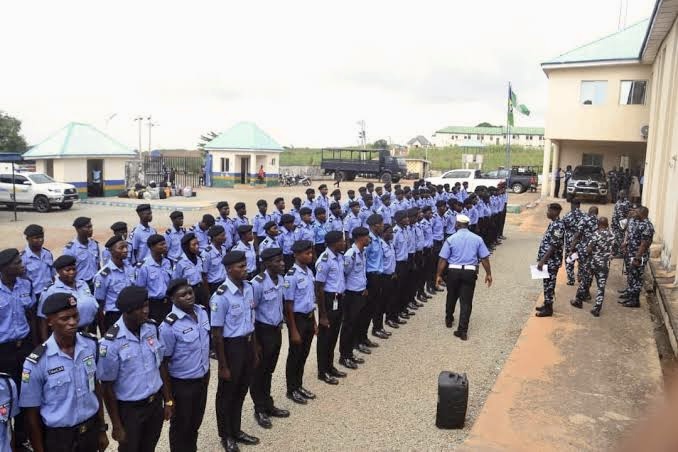
53rd and 54th recruitment intake personnel say they were omitted from the latest constable-to-corporal exercise and have waited months for an explanation. The bigger question is what the promotion records show.
ABUJA, Nigeria — On 30 May 2026, the Nigeria Police Force announced a promotion exercise that moved 17,952 junior police personnel up the ranks nationwide.
Of that number, 17,714 constables were elevated to corporal, while 73 corporals became sergeants and 165 sergeants became inspectors. The Force presented the exercise as part of its effort to improve personnel welfare, morale and career progression.
The announcement should ordinarily have closed one chapter in the careers of thousands of police personnel.
Instead, for some members of the 53rd and 54th Police Recruitment Intakes, it appears to have opened another.
They say their names did not appear among those promoted.
They are not alleging that every member of their intakes was excluded. Their complaint is narrower and potentially more consequential: that some personnel from the same recruitment cohorts who, they say, met the applicable requirements were promoted while others were left behind.
That distinction matters.
A promotion exercise is not merely an administrative list. Inside a disciplined security organisation, rank determines responsibility, remuneration, seniority and future progression.
When some names move and others do not, the document behind that decision becomes as important as the promotion itself.
The complaint behind the numbers
In an appeal made available to SaharaReporters, affected personnel said they had continued to serve and perform their duties but had been omitted from the latest exercise from constable to corporal.
They appealed to the Inspector-General of Police, Olatunji Rilwan Disu, and other relevant authorities to examine their records and determine why they had been excluded.
“We wish to draw the attention of the public, the Nigeria Police Force authorities, and relevant stakeholders to the situation of some members of the 53rd and 54th Police Recruitment Intakes who were omitted from the recent promotion exercise from Constable to Corporal,” the personnel stated.
They said the problem was particularly difficult to understand because some colleagues from the same recruitment intakes had been promoted.
“This omission has caused concern among the affected personnel, particularly as the promotion is already overdue for those who have fulfilled the applicable requirements,” they said.
Their request is therefore not for a blanket promotion.
They want a review of the records of those left out and an explanation of the criteria applied.
“We respectfully appeal to the Inspector-General of Police and the relevant authorities to look into the circumstances surrounding the omission, verify the records of the affected personnel, and ensure that those who are eligible are given appropriate consideration in accordance with the rules and procedures governing promotion in the Nigeria Police Force,” the appeal stated.
That is the administrative question at the heart of the matter.
Which records were checked?
Which records were not?
And what specific reason caused one constable to appear on the promotion list while another serving in the same recruitment intake did not?
A promotion list is not the same thing as a promotion rule
The Nigeria Police Force’s 30 May announcement gave a national total.
It did not, in the published statement available to the public, set out a command-by-command explanation of the criteria used to determine which individual constables were included in the 17,714 figure.
That does not establish that the process was irregular.
It does mean there is a gap between the public announcement and the individual personnel records that would resolve the complaint.
The Police Service Commission’s published Police Promotion Department says it is responsible for formulating promotion policies and guidelines, maintaining promotion examination records, processing appeals and petitions from aggrieved police personnel, and handling complaints involving long-overdue promotions.
It also states that the Commission liaises with the IGP over promotions of rank-and-file personnel under delegated powers.
That structure is important because it makes the case more than an internal complaint to Force Headquarters.
There is an established institutional route for examining precisely this kind of dispute.
The IGP and the PSC: two institutions, different powers
The public language surrounding police promotions can be confusing.
The NPF said in May that IGP Disu had approved the promotion of 17,952 junior police personnel.
The PSC’s own records, meanwhile, describe the Commission as the institution responsible for promotion policy and say that rank-and-file promotions are handled in liaison with the IGP under delegated powers.
The distinction was placed under an even brighter legal light by a National Industrial Court judgment delivered on 10 July 2026.
In Incorporated Trustees of the Nigerian Bar Association v. Police Service Commission & 5 Others, Justice O. Y. Anuwe held that the Police Service Commission has the statutory power to appoint and promote officers, while the IGP’s statutory role in the area is not the same as the Commission’s. The judgment specifically stated that the IGP had not been given powers relating to appointment or promotion and that the PSC is vested with those powers under the constitutional and statutory framework.
There is an important qualification.
The PSC itself has previously stated that powers over promotions of rank-and-file personnel had been delegated to the IGP. In 2023, the then PSC chairman, Solomon Arase, described promotions from the lower ranks as part of the powers delegated to the IGP.
In practical terms, therefore, the institutional picture is not simply “the IGP promotes” or “the PSC promotes”.
The paper trail matters.
The unanswered question in the present dispute is whether the names omitted from the 2026 exercise were excluded at the recommendation stage, during record verification, under disciplinary screening, because of staffing or vacancy considerations, or for another reason provided for in the applicable rules.
Only the relevant personnel files and promotion returns can settle that.
What the rules actually require
There is another reason why the police authorities should identify the precise rule used in the 2026 exercise.
The older Nigeria Police Regulations contained detailed provisions governing rank-and-file promotion, including requirements relating to service, merit, suitability, promotion boards and vacancies.
A Police Service Commission promotion guideline published on its website states that promotion from constable to corporal requires a minimum of three years as a constable.
But Nigeria’s police regulatory framework has since undergone a major update.
The Federal Government formally launched the Nigeria Police Regulations (Amendment) 2026 in April. The Ministry of Police Affairs said the regulations were signed in November 2025 and gazetted in February 2026 to replace outdated provisions and bring the Force’s operational framework into line with the Police Act 2020.
That timing is significant.
The contested promotion exercise was conducted in May 2026, after the new regulatory framework had been gazetted.
For that reason, affected personnel and the public should not be left to infer which version of the rules was applied.
The authorities should state clearly which regulation, standing order, circular or promotion guideline governed the constable-to-corporal exercise announced on 30 May.
That single clarification could answer much of the dispute.
Eligibility is not necessarily automatic
The personnel say some of their colleagues met the requirements.
That does not, by itself, establish an entitlement to promotion.
Police promotion involves more than the date a person entered the Force.
The PSC has stated that promotion processes involve verification and consideration of personnel records. Its published material also refers to pending disciplinary matters, staff records and other requirements in promotion processing.
The historical promotion framework similarly emphasised factors such as seniority, merit, efficiency, good conduct and suitability.
This means there are several possible explanations for an omission.
An affected constable may not have met a particular eligibility requirement.
A personnel record may contain an error.
A recommendation may not have reached the appropriate stage.
A disciplinary or administrative matter may have affected consideration.
A vacancy or establishment issue may have been applied.
Or an administrative error may have occurred.
At present, the public evidence does not establish which of these explanations, if any, applies to the affected personnel in Kebbi, Zamfara or elsewhere.
That is precisely why a records-based investigation is needed.
The silence is becoming part of the story
For the affected personnel, time has become another source of frustration.
They said they had waited for about three months without receiving a clear explanation.
Some also fear that speaking publicly could expose them to disciplinary action or other consequences.
One officer who spoke on condition of anonymity said:
“I am afraid. I don’t want this to cause issues for me. We are very plenty and you know how the police are.”
The officer claimed that the affected personnel were spread across several commands.
“We are very plenty, about two commands and still counting, like Kebbi and Zamfara states,” the officer said.
Those figures have not been independently verified.
The significance, though, lies not only in the number of people involved but in what the fear of speaking says about the complaint itself.
In any disciplined institution, personnel are expected to obey lawful authority.
But an internal grievance system only works if serving personnel can use it without believing that making a good-faith complaint will itself become a disciplinary problem.
The PSC’s current structure specifically includes an Appeals and Petitions function for aggrieved police personnel.
That gives the authorities an opportunity to move the dispute away from anonymous accusations and towards documentary resolution.
The May promotion announcement raises a second question
The size of the May exercise makes the complaint more interesting, not less.
The Force says 17,714 constables were promoted to corporal nationwide.
That figure is large enough to demonstrate that promotion was not frozen across the Force.
There was a nationwide exercise.
There were actual beneficiaries.
State commands subsequently decorated newly promoted personnel, including 458 newly elevated corporals in Cross River and 457 in Delta.
The argument from the affected personnel therefore is not that promotions did not happen.
It is that the selection process may not have captured everyone who should have been considered.
That is a materially different allegation.
And it can be tested.
The records that could settle the dispute
If the police leadership wants the matter resolved without further speculation, the investigation does not require a dramatic public confrontation.
The relevant records should be enough.
First would be the promotion return for the affected commands.
Second would be the nominal rolls and personnel files of the omitted constables.
Third would be the records showing date of appointment, confirmation, previous rank and relevant promotion history.
Fourth would be any disciplinary or administrative flags relied upon to exclude particular personnel.
Fifth would be the recommendations forwarded through the command structure.
Sixth would be the promotion criteria and vacancy or establishment analysis used in compiling the final list.
And finally, the authorities should compare personnel from the same recruitment intakes who were promoted against those who were not.
That comparison is particularly important.
If two constables from the same intake, with broadly similar service histories, qualifications and disciplinary records, received different outcomes, the administrative reason should be identifiable.
If the records show materially different circumstances, the complaint may be explained.
Either outcome would be preferable to silence.
There is already a precedent for disputes over delayed police promotions
This is not the first time police personnel have raised questions publicly about delayed career progression.
In January 2026, the PSC responded to a SaharaReporters report concerning inspectors who complained that their promotions had been delayed after the 2025 Departmental Selection Board exercise.
The Commission rejected suggestions of widespread demoralisation and urged officers to use established grievance procedures rather than relying on media reports. It said promotion delays could arise from due diligence and verification rather than neglect.
That response offers a possible pathway for the present dispute.
The affected 53rd and 54th intake personnel do not necessarily need a public declaration that they are right.
What they need is a documented explanation of why their names were omitted.
That is also what the police authorities need if they want to close the matter convincingly.
A new test for the 2026 reform agenda
The dispute arrives at an awkward moment for the Nigeria Police Force.
The Federal Government has introduced new police regulations designed to strengthen accountability, professionalism and service delivery.
The IGP has repeatedly presented personnel welfare and career progression as important components of police reform.
When the Force announced the May promotion exercise, it said timely promotion was a “critical component” of human-resource management and linked advancement to merit and career development.
That makes an unexplained omission more than a personnel-management problem.
It becomes a test of whether the new emphasis on accountability also extends to internal administrative decisions.
For a police constable working for years on the frontline, promotion is not an abstract human-resources statistic.
It affects rank.
It affects pay and responsibility.
It affects seniority.
And it can affect the direction of a career.
A system that can publish the number of people promoted should also be able to explain why a particular serving person was not.
What the police should now explain
The affected personnel are asking the IGP and other authorities to investigate.
The more institutionally precise request is for the Nigeria Police Force and Police Service Commission to disclose the framework used for the exercise and audit the disputed personnel records.
There are several straightforward questions.
Were all eligible personnel from the 53rd and 54th intakes considered?
Was there a specific cut-off date?
Were promotion recommendations submitted for all qualifying personnel?
Were any names removed during vetting?
Were pending disciplinary matters relied upon?
Were vacancies or establishment limits applied?
Were errors made in personnel records?
And, most importantly, if a person was found to have been wrongly omitted, will the correction carry the appropriate effective date?
Those questions do not prejudge the outcome.
They simply identify the evidence required to establish it.
The unanswered evidence
The affected personnel were careful to frame their complaint as a request for an administrative solution.
“We are making this appeal respectfully and peacefully. Our intention is not to challenge the authority of the Nigeria Police Force, but to seek clarification, fairness, and an administrative review of the situation,” they said.
That is an important distinction.
There is currently no publicly available evidence establishing that the omission of the affected personnel resulted from discrimination, retaliation, favouritism or deliberate wrongdoing.
There is also no public explanation from the police authorities identifying the individual reasons why those personnel were not included.
The Force spokesman did not provide a response to the original report at the time it was filed.
CSP Anietie Okokon Edem Iniedu was appointed Force Public Relations Officer on 19 June 2026, succeeding DCP Anthony Okon Placid.
The original report said calls to Iniedu and a text message seeking clarification were unanswered.
That leaves the central question open.
Not whether the police promoted thousands of constables.
They did.
Not whether the affected personnel are genuinely concerned.
Their appeal demonstrates that they are.
The unanswered question is much narrower:
When 17,714 constables were moved up in May, what evidence explains the names that were left behind?
Until the relevant personnel records, promotion returns and applicable criteria are examined, the dispute remains a question of evidence rather than conclusion.
And that is precisely where a credible police reform system should begin.
Follow us on our broadcast channels today!
- WhatsApp: https://whatsapp.com/channel/0029VawZ8TbDDmFT1a1Syg46
- Telegram: https://t.me/atlanticpostchannel
- Facebook: https://www.messenger.com/channel/atlanticpostng