Troops of the Joint Task Force (North East), Operation HADIN KAI, have recorded another string of operational gains in Yobe and Adamawa states, arresting suspected terrorists and an alleged informant, rescuing two kidnapped children, and recovering a hand grenade during coordinated counter-terrorism operations.
The latest military briefing points to a security theatre still under pressure, but also to a force sustaining its offensive across multiple flashpoints.
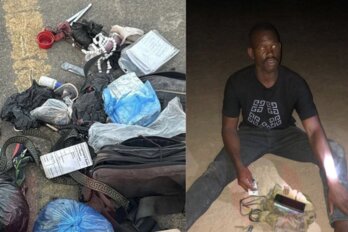
According to the Military Information Officer of OPHK, Lt. Col. Sani Uba, troops deployed in Ngamdu intercepted two suspected terrorists, identified as Haruna Adamu, 32, and Ibrahim Adamu, 20.
Preliminary findings, as relayed by the military, suggest the pair fled from Zamfara State into Yobe State, a development that underscores the way criminal and extremist elements continue to move across state lines in search of cover.
Items recovered from them included phones, a power bank, an identification card, suspected illicit substances, charms and other personal effects, after which they were handed over for further investigation.
In what the military described as a further blow to the insurgents’ support structure, troops of 254 Battalion under Headquarters Sector 2 arrested a suspected Boko Haram and ISWAP informant, Ali Muhammad, 30, at Ngamdu Market.
He was reportedly already on the unit’s watchlist and was found with cash, a keypad phone, identification cards, charms, a knife and an exercise book containing phone numbers linked to suspected terrorist contacts.
Uba said the arrest amounted to a “major disruption to the intelligence network” of terrorist elements operating in the area.
That arrest is significant because informants, couriers and local facilitators often form the unseen logistical spine of insurgent violence.
While the military has not accused the suspect in court, the materials described by the command suggest a deliberate effort to map and sustain terrorist contacts inside the community.
In practical terms, that kind of arrest can be more damaging to an armed group than a single battlefield encounter, because it targets the network rather than only the fighters visible on the surface.
This is an inference from the military’s account of the materials recovered and the watchlist status of the suspect.
The operation also spread into Adamawa State, where troops in the Mubi general area reportedly arrested five suspected drug peddlers during a night operation.
The military said they were found with various items, including ammunition, and are now in custody for investigation.
In another development in Madagali Local Government Area, troops working alongside members of the Civilian Joint Task Force responded to a distress call and rescued two kidnapped children, Barnabas Apagu, 12, and Ruth Apagu, 10.
The military said efforts were still under way to secure the release of other abducted persons.
The rescue of the two children is one of the most humane elements of the latest operation and a reminder that the North-East conflict remains deeply civilian in its impact.
Every rescue is not only a tactical success but a family story interrupted by violence and restored by intervention.
The mention of the Civilian Joint Task Force also highlights the continuing importance of local intelligence and community partnership in a war where soldiers alone cannot see everything and where rapid response often depends on information from residents on the ground.
Troops also recovered a hand grenade in the Kukareta area of Yobe State, which the military said had likely been abandoned by fleeing terrorists and was safely secured in line with established procedures.
While the statement did not link the device to a specific attack, the recovery reinforces the warning that the theatre still contains residual threats, hidden routes and abandoned explosives capable of causing harm if not quickly detected.
Military Headquarters praised the troops for their gallantry and called for the operational tempo to be sustained.
Uba said the command remains committed to “sustaining offensive operations” aimed at degrading terrorist capability, protecting lives and property, and restoring peace and economic stability across the North-East.
That language reflects a wider strategy now visible in the pattern of operations, namely pressure on fighters, pressure on their informants, pressure on their logistics and pressure on the spaces they use to regroup.
For communities in Yobe and Adamawa, the latest report carries both relief and caution. Relief, because two children have been brought out of captivity and suspected hostile actors have been intercepted.
Caution, because the military’s own briefing shows that the insurgency remains adaptive, mobile and embedded enough to require constant patrols, night operations and joint action with civilian partners.
The bigger story is not only that arrests were made, but that the army is still fighting a multi-layered threat that blends terror, criminality, local collaboration and fear.
Follow us on our broadcast channels today!
Facebook: https://www.messenger.com/channel/atlanticpostng
WhatsApp: https://whatsapp.com/channel/0029VawZ8TbDDmFT1a1Syg46
Telegram: https://t.me/atlanticpostchannel