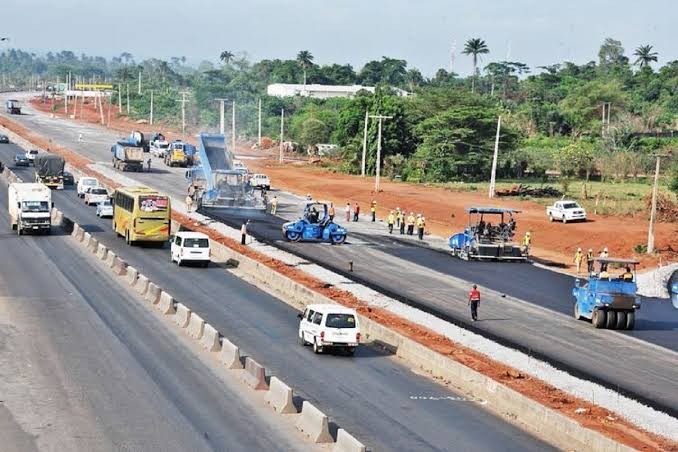
Conflicting explanations over the Lagos–Calabar Coastal Highway’s alignment, an additional 400km East-West Road proposal, procurement questions and unresolved financing claims are intensifying demands for transparency over one of Nigeria’s biggest infrastructure projects.
By Atlantic Post Staff
Nigeria’s most ambitious road project is facing an uncomfortable question: can the Federal Government convince taxpayers that its changing explanations, enormous financial commitments and engineering decisions add up to a coherent national infrastructure plan?
The controversy surrounding the Lagos–Calabar Coastal Highway intensified in October 2026 after Works Minister David Umahi described a presidential directive to route part of the project through the existing East-West Road, before clarifying that the original 750-kilometre coastal highway remained intact and that a separate reconstruction of approximately 400 kilometres of the East-West Road was being proposed.
The distinction matters. A route redesign, an additional road contract and a decision to abandon an original alignment would have different implications for project costs, affected communities, engineering requirements and public spending.
Yet the rapid sequence of explanations has left a central accountability question: where is the consolidated public record showing precisely what the government intends to build, what it will cost and how the different road projects fit together?
The dispute reaches beyond engineering. It touches the priorities of an administration that abolished petrol subsidies in May 2023, the transparency of a major public procurement, the environmental risks of construction along Nigeria’s coastline and the opportunity cost of committing scarce resources to new infrastructure while existing roads remain in poor condition.
An opinion article by Paul Ibe, media adviser to former Vice-President Atiku Abubakar, describes the project as “Tinubu’s Road to Nowhere”. His argument is that the government has yet to demonstrate convincingly why the coastal highway deserves priority over rehabilitation of existing transport corridors.
That is a political assessment, not an established finding of wrongdoing. But the questions it raises warrant examination against the government’s own statements, environmental records and the project’s disclosed financial and procurement arrangements.
The ₦15 trillion question: what will Nigerians actually pay?
The dispute over the highway’s price is not simply a clash between government figures and opposition estimates. It is a question of whether Nigerians can obtain a current, consolidated account of the project’s financial commitments.
In April 2024, Umahi said the 700-kilometre project would cost approximately ₦15 trillion when completed, excluding the proposed railway within the corridor. The first section, covering approximately 47.47 kilometres, was awarded for ₦1.068 trillion. The Federal Government subsequently announced a $747 million syndicated financing arrangement for Phase One, Section One under an engineering, procurement, construction and financing model, commonly known as EPC+F.
These are different figures covering different aspects of the project. They do not establish that ₦15 trillion has already been spent, nor should the financing package be added mechanically to the contract value as if it were a separate expenditure.
The distinction is important. A project can have a headline completion estimate, individual construction contracts, external financing arrangements and future repayment obligations. Without a consolidated statement, the public cannot easily distinguish the amount committed from the amount paid, the outstanding balance or the final liability to taxpayers.
The government has also described the highway as a 750-kilometre corridor in its more recent statements, compared with the 700-kilometre description used in earlier reporting. Changes in route, scope and measurement may explain the difference, but the published baseline should show how the project evolved.
On 8 October, the Ministry of Works reported that Section One, covering approximately 47 kilometres, had been completed, while pavement works on Section Two were nearing completion. The ministry also reported ongoing work on flyovers, overpasses and underpasses. Those are the government’s reported progress figures; a public, independently verifiable financial and physical progress statement would allow Nigerians to assess what the expenditure has delivered.
A current project ledger should therefore identify the original contract sum, revised contract values, approved variations, payments certified and made, financing charges, repayment terms and the estimated cost of completing every section.
The question is not whether a road can be expensive. Major highways involving bridges, difficult terrain, extensive earthworks and drainage systems can carry substantial costs.
The question is whether the final bill can be justified by engineering evidence, properly tested economic assumptions and a transparent funding plan.
East-West Road: the alternative Nigeria cannot ignore
The dispute over the East-West Road exposes a wider weakness in infrastructure planning: the absence of a clearly communicated comparison between competing public investments.
The corridor serves communities and commercial activity across the Niger Delta, where the movement of people, agricultural produce, manufactured goods and oil-related services depends on reliable transport. Poor road conditions increase journey times and vehicle maintenance costs, with businesses and ordinary commuters ultimately absorbing much of the burden.
That does not automatically make rehabilitation more valuable than constructing a new coastal highway. A new road could improve access to ports, industrial zones and coastal communities while creating alternative routes for freight and passenger traffic.
But the government should be able to demonstrate why its chosen combination of projects offers the greatest return on public investment.
How much traffic is the coastal highway expected to carry? What freight volumes will it attract? How much could comprehensive rehabilitation of the East-West Road reduce journey times, accidents and transport costs? What are the projected economic returns of each option over 20 or 30 years?
A credible assessment would compare the alternatives using the same assumptions for construction costs, maintenance, financing, environmental damage, traffic demand and wider economic benefits.
In the material reviewed for this report, no readily accessible public comparison answering all these questions has been established.
That is a gap the government should address.
The issue is particularly important because the government now says the reconstruction of roughly 400 kilometres of the East-West Road is an additional project. If both roads are to proceed, Nigerians need to know the separate budgets, commencement dates, completion targets and funding arrangements.
Otherwise, a project initially presented as one major undertaking could become a growing collection of linked infrastructure commitments without a single public account of their combined cost.
Procurement controversy: allegations and the government’s defence
The award of the initial highway contract to Hitech Construction Company has been controversial since 2024.
Funso Doherty, a former Lagos State governorship candidate, challenged the procurement process, arguing that the use of single-source procurement for the early sections violated the Public Procurement Act 2007. The dispute concerned whether the scale of the contract and the circumstances cited by the government justified limiting competition.
Umahi has defended the government’s decision. In March 2025, he said the ministry had sought a contractor with specialised concrete-paving equipment and relevant experience. He maintained that the government used restrictive procurement for the first section, with the process submitted to the Bureau of Public Procurement and the Federal Executive Council. He also said later sections were opened to selective competitive bidding.
That defence deserves to be assessed against the documentary record rather than dismissed or accepted solely on the minister’s assurance.
The question is whether the required approvals were obtained, the legal conditions for the chosen procurement method were satisfied and the government secured demonstrable value for money.
There is also an important legal distinction. In April 2025, the Federal High Court rejected the challenge on jurisdictional grounds and ordered the matter transferred to the Lagos State High Court. The decision was not a determination that the procurement allegations were true or false.
Consequently, neither the existence of the lawsuit nor the Federal High Court’s decision should be represented as proof of wrongdoing.
What would resolve the underlying public-interest concerns is the publication of the procurement justification, the relevant approvals, the cost comparisons considered by officials, the contract terms and any subsequent variations.
A government confident that it followed due process should have a compelling reason to make those records accessible.
The Chagoury connection and the limits of the conflict-of-interest claim
Questions have also been raised about the relationship between the Chagoury business interests associated with Hitech and the Tinubu family.
In May 2024, Atiku Abubakar questioned Seyi Tinubu’s position on the board of CDK Integrated Industries, in which Chagoury interests hold shares, arguing that the connection raised concerns about the award of the coastal highway contract to Hitech.
The Presidency rejected the accusation of a conflict of interest. Presidential spokesman Bayo Onanuga said Seyi Tinubu had been a director since 2018 and was entitled to pursue legitimate business interests. He also disputed the characterisation of the Chagourys’ ownership interest in CDK.
The available information does not establish that Seyi Tinubu influenced the highway contract or that the contract was awarded improperly because of personal relationships.
A family or business connection, on its own, is not proof of corruption.
Yet public procurement is precisely where transparency matters most. When a major contract is awarded through a non-open process and questions arise about the relationships surrounding the parties, disclosure becomes essential to public confidence.
The appropriate test is documentary: who made the procurement decisions, which officials approved them, what criteria were applied, whether the contractor met those criteria and whether the government obtained competitive value for money.
The public should not be expected to infer wrongdoing from personal relationships. Equally, it should not be expected to accept assurances in place of evidence.
Environmental approvals: a timeline that needs explaining
The environmental assessment process presents another question that deserves a documented answer.
The Federal Ministry of Environment published a notice for public display of the draft environmental and social impact assessment for Section One, covering the first 47.5 kilometres, on 27 August 2024. A corresponding public display for Section Two, covering kilometres 47.5 to 104, was announced on 13 October 2024. Both notices provided for a 21-working-day public display to receive comments.
Construction activities had begun earlier in 2024.
BusinessDay reported on 13 October 2026 that the contractor’s non-technical summary for Section One stated that approval was issued on 8 November 2024. That date raises a legitimate question about the relationship between early construction and environmental approval.
The timeline is not, by itself, conclusive proof that every early work proceeded without lawful approval. The government has maintained that the necessary approvals were obtained, and the complete administrative record must be examined before a definitive judgment can be reached.
But the public should not have to reconcile potentially significant differences in the timeline from scattered notices and competing statements.
The Federal Government should publish the relevant approvals, the dates on which each assessment was submitted and approved, the conditions attached to those approvals and any exemptions granted. It should also identify which construction activities were authorised at each stage.
The environmental questions extend beyond paperwork.
Residents and critics have questioned whether parts of the coastal highway have affected natural drainage and worsened flooding. Umahi has rejected the suggestion that the road caused flooding in Lagos, arguing that existing drainage problems, blocked waterways, low-lying developments and climate change are major factors. In October, he declared: “The Coastal Highway is not flooded and will never get flooded.”
That is a categorical assurance. It should be tested against independent engineering evidence.
An assessment should examine drainage patterns, flood levels, coastal erosion, the effects of reclamation and the capacity of drainage infrastructure to handle extreme weather. It should also assess whether the road affects communities whose livelihoods depend on wetlands, waterways and coastal ecosystems.
The objective is not to establish blame in advance. It is to determine what is happening, what risks remain and which mitigation measures are necessary.
Is there really a proposed $20 billion loan?
The reported possibility of an additional $20 billion borrowing arrangement has added a further layer of uncertainty.
On 12 October, Atiku demanded clarification of the reported proposal and called for disclosure of the contracts, payments and financing terms associated with the highway. He also alleged that lawmakers were being pressured to approve the anticipated borrowing. His statement did not provide documentary evidence establishing the existence of the alleged loan request or the alleged pressure on legislators.
The alleged $20 billion facility must therefore be treated as an unverified claim, not an approved loan or an established government liability.
The distinction matters because the project already has a documented financing structure. The Federal Ministry of Finance announced a $747 million syndicated financing arrangement for Phase One, Section One. That facility does not establish that a separate $20 billion borrowing proposal exists.
The Federal Government should state clearly whether any additional loan has been proposed, what contracts it would finance, who the intended lenders are, what interest and repayment terms would apply and whether the proposed obligations would be guaranteed by the Federal Government.
If no such request exists, an unequivocal official clarification would help settle the dispute.
If one does exist, its terms should be published and subjected to the required legislative scrutiny.
Nigeria’s public debt obligations cannot be assessed responsibly through political statements alone. Nor should allegations involving sums of this magnitude be allowed to circulate without a verifiable documentary trail.
A presidential name, but what kind of legacy?
In July 2026, Umahi announced that the Ministry of Works had renamed the Lagos–Calabar Coastal Highway the President Bola Ahmed Tinubu Coastal Highway, citing Tinubu’s vision for the project. The announcement came before the entire 750-kilometre route had been completed.
Naming public infrastructure after a president is not inherently improper. But the symbolism invites a broader question about how political legacies should be measured.
A highway’s lasting value lies in what it delivers: safer journeys, lower logistics costs, greater access to markets, employment opportunities and improved connections between communities.
The road must also remain affordable to build, maintain and finance. A grand project that consumes resources without delivering commensurate benefits can become a burden long after its political sponsors have left office.
For communities along the route, the question is equally immediate. They need to know which settlements will be connected, whose livelihoods may be affected, what compensation and environmental safeguards apply, and whether changes to the alignment will alter the economic benefits originally promised.
The Ilaje Omuro Community Connect has questioned whether the route changes could deny Ilaje communities access to the development benefits expected from the project. That concern should be examined alongside the government’s engineering explanations.
A project designed to stimulate coastal development must account for the communities it passes through, not merely the cities it promises to connect.
What the National Assembly should demand
The National Assembly has a central role in ensuring that the coastal highway represents a sound use of public resources.
Its scrutiny should go beyond another ministerial briefing or a general declaration that construction is progressing.
Lawmakers should demand a consolidated project file containing:
- The original and revised route maps, feasibility studies and economic cost-benefit assessments.
- The full procurement record, including approvals, contract terms, evaluation documents and variations.
- A current breakdown of contract sums, certified payments, financing facilities, liabilities and projected completion costs.
- Environmental approvals, assessment reports, mitigation plans and records of public consultation.
- Separate budgets and schedules for the coastal highway and the proposed East-West Road reconstruction.
- Documentary clarification of any proposed additional borrowing, including the alleged $20 billion facility.
The relevant documents should be examined at an open public hearing, with independent engineers, environmental specialists, procurement experts, economists and representatives of affected communities invited to contribute.
The government should also commission an independent review of the highway’s revised engineering design, environmental safeguards and projected economic returns.
Such scrutiny need not delay work that is demonstrably safe, lawful and economically justified. It should ensure that future commitments are supported by evidence and that changes in scope do not become a route to uncontrolled costs.
The real destination is public accountability
Nigeria needs reliable highways. The Lagos–Calabar Coastal Highway could bring meaningful economic benefits if it is properly designed, competently delivered and supported by credible financing.
But the case for the project cannot rest on its scale, political importance or the promise that it will eventually connect distant parts of the country.
It must stand on evidence.
The Federal Government has defended its procurement choices, explained its engineering decisions and insisted that the original coastal route remains intact. Those statements deserve to be considered alongside the published environmental records, contracts, financing documents and independent technical assessments.
The unresolved questions are specific: what is the current cost baseline; how do the coastal and East-West roads fit together; when were the required environmental approvals obtained; and what evidence supports the procurement and financing decisions?
Answering them would do more than silence critics. It would help establish whether Nigeria’s infrastructure spending is guided by transparent economic priorities or by decisions that the public is expected to accept after the fact.
The original opinion piece by Paul Ibe, media adviser to Atiku Abubakar, frames the controversy as “Tinubu’s Road to Nowhere”. Its conclusion is deliberately political, but the accountability test is broader than party politics.
A road does not become a national success because it is ambitious, expensive or named after a president. It becomes a success when its costs are defensible, its benefits are measurable and its delivery improves people’s lives.
The Lagos–Calabar Coastal Highway’s ultimate destination should not merely be Calabar. It should be a credible, transparent and economically defensible development plan for Nigeria.
Follow us on our broadcast channels today!
- WhatsApp: https://whatsapp.com/channel/0029VawZ8TbDDmFT1a1Syg46
- Telegram: https://t.me/atlanticpostchannel
- Facebook: https://www.messenger.com/channel/atlanticpostng

Join the debate; let’s know your opinion.