A reported recovery of 39 vehicles now sits uneasily beside claims that fewer than 12 were presented before the military court. The gap does not prove that evidence disappeared, but it raises a basic question every serious prosecution must answer: where is the documentary chain connecting what investigators said they recovered to what the court can actually examine?
ABUJA, Nigeria — The most revealing object in Nigeria’s alleged coup trial may no longer be a weapon, a bank transfer or a confession.
It may be a missing vehicle.
Not one missing vehicle.
Dozens.
Security sources cited by SaharaReporters say investigators initially seized almost 40 vehicles in connection with the alleged plot to overthrow President Bola Ahmed Tinubu.
But fewer than 12 were subsequently presented as exhibits before the military court.
That creates a gap which is larger than a simple courtroom curiosity.
It goes to the heart of how the state built its case, how physical evidence was catalogued and preserved, and whether the public can independently follow the journey from intelligence report to seizure, from seizure to custody, and from custody to courtroom.
The discrepancy does not, by itself, establish that vehicles were lost, removed, substituted or improperly handled.
Nor does it prove that the alleged coup case is false.
What it does is expose an unanswered evidentiary question.
And in a trial involving an alleged plan to overthrow an elected government, unanswered questions about the physical evidence matter.
The Numbers Do Not Easily Match
The first important distinction is between what was reported recovered, what investigators said was purchased, what was actually collected from dealers or other locations, and what was eventually presented to the court.
Those four things are not automatically the same.
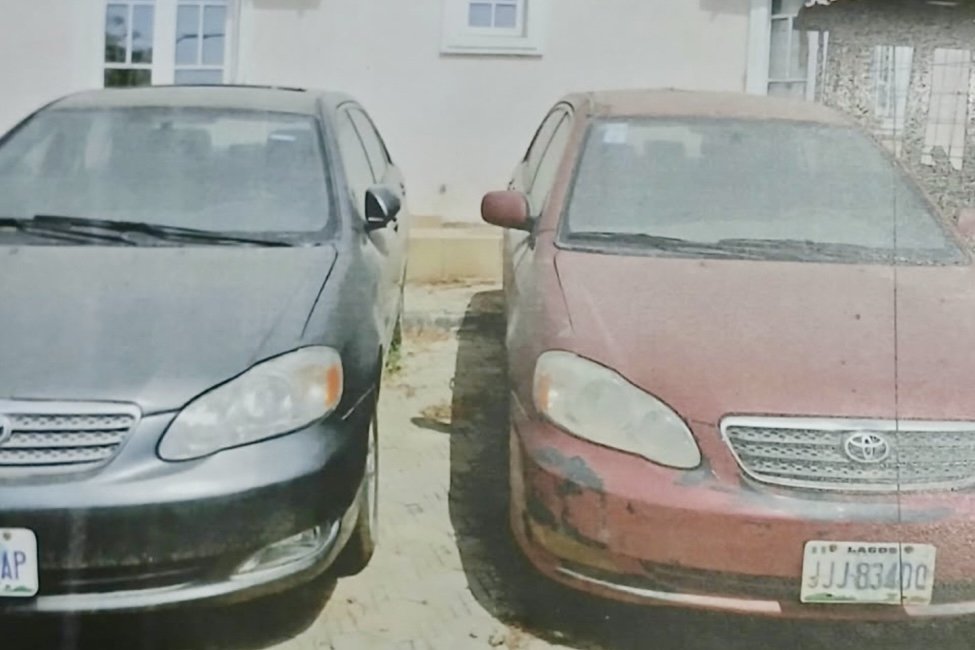
In January, PREMIUM TIMES reported that investigators seized four Toyota Hilux trucks, one Toyota Prado SUV, two Toyota saloon cars and 32 Volkswagen Golf vehicles allegedly procured for covert operations.
The arithmetic comes to 39 vehicles.
That is the most concrete basis for the subsequent description of an almost 40-vehicle haul. Investigators reportedly said the cars were acquired to facilitate discreet movement, reconnaissance and access to sensitive locations, including airports and other strategic facilities.
One security source put it more directly:
“The cars were used to move operatives around without attracting attention and to conduct reconnaissance activities linked to the plot.”
Yet the latest reporting says fewer than 12 vehicles were ultimately presented before the General Court Martial.
If the earlier 39-vehicle figure represented actual physical recoveries, the difference is substantial.
If “recovered” included vehicles traced through purchase records but not physically retained by investigators, the apparent gap becomes easier to explain.
That distinction is precisely what the public has not yet been given in sufficient detail.
The 39 May Not Mean 39 Vehicles Sitting in a Military Yard
There is another complication buried inside the evidence trail.
An August PREMIUM TIMES investigation identified a transaction in which Colonel Mohammed Ma’aji, one of the central figures named by investigators, was linked to the purchase of six vehicles worth about ₦65 million.
The dealer, Ahmed Abdulganiyu of Arun G Motors in Lokogoma, Abuja, said the transaction began on 26 September 2025.
He told investigators:
“On 26 September 2025, I was called by one Mr Aliyu that his boss needs a Toyota Corolla.”
According to the statement, Ma’aji and another man subsequently went around Abuja dealerships and obtained two Toyota Corollas, one Toyota Prado and three Toyota Hilux trucks.
The payments were made through two transfers totalling ₦65 million.
The dealer said that after the second payment, an unidentified man collected the three Hilux trucks and the Prado.
The two Corollas were left behind.
His statement recorded:
“Up till now they have not come to carry the Corollas.”
That account is important because it demonstrates why the word “recovered” needs to be unpacked.
A vehicle can appear in an investigative file because there is a receipt.
It can appear because a dealer confirms a purchase.
It can appear because a bank transfer traces payment.
It can be physically collected.
It can then be moved to another location.
And ultimately it can be tendered in court as a physical exhibit, through photographs, records or other documentary evidence.
Those stages leave very different evidentiary footprints.
The September vehicle purchases are particularly significant because the dealer himself said investigators could not establish directly that the cars were intended to execute the alleged coup. What investigators could establish, according to the report, was the timing of the purchases and their proximity to other financial transactions they were examining.
That is a crucial distinction.
Suspicious timing may support an investigative hypothesis.
It is not automatically proof of purpose.
The Evidence Chain Is Now the Story
This is where the reported discrepancy becomes more than a numbers game.
In any serious criminal investigation, especially one involving a national-security allegation, the question is not simply whether investigators found an item.
The question is whether the state can explain what happened to that item afterwards.
Who seized it?
Where was it first stored?
Who inventoried it?
Was its registration number recorded?
Was its chassis or vehicle identification number recorded?
Was it photographed?
Was it examined?
Was its condition documented?
Was there a chain-of-custody record?
Was it physically produced in court?
If not, what alternative evidence proves its existence, ownership, movement and alleged connection to the conspiracy?
Those questions become more important when the prosecution’s account depends on a fleet of vehicles allegedly being acquired for covert reconnaissance and operational movement.
A 39-car fleet is not an insignificant logistical detail.
It is potentially one of the most measurable aspects of the alleged operation.
Documents can be disputed.
Statements can be challenged.
Interpretations of conversations can be contested.
Vehicles have registration numbers, chassis numbers, owners, dealers, payment trails, insurance records, workshop records and locations.
That makes the vehicle trail potentially powerful evidence.
It also makes unexplained discrepancies harder to dismiss.
What the Earlier Investigation Actually Reported
The January PREMIUM TIMES investigation said investigators had recovered weapons from a lieutenant colonel attached to the Army’s 130 Battalion, including gun trucks, anti-aircraft weapons, PKT guns, RPG bombs, AK-47 rifles, ammunition and tactical equipment.
Alongside the weapons were the reported 39 vehicles.
Investigators said the vehicles were linked to covert activities and reconnaissance.
They also alleged that the plot involved a coordinated effort to seize strategic sites including the Presidential Villa, Niger Barracks, the Armed Forces of Nigeria Complex and Nnamdi Azikiwe International Airport.
Other reports from the investigative records said Radio House, military quarters, residences of senior commanders and other strategic facilities were among the targets.
The alleged conspirators were also accused of planning to eliminate senior political leaders and seize control of critical state infrastructure.
Those are grave allegations.
But they are still allegations.
The distinction matters because the Federal High Court itself has been dealing with disputed evidence from the investigation.
The Confession Fight Adds Another Layer
The vehicle controversy comes as the broader prosecution is already facing an evidentiary battle over interrogation statements and videos.
The Federal High Court in Abuja ordered a trial-within-trial after defence lawyers challenged the admissibility of extra-judicial statements and video recordings tendered by the prosecution.
The defence alleged that some statements were obtained through coercion and that safeguards under the Administration of Criminal Justice Act and Anti-Torture Act had not been followed.
The prosecution rejected the objections and said its evidence was obtained properly.
The dispute is not technical window dressing.
Under section 29 of Nigeria’s Evidence Act, where a defendant alleges that a confession was obtained through oppression or circumstances capable of making it unreliable, the prosecution must meet the statutory test before the statement can be admitted. Nigerian appellate courts have repeatedly treated voluntariness as a central issue where such objections are raised.
The Anti-Torture Act goes further by prohibiting torture and providing that a confession, admission or statement obtained as a result of torture cannot be used as evidence except in proceedings against the person accused of torture.
This matters to the vehicle story because it demonstrates the larger problem facing the prosecution.
The court is not simply being asked to decide whether a coup plot allegedly existed.
It is being asked, step by step, whether the evidence said to establish that plot was obtained, preserved and presented in a legally reliable form.
A Court Behind Closed Doors
Public scrutiny is made more difficult by the decision to conduct the General Court Martial proceedings behind closed doors.
Journalists were denied access when the military court opened in April, while security restrictions were also imposed around the use of mobile phones.
The military inaugurated the General Court Martial to try 36 serving personnel over allegations arising from the purported coup plot. Separate proceedings were brought at the Federal High Court against six defendants, including retired military officers, a serving police inspector and civilians.
The closed proceedings are not necessarily unlawful.
Section 139 of the Armed Forces Act provides that a court martial should ordinarily sit in open court, but permits proceedings to be held in camera where necessary in the interests of defence and security, including where evidence could reveal information harmful to national-security interests.
That provision recognises the special nature of national-security trials.
It does not remove the importance of a properly documented evidentiary record.
That distinction is fundamental.
National security can justify restricting access to sensitive information.
It should not become a reason why the public cannot understand the basic provenance of physical exhibits.
The Government’s Case Has Not Been Mere Speculation
It would be wrong to reduce the entire prosecution case to an unexplained vehicle count.
The government has produced a broader investigative narrative.
A protected prosecution witness told the Federal High Court that intelligence received by the then Chief of Army Staff, Olufemi Oluyede, pointed to coordination between Ma’aji, former Bayelsa governor Timipre Sylva and other suspects.
The witness said the intelligence was assessed and considered credible, forming part of the basis for the investigation that led to Ma’aji’s arrest and the recovery of electronic and documentary evidence.
The prosecution has also presented financial records and other documentary material.
A 7,400-page investigation dossier was reported to contain statements, bank records, chat exchanges, receipts, hotel records and other exhibits.
That is a considerable body of material.
It does not automatically prove the prosecution’s allegations.
But it shows that the vehicle question cannot fairly be treated as the entire case.
The proper question is narrower and more demanding:
What evidentiary value did the recovered vehicles actually have, and can the prosecution show the court how each relevant vehicle connects to the alleged conspiracy?
Then There Is the Defence Minister’s Assertion
In September, Defence Minister Christopher Musa said the alleged coup was real.
He told Channels Television:
“The coup was genuine, and they truly intended to carry it out.”
He also said the suspects were motivated largely by financial interests.
“They’re just a bunch of misguided individuals who went into it for money alone.”
That is a strong political and security assertion.
But the minister also acknowledged the institutional boundary that matters here.
“I believe they have been investigated. They have taken them to court, so it remains with the courts. It is not with us; it is still with the courts.”
That principle cuts both ways.
If the matter is now for the courts, the public should be able to distinguish clearly between the intelligence community’s assessment, the investigator’s theory and evidence actually capable of surviving judicial scrutiny.
The Corollas Raise a Small but Revealing Question
The dealer’s account of the two uncollected Corollas may seem insignificant beside allegations of a coup.
It is not.
It illustrates the difference between purchase evidence and operational evidence.
The documents may establish that six vehicles were bought.
They may establish who paid.
They may establish when payment was made.
The dealer may establish who arrived.
But the state still has to establish what the vehicles were intended for.
The investigation itself reportedly acknowledged that it could not confirm from the dealer’s account alone that the vehicles were intended for execution of the alleged coup.
That is precisely how responsible evidence assessment should work.
The state can say: these purchases happened.
It can say: they happened at a suspicious time.
It can say: other financial transactions were occurring.
It can say: other evidence links the suspect to the alleged conspiracy.
The court then decides whether the combined evidence proves the required elements of the offences.
The mistake would be to leap from “bought at the relevant time” to “therefore bought for the coup”.
What Happened to the 32 Golf Cars?
This may be the most obvious question now hanging over the evidence trail.
The January investigation said 32 Volkswagen Golf vehicles had been seized alongside seven Toyota vehicles.
Yet the latest report says fewer than 12 vehicles were physically presented as evidence before the military court.
That leaves a large unexplained difference.
Were all 32 Volkswagen Golf cars physically recovered?
Were some identified through purchase records only?
Were some recovered at different locations?
Were some returned to owners?
Were some damaged or otherwise unavailable?
Were photographs, registration records, purchase receipts or forensic examinations relied upon instead?
Were all of them marked as exhibits?
And, crucially, is there an exhibit schedule showing how the original 39 vehicles relate to the smaller number later presented?
There is no evidence in the publicly accessible reporting reviewed for this story that answers those questions comprehensively.
That does not mean the answers do not exist.
They may be contained in the prosecution’s proof of evidence, military inventory records or exhibits not publicly accessible because of the closed proceedings.
That is exactly why the discrepancy deserves clarification rather than speculation.
The 39-Vehicle Gap Is Not Proof of a Failed Case
There is a danger in turning an evidentiary discrepancy into a verdict.
That would be as careless as accepting every allegation made by investigators as proven fact.
The missing numerical explanation does not establish that the vehicles were planted.
It does not establish that the prosecution fabricated its evidence.
It does not establish that evidence was destroyed.
And it does not establish that the alleged coup plot did not exist.
The strongest journalistic conclusion is much simpler.
The prosecution has described a substantial vehicle trail.
Earlier reporting put the fleet at 39 vehicles.
More recent reporting says fewer than 12 were presented as exhibits.
The public has not yet been shown a sufficiently detailed explanation reconciling those figures.
That is the unanswered question.
The Bigger National-Security Issue
There is a reason this matters beyond the defendants in the dock.
Nigeria is dealing with a particularly sensitive security environment in which military coups have returned to the centre of West African politics.
A credible investigation into an alleged attempt to overthrow an elected government is therefore important to the preservation of constitutional rule.
But constitutional rule depends on more than stopping an alleged coup.
It depends on institutions proving their allegations through credible procedures.
The state must be able to investigate secretly when necessary.
It must protect intelligence sources when necessary.
It must protect witnesses when necessary.
But when a case reaches a judicial forum, the evidence must ultimately be capable of being tested.
The harder the allegation, the stronger that principle becomes.
A claim that officers planned to seize the Presidential Villa, Radio House and military formations is too consequential to rest comfortably on unexplained transitions between intelligence reports, seized property and courtroom exhibits.
The state does not need to parade every sensitive intelligence operation before the public.
It does need to explain the evidence it relies upon.
October 5 Was Supposed to Be Another Test
The General Court Martial was scheduled to rule on 5 October on the admissibility of statements after a trial-within-trial.
The decision had already been postponed four times, with the latest adjournment moving the ruling from 30 September to 5 October.
The military did not publicly give a reason for the latest postponement.
As this report is being prepared on 5 October, the web-indexed reports available to us do not yet provide a verified account of the court’s ruling today.
That makes the timing of the vehicle controversy even more significant.
The case is approaching a stage where the courts must determine which parts of the investigative record can actually enter the evidentiary record.
And that is where the difference between an intelligence claim and admissible evidence becomes decisive.
What the Public Should Be Asking
The important question is not:
“Where are the missing cars?”
It is more precise.
What exactly did investigators classify as recovered vehicles, where were those vehicles located, which were physically seized, which were merely traced through documentary evidence, and which of them were tendered or marked as exhibits before the court?
There should be an answer to that question.
There should also be an exhibit schedule capable of reconciling the numbers.
If 39 vehicles were recovered, an exhibit inventory should account for those vehicles.
If only 11 were produced physically, there should be a documented explanation for the remaining 28 or more.
If the remaining vehicles were proved through photographs, receipts, registration documents, bank records or other evidence, that should be clear too.
That would not weaken the prosecution.
It could strengthen it.
A transparent reconciliation could turn what currently looks like a contradiction into a documented chain of evidence.
Leaving the question unanswered achieves the opposite.
The Evidence Must Survive the Spotlight
Nigeria’s alleged coup trial has already moved beyond the original mystery surrounding the arrests.
The Defence Headquarters eventually confirmed that some officers had been investigated over allegations of plotting to overthrow the government after initially describing the arrests as involving indiscipline and breaches of service regulations.
The government has since presented an extensive narrative involving military personnel, civilians, money flows, reconnaissance, logistics, weapons and vehicles.
The courts must now determine which parts of that narrative amount to admissible and reliable evidence.
That is why the 39-vehicle discrepancy matters.
Not because a vehicle can prove a coup on its own.
But because physical evidence is supposed to anchor an investigation in things that can be identified, traced and tested.
The state has told Nigerians that an elaborate conspiracy was uncovered before it could be executed.
It has told the courts that vehicles were part of the logistics of that alleged conspiracy.
It has presented suspects for trial.
Now it must answer the less dramatic but more important question.
What happened between the 39 vehicles investigators said they had recovered and the fewer than 12 vehicles the military court was actually shown?
Until that evidentiary bridge is made clear, the vehicle story remains one of the biggest unanswered pieces in Nigeria’s alleged coup case.
And in a prosecution built around the preservation of constitutional government, the credibility of the evidence trail is almost as important as the allegation itself.