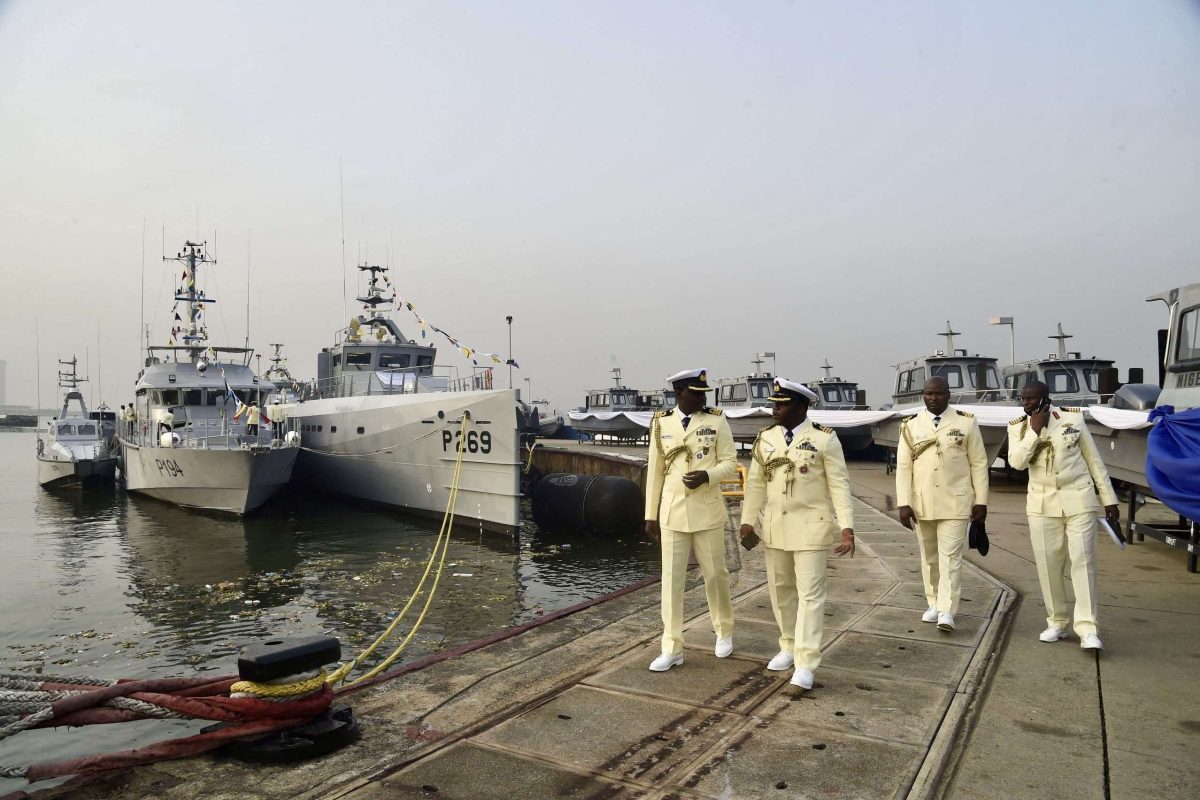
A 40,000-litre plant was allegedly caught before production began. But the arrest of three suspected financiers may be the bigger story buried inside the raid.
The most revealing thing about the latest illegal-refining discovery in Bonny may be what was missing.
There was no reported mountain of stolen crude waiting to be cooked.
There was no completed production operation.
There was, according to the Nigerian Navy and the Federal Government’s Inter-Agency Task Force on Petroleum Theft, a refinery being built for large-scale illegal processing.
And investigators say they have three people linked to its financing in custody.
That changes the question.
This is no longer simply about who was operating an illegal refinery in the creeks.
It is about who was prepared to pay for one.
Captain Stanley Mazi Chukwuemeka Umeh, the Nigerian Navy’s Forward Operating Base commander in Bonny, said his personnel had reached the facility after an intelligence-led operation involving multiple security and intelligence agencies. His March 2026 assumption of command at FOB Bonny was reported at the time.
Umeh said:
“This discovery is like nipping the act in the bud.”
He described the site as being at the “preparatory stage”.
That phrase may ultimately prove more important than the reported 40,000-litre capacity.
The capacity means the facility was designed to handle roughly 252 barrels. It does not mean authorities recovered 40,000 litres of stolen crude there.
The distinction is critical.
A headline about a 40,000-litre refinery can easily be interpreted as 40,000 litres seized.
The information released so far does not support that interpretation.
What it does support is the discovery of infrastructure which authorities believe was intended for large-scale illegal refining.
And then came the financial trail.
Omar John Sini, Head of Investigation of the Special Prosecution Team, said three suspects were already in custody and were associated with financing the operation.
“We’ve been able to detect, we allowed them to invest their money, their hard-earned resources, and they’ve built this refinery with an amount that would be running into millions of Naira,” he said.
The suspects have not been convicted and their names were not released in the account.
That leaves the most important investigative work ahead.
Where did the money come from?
Who supplied the equipment?
Who was going to supply crude?
Who had the transport arrangements?
Who was going to buy the finished product?
And was this refinery meant to serve one criminal group or a wider chain?
Those questions matter because Bonny has been experiencing repeated attempts to establish or reactivate illegal-oil infrastructure.
On September 8, the Navy reported 87,000 litres of suspected stolen crude at four newly activated illegal refining sites around Aworkiri and 19 dugout pits.
On September 22, it reported another 182,000 litres in Bethel Creeks, stored in five of eight discovered pits.
Then, on September 29, another operation at Allison uncovered about 85,000 litres in 16 concealed pits, including crude believed to be awaiting processing.
The sequence suggests a contest over infrastructure.
Security agencies destroy or disrupt one facility.
Operators attempt to build or activate another.
That is why the Bonny raid may be more significant than an ordinary refinery bust.
For perhaps the first time in this particular sequence, investigators say they have moved beyond the equipment to the alleged financiers.
That is the point where an oil-theft investigation can potentially become a network investigation.
Nigeria’s production figures make the stakes clear.
NUPRC reported average August 2026 crude production of 1.500 million barrels per day, with Bonny Terminal accounting for about 320,040 barrels per day in its stream and terminal breakdown.
The Federal Government and industry have repeatedly linked improved security to higher production. NNPC said an integrated security model had helped national output recover from the low levels recorded in 2022.
Yet the Bonny discoveries show how quickly illegal infrastructure can attempt to regenerate.
Sini said the task force’s objective is to stop crime before it happens.
“The primary purpose of law enforcement is to detect crime. We don’t even want it to occur so that we don’t be reactive, we want to be preventive,” he said.
That sounds straightforward.
In practice, it is a much harder standard.
Stopping a refinery before its first production run requires intelligence good enough to detect money, equipment, movements and planning before the criminal operation becomes visible.
It also requires investigators to preserve enough evidence to survive the courtroom after the headlines disappear.
Sini said the task force had secured at least 137 convictions since inception and argued that this had contributed to falling illicit activity in the hydrocarbon sector.
That figure remains an official claim requiring independent verification.
He also called for stronger sentencing provisions, arguing that current penalties do not always create enough deterrence.
The Bonny operation will now put that entire chain under pressure.
The Navy has already promised more surveillance.
Umeh said:
“We will continue to raid and make sure they have no hiding places. It is a zero tolerance.”
But the biggest hiding place may not be the swamp.
It may be the financial system behind the swamp.
The men who physically build an illegal refinery are usually easier to see than the people who finance it, source its equipment, arrange crude supply and organise the eventual market.
That is why the next phase of Bonny’s story should not end with the destruction of tanks and cooking equipment.
It should begin there.
Because the refinery was still being built.
The money had already arrived.
And three alleged financiers are now in custody.
The unanswered question is how far that money trail goes.
Follow us on our broadcast channels today!
- WhatsApp: https://whatsapp.com/channel/0029VawZ8TbDDmFT1a1Syg46
- Telegram: https://t.me/atlanticpostchannel
- Facebook: https://www.messenger.com/channel/atlanticpostng
Join the debate; let's know your opinion.